


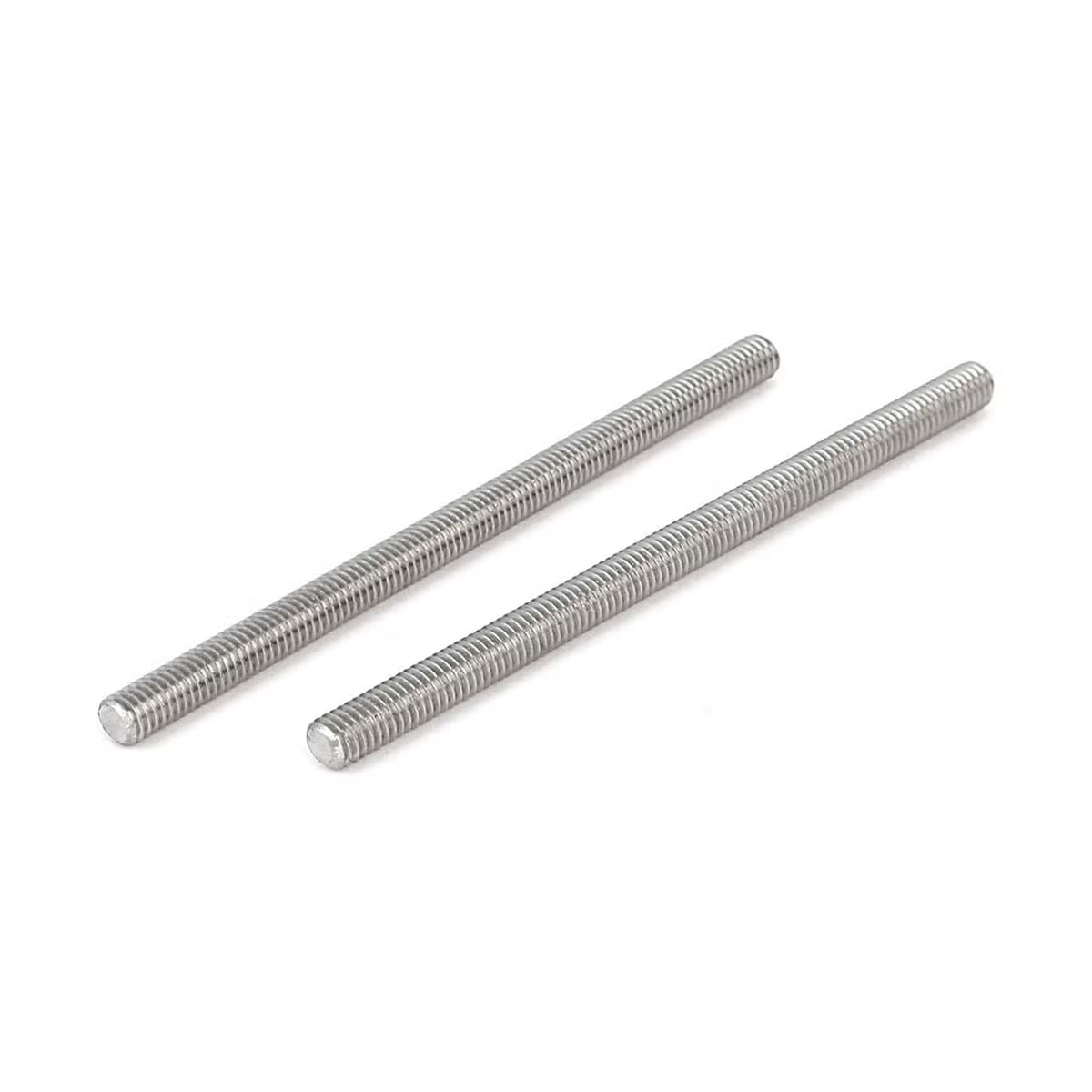
Premium A2 (304) and A4 (316) stainless steel Threaded Rod. Available in metric coarse threads and select UNC/BSW on request. Mill Test Certificates (MTC), strict dimensional tolerances, and fast dispatch from ready stock.
DIN 975
Stainless Steel Threaded Rod
TRSUTED SS Threaded Rod FOR DEMANDING APPLICATION
Key Specifications
Standards
DIN 975
Grades (Material)
A2 (304), A4 (316)
Strength Classes
Threads
Metric coarse (default). Fine/UNC/BSW available on request
Sizes
M1.6 to M 70, 3/16" to 2.1/2" (others on request)
Lengths
50-2000mm
Head
Marking
Grade/class & manufacturer ID as applicable
Certificates
MTC 3.1 / chemical composition & mechanicals available
Compliance
RoHS/REACH; generally non-magnetic in solution-annealed state (slight magnetism possible after cold-work)
Choosing the Right Stainless Steel Threaded Rod
Choosing the Right Threaded Rod
1) What is a threaded rod & when to use it?
A threaded rod (also called stud, full-thread bar, all-thread) is a long bar fully threaded along its length.
Use a threaded rod when you need:
Adjustable length studs or hangers
To join components from both sides using nuts and washers
To create anchor assemblies, supports, clamps, or frames where a standard bolt is too short or not available in the required length
Typical applications:
HVAC & cable tray supports, pipe hangers, ceiling suspensions
Joiner studs for flanges, machinery, and fabricated frames
Chemical / mechanical anchor assemblies in concrete
Threaded ties in formwork, structural and bracing systems
2) Environment & corrosion – material selection (A2 vs A4 vs CS)
Choose material based on exposure:
Carbon steel (plain / zinc / HDG)
Common for general structural and MEP work
HDG for outdoor steel structures, cable tray supports, etc.
A2 (304) stainless threaded rod
For indoor and general outdoor environments where rust must be controlled
Plant piping supports, utility frames, cable trays, light structural bracing
A4 (316) stainless threaded rod
For marine, coastal, poolside, or chemical environments
Offshore, seafront, water treatment, chemical plants, food & pharma wash-down areas
Match hardware:
Carbon steel rod + matching CS/HDG nuts & washers
A2 rod + A2 nuts & washers
A4 rod + A4 nuts & washers
3) Diameter & length – sizing for load & layout
Select diameter (M6, M8, M10, M12, M16, M20, etc.) based on:
Tension load (hanging supports, anchoring)
Bending / compression (struts, braces)
Spacing and load per rod in the system
Examples (very general, final by design):
Light services & small brackets → M6 / M8
Medium pipe/cable tray supports → M8 / M10 / M12
Heavier frames, equipment supports → M12 / M16 / M20
Length:
Standard stock lengths: often 1 m / 2 m / 3 m (cut to size on site)
Ensure enough length for:
All clamped parts / fixtures
Washers and nuts at both ends
2–3 extra threads beyond each nut
4) Thread type – metric coarse vs special threads
Most threaded rods are supplied in:
Metric coarse thread (standard)
M6×1, M8×1.25, M10×1.5, M12×1.75, etc.
Compatible with standard metric nuts, couplers, and anchors
Other variants (by special request):
Metric fine
UNC/UNF / BSW
Only use these where required by drawings, imported equipment, or existing anchors.
Always ensure the thread standard and pitch match nuts, couplers, and inserts.
5) Application type – hanger, stud, anchor, coupler
Think about how the rod is used:
Hanger/suspension rod
Rod fixed at top with anchor or clevis; supports pipe clamps, cable trays, ducts
Load mostly in tension
Stud / joining rod
Threaded piece between two flanges or plates with nuts both ends
Acts like an extra-long bolt
Anchor assembly
Threaded rod bonded into concrete using chemical anchor or cast-in sleeves
Used to fix base plates, machines, frames
Coupler/extension
Two rods joined using threaded couplers to achieve extra long lengths
Match rod diameter, grade, and material to the load and environment.
Mechanical Properties (Guide)
Mechanical Properties (Guide) – Stainless Threaded Rod
Threaded rod follows the same property class system as bolts.
Because it’s fully threaded, the stress area is the thread area (not a larger shank).
A2-70 Stainless Threaded Rod
Material: A2 (304) stainless steel
Property class: 70
Minimum tensile strength ≈ 700 MPa
Typical proof strength ≈ 450 MPa
Use with: A2-70 nuts & washers
Typical applications:
Pipe & cable tray hangers in normal environments
Light/medium structural supports and frames
General plant utility supports where 304 is adequate
A4-70 Stainless Threaded Rod
Material: A4 (316) stainless steel
Property class: 70
Same mechanical level as A2-70 with better pitting/chloride resistance
Use with: A4-70 nuts & washers
Typical applications:
Coastal/marine & chemical plant supports
Poolside, water treatment, food & pharma wash-down systems
Any threaded support where corrosion resistance is critical
A4-80 Stainless Threaded Rod (if used)
Material: high-strength A4 (316)
Property class: 80
Minimum tensile strength ≈ 800 MPa
Typical proof strength ≈ 600 MPa
Applications:
Higher load supports, structural clamping, and anchoring
When higher capacity is required in the same diameter in corrosive environments
6000+ Products
Trusted by 2000+ Clients
40+ Years of Experience
Exporting to 12+ Countries
What We Do
From a vast manufacturing facility situated in GIDC Wadhwan, Gujarat to strategic
sales offices in Mumbai and Chennai, we design, produce, and deliver a wide array of stainless steel
fasteners, hex bolts, machine screws, socket screws, washers, nuts, self‑tapping screws, threaded rods,
anchor fasteners, and specialty material products, engineered for demanding sectors like petrochemicals,
pharmaceuticals, automotive, and construction.
Our Legacy & Mission
Founded on a vision of precision and service, we have consistently expanded our
capabilities to meet evolving industrial needs. Our commitment to "We Deliver Quality" reflects in the
long-term relationships we build with clients across India and abroad.
Frequently Asked Questions
What is a threaded rod?
A threaded rod is a long bar that is fully threaded along its entire length.
It’s also called stud, stud bar, all-thread, or full-thread rod, and works like a very long bolt that you can cut to any length and use with nuts and washers at one or both ends.
Where are threaded rods commonly used?
Typical applications include:
Pipe and cable tray hangers from ceilings and beams
Duct and equipment supports (HVAC, MEP installations)
Chemical / mechanical anchor assemblies in concrete
Joining flanges, frames and fabrications where long studs are needed
Temporary bracing, formwork ties, and structural tie rods
Anywhere you need an adjustable, threaded connection over a long length, threaded rod is ideal.
What is the difference between a bolt and a threaded rod?
Bolt:
Usually has a head (hex, dome, etc.)
Typically partially threaded (for many standards), with a defined length.
Threaded rod:
No head; fully threaded from end to end.
Supplied in long lengths (e.g., 1 m, 2 m, 3 m) and cut as required.
Functionally, a threaded rod acts as a long, headless bolt used with nuts and washers.
Can I cut threaded rod to length? Will the nut still fit?
Yes. Threaded rod is designed to be cut on site. After cutting:
File/chamfer the cut end
Remove burrs so the nut can start smoothly on the threads
If you don’t deburr, the nut may jam or damage the first threads.
What are coupler nuts and when should I use them?
A coupler nut (long nut) is used to join two pieces of threaded rod in line.
Use couplers when:
You want to extend overall rod length
You need full-strength connection between two rods (use full-length couplers, not short nuts)
Ensure the thread (size + pitch) of rod and coupler match.


