


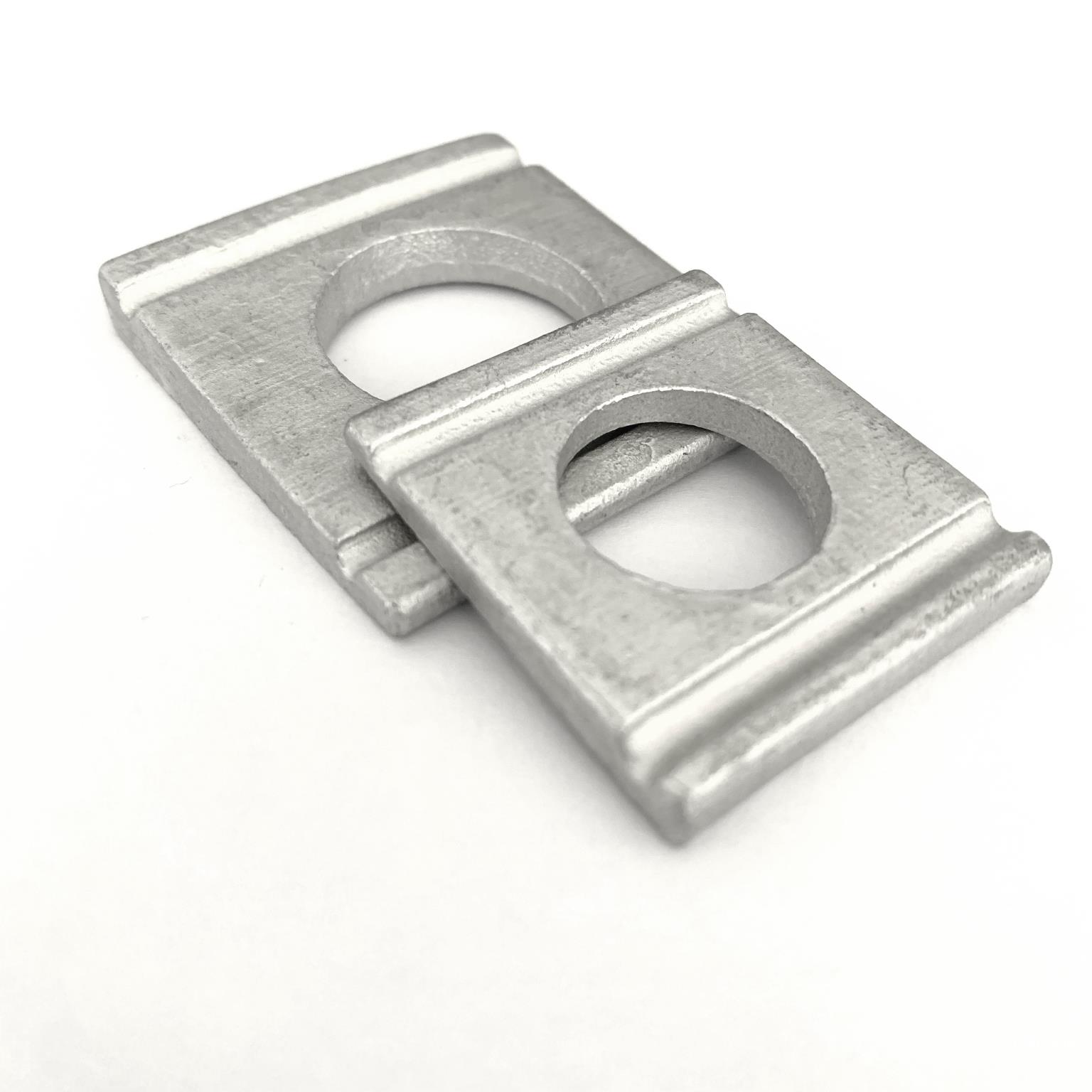
Premium A2 (304) and A4 (316) stainless steel Tapper Washer. Available in metric coarse threads and select UNC/BSW on request. Mill Test Certificates (MTC), strict dimensional tolerances, and fast dispatch from ready stock
DIN 434
Stainless Steel Tapper Washer
TRSUTED SS Tapper Washer FOR DEMANDING APPLICATION
Key Specifications
Standards
-
Grades (Material)
A2 (304), A4 (316)
Strength Classes
-
Threads
Metric coarse (default). Fine/UNC/BSW available on request
Sizes
M1.6 to M 70, 3/16" to 2.1/2" (others on request)
Lengths
-
Head
-
Marking
Grade/class & manufacturer ID as applicable
Certificates
MTC 3.1 / chemical composition & mechanicals available
Compliance
RoHS/REACH; generally non-magnetic in solution-annealed state (slight magnetism possible after cold-work)
Choosing the Right Stainless Steel Tapper Washer
Choosing the Right Taper Washer
(For I-Beams, Channels & Sloped Surfaces)
1) What is a taper washer & when do you need it?
A taper washer is a sloped (wedge-shaped) washer designed so that:
One face is inclined,
The other face is parallel to the bolt head/nut,
so that the bolt head or nut sits square even when the supporting surface is not perpendicular to the bolt axis.
Use a taper washer when:
Bolting through I-beams, channels, angles where flanges are sloped
You need the bearing surface under the nut/bolt head to be flat so the load is even
You want to avoid bending the bolt or crushing one side of the washer/nut due to the slope
Typical applications:
Structural steel connections (beams, columns, purlins)
Equipment bases mounted on taper-flange members
Heavy brackets and supports fixed to rolled steel sections
If the surface under the nut/bolt head is sloped or tapered, a taper washer is essential for a proper structural joint.
2) Why use a taper washer instead of a normal plain washer?
On sloping flanges (like I-beam and channel flanges):
A plain flat washer makes the nut/bolt sit at an angle, so the load is carried on one edge only.
This can cause:
Bending in the bolt,
Crushing or local yielding of the washer/flange,
Uneven preload and premature loosening.
A taper washer:
Corrects the angle so the nut/bolt bears on a flat, square face,
Distributes load uniformly over the flange,
Reduces bolt bending and improves the life and safety of the joint.
In short:
Sloped flange / inclined surface → taper washer, not plain washer.
3) Matching the taper washer to the section
Taper washers are usually specified for:
I-beam flanges (wide or standard I-sections)
Channel sections
Sometimes for angle sections or custom inclined plates
Key points to match:
Bolt size
Choose the taper washer size to suit the bolt diameter:
e.g. taper washer for M16, M20, M24, etc.
Flange angle / slope
Taper washers are manufactured with a specific angle to match common rolled sections.
For standard I-beams/channels, use the standard “for I-beam” / “for channel” taper washers.
Contact face dimensions
The contact area under the nut/bolt head must be large enough for the bolt size and structural loading.
Structural taper washers are usually thicker and larger than normal plain washers for this reason.
Mechanical Properties (Guide)
Mechanical Properties (Guide) – Taper Washer
For taper washers, key mechanical aspects are material strength, hardness, and thickness, because they must transfer high-bearing loads without crushing or deforming while correcting the angle.
1) Mild steel taper washers (standard structural type)
Typical characteristics:
Material: mild or medium carbon steel, often with structural-grade yield strength.
Thicker and stiffer than normal washers to withstand structural bearing loads.
Bearing area sized for high-tensile bolts.
Functional behaviour:
Designed to carry compressive bearing loads under the nut/bolt head without significant permanent deformation.
The wedge shape ensures full-face contact, reducing bolt bending.
In properly tightened joints, they help maintain uniform preload by providing a flat seat.
If a standard non-structural washer is used instead of a proper taper washer:
One edge can crush/yield,
Bolt preload can relax,
Joint performance and fatigue life can be compromised.
2) Hardened / structural-grade taper washers
For high-tensile structural bolts, you may use hardened taper washers made from higher-grade steels and heat-treated.
Typical characteristics:
Higher hardness, suitable for bearing against 8.8 / 10.9 grade bolts.
Minimizes embedment and dishing under high clamp loads.
Maintains washer shape even under repeated loading cycles.
Functional behaviour:
Ensures the contact surface stays true and flat under service loads.
Reduces loss of preload and improves fatigue resistance of the joint.
3) Stainless steel taper washers (A2 / A4)
Typical characteristics:
Material: A2 (304) or A4 (316) stainless, depending on environment.
Good combination of corrosion resistance and bearing strength for most structural and support applications in stainless fabrications.
Functional behaviour:
Used in stainless structures, platforms, handrails, equipment supports, etc.
Resist rusting or staining in aggressive and hygienic environments.
Still must be sized correctly to avoid local yielding on heavily loaded flanges.
6000+ Products
Trusted by 2000+ Clients
40+ Years of Experience
Exporting to 12+ Countries
What We Do
From a vast manufacturing facility situated in GIDC Wadhwan, Gujarat to strategic
sales offices in Mumbai and Chennai, we design, produce, and deliver a wide array of stainless steel
fasteners, hex bolts, machine screws, socket screws, washers, nuts, self‑tapping screws, threaded rods,
anchor fasteners, and specialty material products, engineered for demanding sectors like petrochemicals,
pharmaceuticals, automotive, and construction.
Our Legacy & Mission
Founded on a vision of precision and service, we have consistently expanded our
capabilities to meet evolving industrial needs. Our commitment to "We Deliver Quality" reflects in the
long-term relationships we build with clients across India and abroad.
Frequently Asked Questions
What is a taper washer?
A taper washer is a wedge-shaped washer used where the bearing surface is sloped, such as on the flange of an I-beam or channel.
It corrects the angle so the nut or bolt head sits flat, keeping the bolt straight and the load evenly distributed.
When do I need a taper washer instead of a normal flat washer?
Use a taper washer when:
The bolt passes through an I-beam, channel, angle, or any sloped/angled flange
The surface under the nut/bolt head is not perpendicular to the bolt
You want to avoid bending the bolt and crushing one side of the washer/nut
Flat washer = flat surface.
Taper washer = sloped surface.
What happens if I don’t use a taper washer on a sloping flange?
If you use a normal flat washer on a sloped flange:
The nut/bolt head bears only on one edge of the washer
The bolt is forced to bend
The flange or washer may crush/yield on one side
Bolt tension becomes uneven, and the joint may loosen or fatigue crack earlier
Taper washers avoid all of this by making the bearing face square to the bolt.
Are taper washers only for structural steel?
They are most common in structural steelwork (beams, channels, columns), but also used for:
Equipment bases mounted on sloped flanges
Heavy brackets and supports on rolled sections
Any assembly where a bolt goes through a sloping plate and the nut/bolt head must seat flat
So they are primarily structural, but you will also see them in industrial fabrications and plant supports.
Should I use a taper washer under the head, under the nut, or both?
It depends on where the surface is sloped:
If only one side (for example, the nut side) is on a sloping flange and the bolt head is on a flat plate, then use the taper washer only on the sloping side.
If both sides are on sloped surfaces, you may need taper washers on both head and nut.
General rule:
Where the surface is sloped → that side gets the taper washer.


