


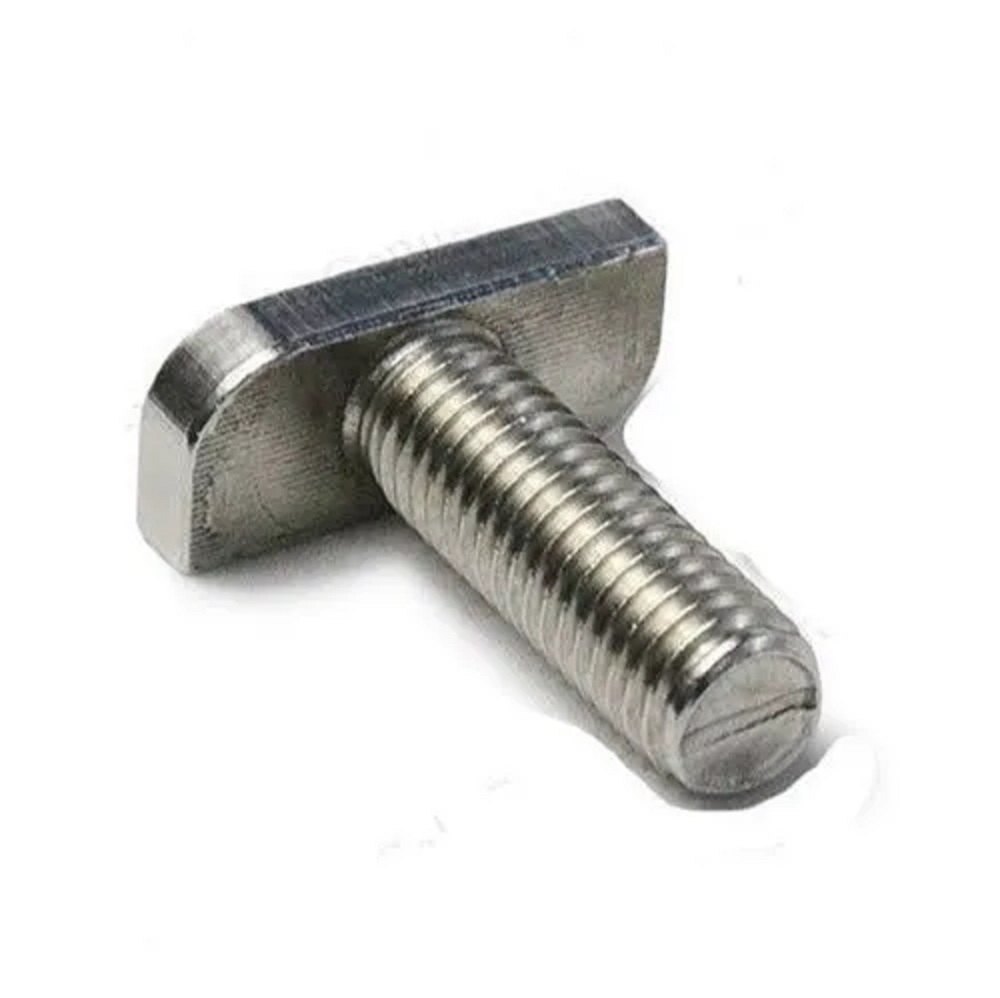
Premium A2 (304) and A4 (316) stainless steel T bolt. Available in metric coarse threads and select UNC/BSW on request. Mill Test Certificates (MTC), strict dimensional tolerances, and fast dispatch from ready stock.
Stainless Steel T Bolt
TRSUTED SS T Bolt FOR DEMANDING APPLICATION
Key Specifications
Standards
-
Grades (Material)
A2 (304), A4 (316)
Strength Classes
-
Threads
Metric coarse (default)
Sizes
M 6 to M 24 (others on request)
Lengths
-
Head
-
Marking
Grade/class & manufacturer ID as applicable
Certificates
MTC 3.1 / chemical composition & mechanicals available
Compliance
RoHS/REACH; generally non-magnetic in solution-annealed state (slight magnetism possible after cold-work)
Choosing the Right Stainless Steel T Bolt
Choosing the Right T-Bolt
1) What is a T-bolt & when to use it?
A T-bolt (T-head bolt / channel bolt / hammer bolt) has a T-shaped head designed to fit into a slot, channel, or profile, so the head locks by rotation and provides a threaded stud for clamping.
Use a T-bolt when you need:
Fast, adjustable fixing along a slot or channel
To clamp parts to strut channels, Unistrut, solar rails, or aluminium profiles
To fix items onto machine T-slots, jigs, fixtures, or mounting rails
Typical applications:
Strut/channel support systems (cable trays, ducts, pipes)
Solar panel mounting (rails and clamps)
Aluminium profile systems (Bosch-type)
Machine beds, T-slot tables, jigs & fixtures
T-bolts allow tool access only from the nut side, while the head stays hidden and locked inside the slot.
2) Environment & corrosion – material choice (A2 vs A4)
For stainless T-bolts:
A2 (304) stainless T-bolt
For indoor and general outdoor environments
Electrical supports, machinery frames, plant utility systems, standard roof-top solar (non-marine)
A4 (316) stainless T-bolt
For marine, coastal, chemical, or chloride-rich environments
Coastal solar, treatment plants, chemical plant supports, harsh industrial atmospheres
Match the system:
A2 T-bolt with A2 nuts, washers, and spring channels
A4 T-bolt with A4 nuts, washers, and compatible hardware
3) Channel / slot compatibility – head size & type
The first selection step for a T-bolt is the channel/T-slot system it fits:
Strut/channel systems
T-bolt head dimensions must match the channel opening & lip so that:
Head passes through the slot
Then rotates 90° and bears properly on the lips
Some designs have spring-loaded T-bolts (with a spring under the head) to hold them in place during assembly.
Aluminium profiles / T-slot tables
Head dimensions and shape match specific profile series (e.g., 30×30, 40×40, 45 series) or machine T-slots.
Use the correct T-bolt type/size recommended for that profile/T-slot.
Key point:
Always ensure the T-head dimensions are compatible with the channel/slot you are using – wrong head size can cause tilting, poor bearing, or pull-through.
4) Thread size & length
Select thread diameter based on:
Required clamp load (M6, M8, M10, M12 etc.)
Channel/profile capacity and connected part thickness
Length selection:
Bolt length must cover:
Channel depth + any packing/plates
Thickness of the item being clamped
Washers / spring elements
Nut height + 2–3 visible threads
If you plan to use thick brackets, multiple parts, or two nuts, allow extra length.
Mechanical Properties (Guide)
Mechanical Properties (Guide) – Stainless Steel T-Bolts
T-bolts follow the same property class system as standard stainless hex bolts.
The T-head shape is for anchoring in a slot; the thread strength is governed by the property class.
A2-70 Stainless T-Bolts
Material: A2 (304) stainless steel
Property class: 70
Minimum tensile strength ≈ 700 MPa
Typical proof strength ≈ 450 MPa
Use with: A2-70 nuts and appropriate washers/channel nuts.
Typical applications:
Strut/channels & supports in buildings and plants
Aluminium profile framing and machine guards
General solar mounting in non-marine environments
A4-70 Stainless T-Bolts
Material: A4 (316) stainless steel
Property class: 70
Same mechanical level as A2-70, with higher corrosion resistance
Use with: A4-70 nuts and A4 washers/channel components.
Typical applications:
Coastal & marine solar structures
Chemical/process plants, water treatment, poolside structures
Stainless/aluminium support systems exposed to chlorides and aggressive cleaners
A4-80 Stainless T-Bolts (if used)
Material: high-strength A4 (316) stainless
Property class: 80
Minimum tensile strength ≈ 800 MPa
Typical proof strength ≈ 600 MPa
Used when:
Higher clamp load is needed in the same diameter, and
Environment requires 316-level corrosion resistance
6000+ Products
Trusted by 2000+ Clients
40+ Years of Experience
Exporting to 12+ Countries
What We Do
From a vast manufacturing facility situated in GIDC Wadhwan, Gujarat to strategic
sales offices in Mumbai and Chennai, we design, produce, and deliver a wide array of stainless steel
fasteners, hex bolts, machine screws, socket screws, washers, nuts, self‑tapping screws, threaded rods,
anchor fasteners, and specialty material products, engineered for demanding sectors like petrochemicals,
pharmaceuticals, automotive, and construction.
Our Legacy & Mission
Founded on a vision of precision and service, we have consistently expanded our
capabilities to meet evolving industrial needs. Our commitment to "We Deliver Quality" reflects in the
long-term relationships we build with clients across India and abroad.
Frequently Asked Questions
What is a T-bolt?
A T-bolt is a bolt with a T-shaped head designed to fit into a slot, channel, or profile.
The head locks inside the slot (usually by turning 90°), and the threaded part is used with a nut to clamp brackets, clamps, or components.
Where are T-bolts commonly used?
Typical applications include:
Strut / channel support systems (cable trays, ducts, pipe clamps)
Solar panel mounting rails and clamps
Aluminium profile systems (Bosch-type framing, machine guards, workstations)
Machine T-slots, jigs, and fixtures
Anywhere you need a repositionable fixing point along a slot or rail, T-bolts are ideal.
How do I choose the right T-bolt for my channel or profile?
The most important factor is head compatibility:
The T-head must fit through the slot and bear properly on the lips or shoulders of the channel/profile.
Check the channel/profile series (e.g., Unistrut type, 30/40/45 series aluminium profile, solar rail type) and choose T-bolts specifically made for that system.
Using the wrong head size can cause tilting, poor contact, or even pull-through.
Should I use A2 or A4 stainless steel T-bolts?
A2 (304) → For indoor and general outdoor use:
Building services, cable tray supports, machinery framing, standard rooftop solar (non-marine).
A4 (316) → For marine, coastal, chemical, or chloride-rich environments:
Coastal solar structures, treatment plants, chemical plants, wet industrial areas.
Always match:
A2 T-bolt with A2 nuts & washers
A4 T-bolt with A4 nuts & washers / rail hardware
Are T-bolts stronger than normal hex bolts?
For the same diameter and property class (e.g., A2-70, A4-70), the thread strength of a T-bolt is similar to a hex bolt.
However, overall performance also depends on:
Proper engagement of the T-head in the channel
Channel/profile wall thickness and strength
Type of nut/washer and load direction
The T-head shape is for anchorage in the slot, not for extra tensile strength.


