


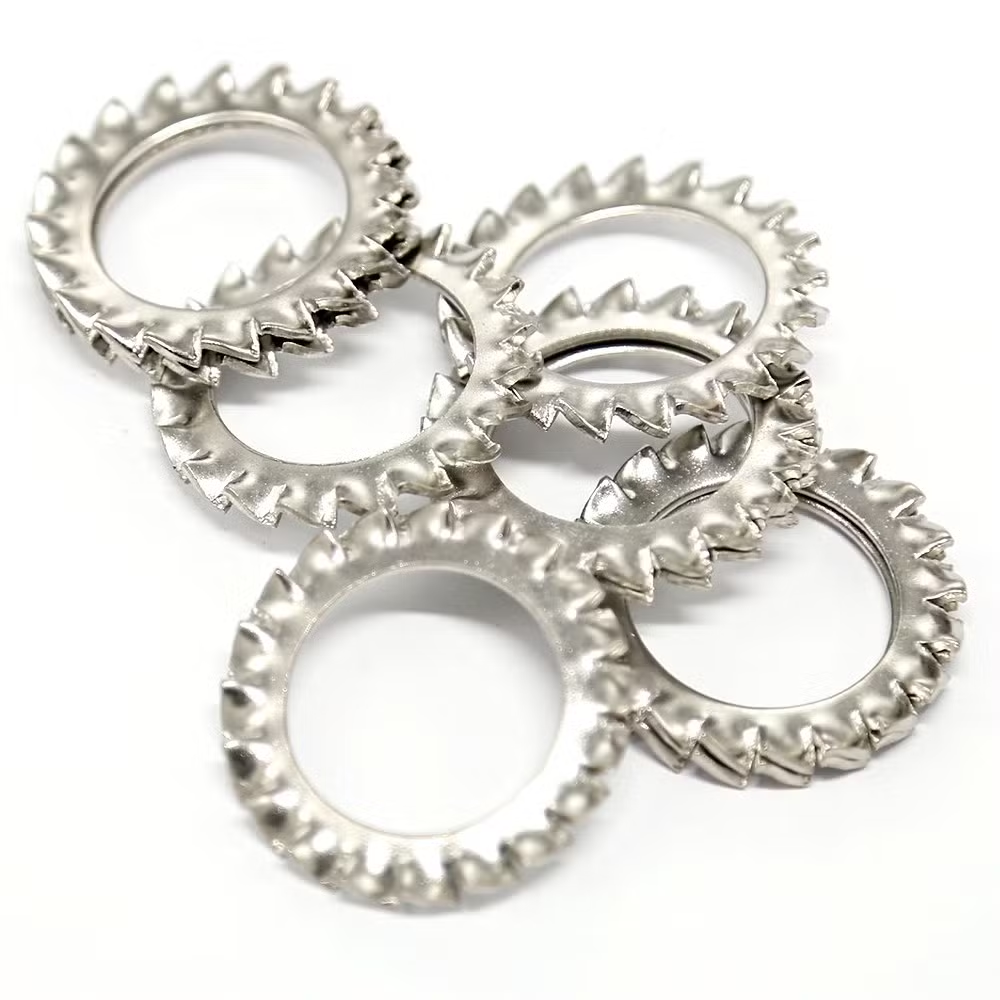
Premium A2 (304) and A4 (316) stainless steel Star Washer. Available in metric coarse threads and select UNC/BSW on request. Mill Test Certificates (MTC), strict dimensional tolerances, and fast dispatch from ready stock
DIN 6797
Stainless Steel Star Washer
TRSUTED SS Star Washer FOR DEMANDING APPLICATION
Key Specifications
Standards
-
Grades (Material)
A2 (304), A4 (316)
Strength Classes
-
Threads
Metric coarse (default). Fine/UNC/BSW available on request
Sizes
M1.6 to M 70, 3/16" to 2.1/2" (others on request)
Lengths
-
Head
-
Marking
Grade/class & manufacturer ID as applicable
Certificates
MTC 3.1 / chemical composition & mechanicals available
Compliance
RoHS/REACH; generally non-magnetic in solution-annealed state (slight magnetism possible after cold-work)
Choosing the Right Stainless Steel Star Washer
Choosing the Right Star Washer
(Internal Tooth / External Tooth Toothed Lock Washer)
1) What does a star washer do & when should you use it?
A star washer (toothed lock washer) is a washer with multiple sharp teeth around its inner or outer edge.
It is designed to:
Increase friction between the nut/bolt and the surface
Provide a mild spring effect
Help resist loosening from vibration and movement
In electrical applications, break through paint/oxide to ensure good grounding/earthing contact
Use a star washer when:
You need better anti-rotation than a plain washer alone
You want the teeth to bite into the surface or the nut/bolt
You need good electrical continuity through painted or plated surfaces (earthing lugs, busbars, panels)
2) Internal tooth vs external tooth – which one to choose?
Internal tooth star washer
Teeth are on the inner diameter.
Best when you want to bite against the shaft or under the head of a screw, especially under pan/head screws in electrical and electronic assemblies.
Offers a cleaner outer profile, better when space is limited or you don’t want teeth visible at the edge.
External tooth star washer
Teeth are on the outer diameter.
Provides a larger outside diameter and generally stronger locking action because teeth have a bigger lever arm.
Ideal under hex heads and nuts where there is enough outer space and you want maximum bite into the surface.
Simple selection:
Under screw heads (pan, round, cheese, small heads), and in electrical lugs, terminals → Internal tooth.
Under nuts and larger bolt heads, especially on flat surfaces → External tooth.
3) Environment & corrosion – material & finish
Indoor / dry / electrical & light mechanical use:
Use MS (mild steel) star washers with zinc plating or phosphated/black finish.
Common in control panels, enclosures, electronics, instrument panels.
Outdoor / mildly corrosive / industrial use:
Use zinc-plated MS or thicker coatings where some corrosion protection is needed.
For harsher outdoor use, prefer stainless.
Stainless / food / pharma / marine / aggressive environments:
Use SS 304 (A2) star washers for general stainless assemblies.
Use SS 316 (A4) star washers for coastal, marine, and chemical environments.
As always, best practice is to match washer material with the bolt/nut and environment to avoid galvanic corrosion and staining.
Mechanical Properties (Guide)
Mechanical Properties (Guide) – Star Washer
For star washers, the most important properties are material strength, hardness, and the spring/biting ability of the teeth. They are thin, so they don’t carry significant structural load – they are mainly locking and electrical contact components.
1) Mild steel star washers (standard)
Typical characteristics:
Material: low/medium carbon steel, often hardened or work-hardened at the tooth edges.
Teeth are formed and then heat-treated or strain-hardened to maintain springiness and bite.
Functional behaviour:
Teeth provide a small spring deflection as the nut/bolt is tightened.
As tightening torque increases, teeth dig into:
The underside of the nut/bolt head, and
The surface of the joint member.
This increases friction and resistance to rotation, and can slightly compensate for minor relaxation in the joint.
Limitations:
Being thin, they are not designed to carry major bearing loads.
Over-tightening can flatten the teeth completely, reducing their locking ability.
2) Stainless steel star washers (A2 / A4)
Typical characteristics:
Material: A2 (304) or A4 (316) stainless.
Provide corrosion-resistant tooth washers for stainless and outdoor assemblies.
Functional behaviour:
Similar spring and biting action to carbon steel, but with excellent corrosion resistance.
Ideal for stainless electrical panels, outdoor enclosures, marine-duty equipment, etc.
Because stainless is tougher, teeth may not be quite as sharp as hardened carbon steel, but still give effective bite in many applications.
6000+ Products
Trusted by 2000+ Clients
40+ Years of Experience
Exporting to 12+ Countries
What We Do
From a vast manufacturing facility situated in GIDC Wadhwan, Gujarat to strategic
sales offices in Mumbai and Chennai, we design, produce, and deliver a wide array of stainless steel
fasteners, hex bolts, machine screws, socket screws, washers, nuts, self‑tapping screws, threaded rods,
anchor fasteners, and specialty material products, engineered for demanding sectors like petrochemicals,
pharmaceuticals, automotive, and construction.
Our Legacy & Mission
Founded on a vision of precision and service, we have consistently expanded our
capabilities to meet evolving industrial needs. Our commitment to "We Deliver Quality" reflects in the
long-term relationships we build with clients across India and abroad.
Frequently Asked Questions
What is a star washer?
A star washer (toothed lock washer) is a thin washer with multiple sharp teeth on the inner or outer edge.
The teeth bite into the mating surfaces to increase friction, help prevent loosening, and in many cases break through paint/oxide to ensure good electrical contact.
What is the difference between internal tooth and external tooth star washers?
Internal tooth star washer:
Teeth are on the inner diameter.
Best under small screw heads (pan, cheese, etc.) and in electrical/terminal connections.
Keeps the outside profile smooth, useful in tight spaces.
External tooth star washer:
Teeth are on the outer diameter.
Larger OD and generally stronger locking action.
Ideal under nuts and hex bolt heads on flat plates, where there is space for the teeth to project.
Do star washers really stop screws and nuts from loosening?
They help but they are not a magic solution:
The teeth dig in and increase friction, giving better resistance to loosening than a plain washer alone.
They work well in light to moderate vibration applications.
In severe vibration or safety-critical joints, you should still use nylock/prevailing torque nuts, serrated flanges, chemical thread-locker, double nuts, or wedge-lock systems.
Star washers are best seen as a light–medium duty locking aid, especially for small fasteners and electrical connections.
When should I use a star washer instead of a spring washer?
Use a star washer when:
You need the teeth to bite through paint or plating to make metal-to-metal contact (earthing/grounding).
Space is limited and you want a thin but effective lock washer.
The fastener is small (M3, M4, M5) and used in electrical or light mechanical assemblies.
Use a spring washer when:
You mainly want a simple spring effect and extra friction in a general mechanical joint.
Electrical contact is not a major concern.
For electrical terminals and panels, star washers are usually preferred over spring washers.
How do I choose the right star washer size?
Match the washer size to the screw/bolt diameter:
M4 star washer for M4 screw, M8 for M8 bolt, etc.
For internal tooth: ID must fit snugly under the screw shank/head.
For external tooth: ID matches the bolt; OD and teeth must fit the available space under the nut/bolt head.
If the customer gives the bolt size, you can directly offer the same size star washer.


