


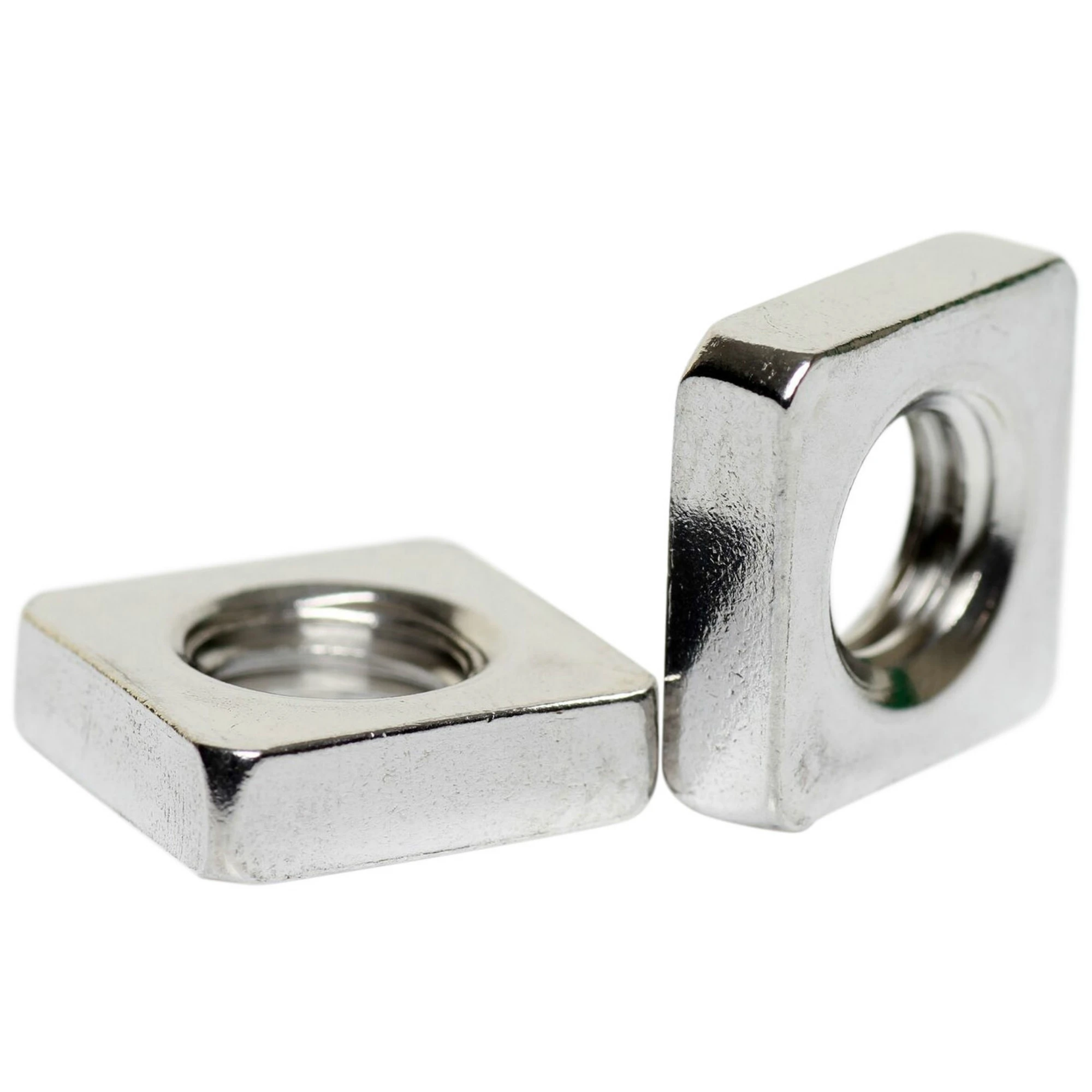
Premium A2 (304) and A4 (316) stainless steel square nuts. Available in metric coarse threads and select UNC/BSW on request. Mill Test Certificates (MTC), strict dimensional tolerances, and fast dispatch from ready stock.
DIN 557
Stainless Steel Square Nuts
TRSUTED SS SQUARE NUT FOR DEMANDING APPLICATION
Key Specifications
Standards
DIN 557
Grades (Material)
A2 (304), A4 (316)
Strength Classes
-
Threads
Metric coarse (default). Fine/UNC/BSW available on request
Sizes
M6 to M 20 (others on request)
Lengths
-
Head
-
Marking
Grade/class & manufacturer ID as applicable
Certificates
MTC 3.1 / chemical composition & mechanicals available
Compliance
RoHS/REACH; generally non-magnetic in solution-annealed state (slight magnetism possible after cold-work)
Choosing the Right Stainless Steel Square Nuts
When should I use a square nut?
Use a square nut instead of a hex nut when you need:
Better anti-rotation – square shape grips against edges/slots and resists turning.
Larger bearing area on the contact face compared to a similar-size hex nut.
Simple, robust fastening in channels, slots, or fabricated structures.
Traditional / specific design where the drawing or standard calls for square nuts.
Typical applications:
Channel/strut systems & brackets
Timber connections (square nut + square plate washer)
Railway, infrastructure & fabrication work
Old/legacy machinery where square nuts are specified.
Environment & corrosion
Indoors / general outdoor → A2 (304) square nut
Marine / coastal / chloride / chemical → A4 (316) square nut
A2: general machinery, fabrication, indoor frames, standard outdoor exposure.
A4: areas with salt, sea air, chemicals, pools, or aggressive cleaners.
Always try to match nut material with the bolt:
A2 square nut with A2 bolts
A4 square nut with A4 bolts
Square vs hex – which one to choose?
Choose a square nut when:
The nut sits in a pocket, channel, or square recess where it can self-lock against rotation.
You want more bearing area under the nut on timber or softer materials.
Assembly is from one side and you rely on the nut jamming against surfaces so you can tighten from the bolt head side.
Choose a hex nut when:
You need easier access for spanners/sockets from all angles.
Space is tight around the nut (hex is easier to tool in cramped areas).
Thread size, load & engagement
When choosing the size:
Select thread diameter (M6, M8, M10, etc.) based on:
Required clamping load
Matching bolt/stud size.
Ensure adequate thread engagement:
Bolt should engage enough threads (commonly ≈1× bolt diameter in steel designs, or as per your standard).
Mechanical Properties (Guide)
Square nuts follow the same basic property classes as standard stainless hex nuts (e.g., A2-70, A4-70).
The geometry (square shape) mainly affects tooling and bearing area, not the basic material strength.
A2-70 Square nuts
Material: A2 (304) stainless steel
Property class: 70
Intended for use with A2-70 bolts/studs (700 MPa tensile class).
Suitable for:
General indoor/outdoor fabrication
Channels, brackets, timber connections, frames, equipment supports in mild environments.
A4-70 Square nuts
Material: A4 (316) stainless steel
Property class: 70
Intended for use with A4-70 bolts/studs.
Suitable for:
Marine/coastal/chemical environments
Outdoor structures, plant equipment, and supports where corrosion resistance and simple, robust fastening are needed.
As long as thread engagement is adequate and the bolt & nut property classes match, a square nut of class 70 can carry similar bolt loads as a hex nut of the same class.
The larger bearing area of the square face is often an advantage on timber and softer materials, while the main limitation is tool access and clearance around the nut.
6000+ Products
Trusted by 2000+ Clients
40+ Years of Experience
Exporting to 12+ Countries
What We Do
From a vast manufacturing facility situated in GIDC Wadhwan, Gujarat to strategic
sales offices in Mumbai and Chennai, we design, produce, and deliver a wide array of stainless steel
fasteners, hex bolts, machine screws, socket screws, washers, nuts, self‑tapping screws, threaded rods,
anchor fasteners, and specialty material products, engineered for demanding sectors like petrochemicals,
pharmaceuticals, automotive, and construction.
Our Legacy & Mission
Founded on a vision of precision and service, we have consistently expanded our
capabilities to meet evolving industrial needs. Our commitment to "We Deliver Quality" reflects in the
long-term relationships we build with clients across India and abroad.
Frequently Asked Questions
What is a square nut?
A square nut is a four-sided nut with internal threads.
Compared to a hex nut, it has:
Larger flat bearing area on each face
Better ability to jam/lock against flat surfaces or in channels
They are often used in channels, timber, brackets, and fabrication work.
When should I use a square nut instead of a hex nut?
Use a square nut when:
The nut sits in a channel, slot, or pocket where it can self-lock and resist rotation
You want more bearing area on timber or softer materials
You want a simple, robust nut for heavy-duty or traditional designs
Use a hex nut when:
Tool access is tight and you need easier access from multiple angles
The design or standard specifically calls for hex nuts.
Where are square nuts commonly used?
Typical applications include:
Strut/channel systems and support brackets
Timber connections with square plate washers
Fabricated frames, clamps, and fixtures
Railway/infrastructure components
Older machinery where square nuts are specified on the drawing.
Are square nuts as strong as hex nuts?
For the same property class (e.g., A2-70, A4-70), the material strength is similar.
Key differences:
Square nuts provide more bearing area on the surface.
Hex nuts are better for tool access and higher torque with standard spanners/sockets.
As long as thread engagement is sufficient and property classes match, square nuts can carry similar bolt loads to hex nuts of the same class.
Can square nuts be reused?
Yes, if:
Threads are clean, sharp, and not stripped
There is no serious deformation or corrosion
For safety-critical or highly loaded joints, it is safer to install new nuts when reassembling.


