


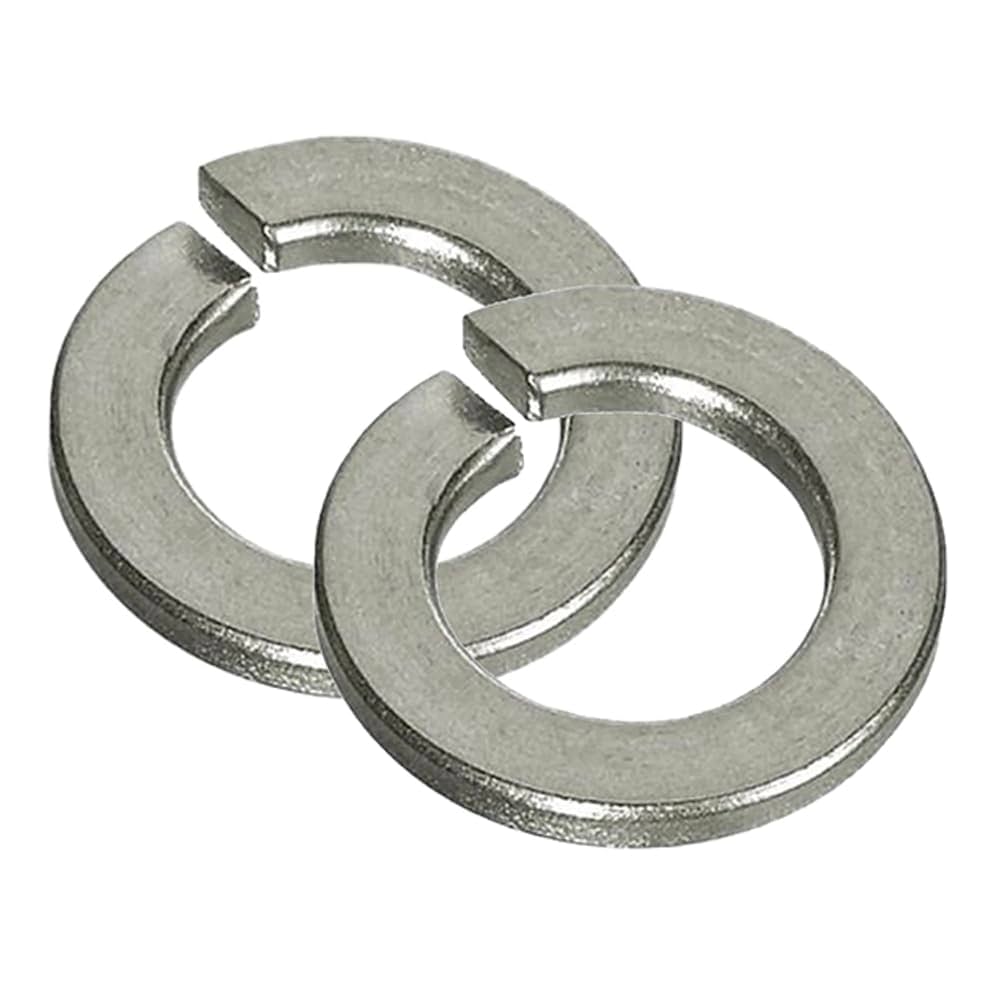
Premium A2 (304) and A4 (316) stainless steel Spring Washer. Available in metric coarse threads and select UNC/BSW on request. Mill Test Certificates (MTC), strict dimensional tolerances, and fast dispatch from ready stock.
DIN 127
Stainless Steel Spring Washer
TRSUTED SS Spring Washer FOR DEMANDING APPLICATION
Key Specifications
Standards
-
Grades (Material)
A2 (304), A4 (316)
Strength Classes
-
Threads
Metric coarse (default). Fine/UNC/BSW available on request
Sizes
M1.6 to M 70, 3/16" to 2.1/2" (others on request)
Lengths
-
Head
-
Marking
Grade/class & manufacturer ID as applicable
Certificates
MTC 3.1 / chemical composition & mechanicals available
Compliance
RoHS/REACH; generally non-magnetic in solution-annealed state (slight magnetism possible after cold-work)
Choosing the Right Stainless Steel Spring Washer
Choosing the Right Spring Washer
1) What does a spring washer do & when should you use it?
A spring washer (typically split / helical type) is a slightly twisted ring with a cut that provides:
A small amount of elasticity in the bolted joint
Increased contact pressure at the interface
Some resistance to loosening under vibration and shock (limited)
Use a spring washer when:
You want basic anti-loosening help in non-critical joints
The assembly faces light vibration or movement
You need a simple, low-cost method to maintain contact between nut/bolt and bearing surface
Important: Modern engineering practice treats split spring washers as limited anti-vibration devices. For highly critical joints, use nylock nuts, prevailing torque nuts, chemical thread-lockers, double nuts, or structural lock systems instead.
2) Environment & corrosion – choosing the spring washer material
Indoor / dry / general machinery & fabrication:
Use MS (mild steel) spring washers with black, phosphated or zinc-plated finish.
Suitable for general equipment, machines, fabrications, panels.
Outdoor / mild corrosion / galvanized structures:
Use MS spring washers with zinc plating / hot-dip galvanizing.
Match the coating system of bolts and nuts (e.g. HDG bolts → HDG spring washers).
Stainless assemblies / food / pharma / decorative:
Use stainless spring washers:
SS 304 (A2) – for general outdoor, food equipment, stainless structures
SS 316 (A4) – for coastal, marine, chemical, and wash-down environments
Best practice:
Wherever possible, match spring washer material to the bolt & nut material and the environment to avoid galvanic corrosion and staining.
3) Size & standard – matching bolt size and thickness
Spring washers are sized to suit the bolt diameter:
Inner diameter (ID):
Sized to clear the bolt shank; e.g., M10 spring washer for M10 bolt.
Too large ID reduces effective contact and locking effect.
Outer diameter (OD):
Standard OD for normal duty.
Larger OD variants exist, but plain washers are usually preferred for load spreading.
Thickness & section height:
Standard thickness for typical anti-loosening function.
Heavier sections are used for larger diameters and higher loads.
Rule:
For standard metric bolts → use the corresponding size spring washer as per DIN/ISO for that bolt.
Mechanical Properties (Guide)
Mechanical Properties (Guide) – Spring Washer
Mechanically, spring washers are defined by their material, hardness, and spring characteristics (deflection vs load). Their function is to provide elastic preload and edge friction under the nut/bolt head.
1) Mild steel spring washers (standard)
Typical characteristics:
Material: low carbon or medium carbon steel, hardened & tempered.
Hardness: higher than standard plain washers, to keep spring effect and resist flattening.
Functional behaviour:
Provide a small elastic deflection when compressed under the bolt/nut.
Edge of the cut section bites slightly into the nut/bolt and the bearing surface, increasing friction.
Under very high preload, they can flatten permanently, losing their spring action.
Use them with standard bolts in general duty applications, not as the only locking mechanism in critical joints.
2) Stainless steel spring washers (A2 / A4)
Typical characteristics:
Material: A2 (304) or A4 (316) stainless steel.
Corrosion resistant and suitable for stainless assemblies.
Spring characteristics slightly different (modulus and hardness) from hardened carbon steel, but still provide useful deflection for normal tightening ranges.
Functional behaviour:
Ideal where corrosion resistance is important (outdoor, food plant, marine).
Less prone to rust but can still lose spring action if over-compressed.
Must be used with matched stainless nuts & bolts to avoid galvanic issues and staining.
3) Behaviour in a bolted joint
In a properly tightened joint with a spring washer:
The washer is compressed and exerts a reaction force against nut/bolt head and surface.
This helps maintain contact pressure even if minor relaxation or embedding occurs.
The cut ends may apply local biting action, adding some friction to rotation.
Limitations:
Once the joint is fully tightened, most of the locking still comes from bolt tension and friction in threads & underhead; the spring washer adds only a small additional effect.
If it is flattened fully or permanently deformed, its spring function is largely lost.
6000+ Products
Trusted by 2000+ Clients
40+ Years of Experience
Exporting to 12+ Countries
What We Do
From a vast manufacturing facility situated in GIDC Wadhwan, Gujarat to strategic
sales offices in Mumbai and Chennai, we design, produce, and deliver a wide array of stainless steel
fasteners, hex bolts, machine screws, socket screws, washers, nuts, self‑tapping screws, threaded rods,
anchor fasteners, and specialty material products, engineered for demanding sectors like petrochemicals,
pharmaceuticals, automotive, and construction.
Our Legacy & Mission
Founded on a vision of precision and service, we have consistently expanded our
capabilities to meet evolving industrial needs. Our commitment to "We Deliver Quality" reflects in the
long-term relationships we build with clients across India and abroad.
Frequently Asked Questions
What is a spring washer and how is it different from a plain washer?
A spring washer (usually split/helical type) is a ring that’s cut and twisted to act like a small spring.
Plain washer → spreads load & protects surfaces.
Spring washer → adds a bit of elasticity and extra contact pressure to help resist loosening.
Does a spring washer completely stop nuts and bolts from loosening?
No – and this is important to explain honestly:
Spring washers provide limited resistance to loosening by adding friction and spring force.
In high-vibration or safety-critical joints, they are not enough on their own.
For serious locking, use nylock/prevailing torque nuts, serrated washers, thread-locker, double nuts, or mechanical locking systems.
When should I use a spring washer?
Good use cases:
General machinery and fabrications with light to moderate vibration
Panels, brackets, electrical boxes where a simple locking aid is desired
Older designs that specifically call for spring (split) washers and are not safety-critical
Avoid relying only on spring washers for heavy vibration, structural, or safety-critical applications
How do I choose the right size spring washer?
Match the washer size to the bolt diameter (e.g. M10 spring washer for M10 bolt).
The inner diameter must clear the shank but not be excessively loose.
The section and thickness are defined by the standard – just select the standard size for your bolt.
If the customer gives the bolt size, you can directly offer the matching spring washer size.
Should I use a plain washer together with a spring washer?
Often yes, especially when you need both:
Plain washer → spreads load and protects the surface.
Spring washer → gives spring effect and extra friction.
Typical stack (from nut downwards):
Nut → Spring washer → Plain washer → Surface
This is useful on soft, painted or thin materials where you don’t want the spring washer edge to dig directly into the part.


