


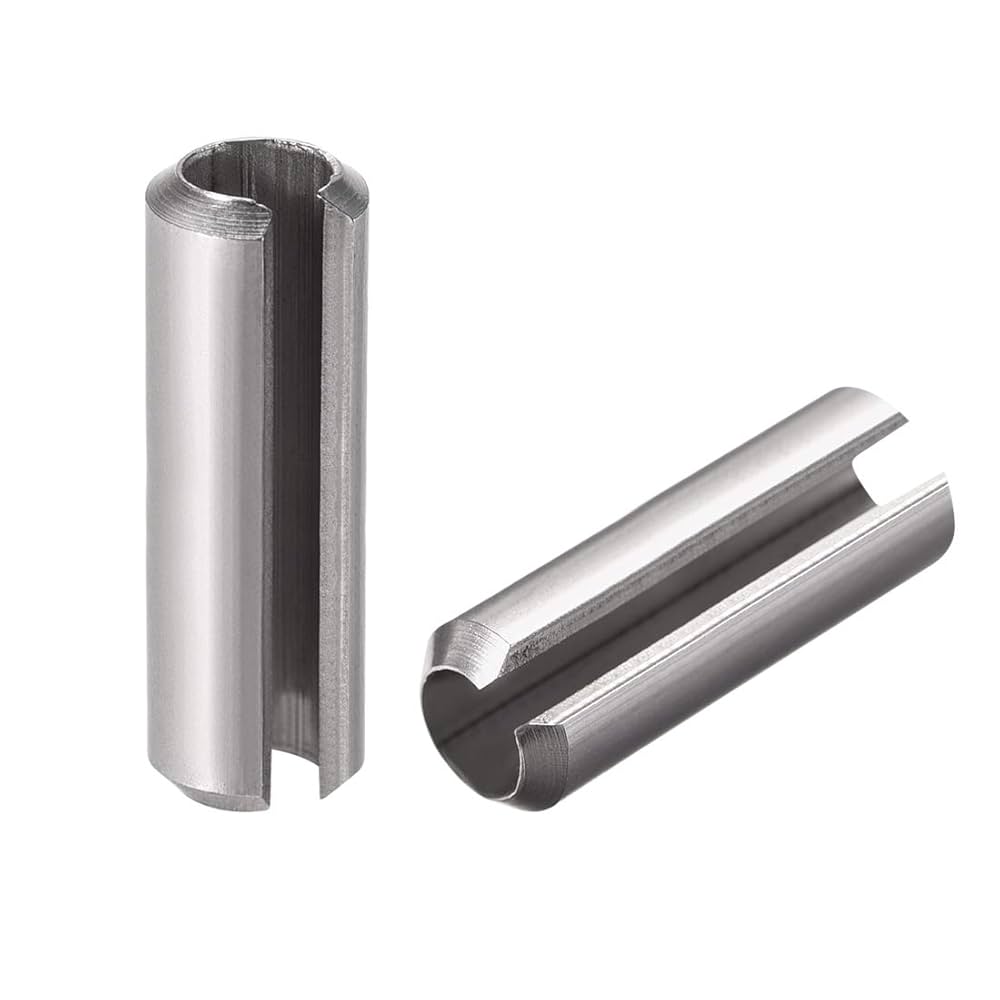
Premium A2 (304) and A4 (316) stainless steel Spring Dowell pin. Available in metric coarse threads and select UNC/BSW on request. Mill Test Certificates (MTC), strict dimensional tolerances, and fast dispatch from ready stock.
Stainless Steel Spring Dowell Pin
TRSUTED SS Spring dowell pin FOR DEMANDING APPLICATION
Key Specifications
Standards
-
Grades (Material)
A2 (304), A4 (316)
Strength Classes
-
Threads
Metric coarse (default). Fine/UNC/BSW available on request
Sizes
M6 to M 20 (others on request)
Lengths
-
Head
-
Marking
Grade/class & manufacturer ID as applicable
Certificates
MTC 3.1 / chemical composition & mechanicals available
Compliance
RoHS/REACH; generally non-magnetic in solution-annealed state (slight magnetism possible after cold-work)
Choosing the Right Stainless Steel Spring Dowell Pin
Choosing the Right Spring Dowel Pin
1) What is a spring dowel pin & when to use it?
A spring dowel pin is a slotted or coiled tubular pin made from spring steel or stainless, designed to be compressed when driven into a hole and then expand to hold itself in place.
Use a spring dowel pin when you need:
Self-retaining pins (they stay in the hole without press-fit machining like solid dowels)
Quick, economical assembly (hammer-in or press-in)
Good shear capacity with some flexibility
A pin that can absorb shock, vibration and slight misalignment better than a rigid solid dowel
Typical applications:
Hinges, linkages, levers, handles
Locking and positioning pins in machinery
Automotive, tools, hand equipment, agricultural machinery
General assemblies where you want a simple, low-cost locating or shear pin without precision reaming.
2) Slotted vs Coiled (spiral) spring pins
Spring dowel pins mainly come in two constructions:
Slotted / Roll Pins (ISO 8752 style)
A single piece of spring steel rolled into a cylinder with a long slot.
Compresses as it’s driven into the hole.
Very common in general mechanical applications.
Coiled / Spiral Spring Pins
Made from coiled strip wound into a spiral.
More even stress distribution, often better fatigue life.
Used where shock and vibration are high or where you want smoother insertion and more consistent spring behaviour.
Selection:
General machinery, simple linkages, standard usage → Slotted spring pins.
High-vibration, high-fatigue, or more premium applications → Coiled spring pins (if you stock them).
3) Diameter – nominal size vs hole size
For spring pins, nominal diameter is the standard size, but the hole is usually slightly smaller to ensure compression and retention.
Example (conceptual):
Nominal pin: Ø6 mm
Recommended hole: slightly under 6 mm (e.g. 5.8–5.9 mm depending on standard and tolerance).
Key points:
Hole must be sized according to the pin manufacturer’s recommendation.
Too small → excessive interference, very hard to insert, risk of damage.
Too large → pin will not grip properly, can loosen or fall out.
Spring pins tolerate normal drilled hole quality better than solid dowels, but:
Holes should still be round and reasonably accurate.
Avoid oversized or badly worn drills.
4) Length – engagement, shear & insertion
Spring dowel pins are specified by nominal diameter × length (e.g. 6 × 32).
Choose length so that:
Pin is long enough to engage fully in both components and carry the required shear load.
Ends are flush or slightly recessed unless a small projection is acceptable/required.
Rough guideline:
Length typically 1.5–3× the nominal diameter depending on application and plate thickness.
Too short → limited shear area, risk of pull-out or bending.
Too long → may bend or interfere, especially in thin parts.
Mechanical Properties (Guide)
Mechanical Properties (Guide) – Spring Dowel Pins
Spring dowel pins rely on spring properties (elastic deformation) as well as shear strength.
They are not classified by bolt “property classes” like 8.8 or A2-70, but by material, hardness, and spring characteristics. Stainless Steel Spring Pins
Material: Stainless spring steel (grade depends on manufacturer; often an austenitic or martensitic spring stainless).
Properties:
Good corrosion resistance in water, humidity, and many chemicals.
Adequate spring and shear performance for general-duty applications.
Often slightly less hard than the highest-grade carbon spring steels, but balanced for corrosion + elasticity.
6000+ Products
Trusted by 2000+ Clients
40+ Years of Experience
Exporting to 12+ Countries
What We Do
From a vast manufacturing facility situated in GIDC Wadhwan, Gujarat to strategic
sales offices in Mumbai and Chennai, we design, produce, and deliver a wide array of stainless steel
fasteners, hex bolts, machine screws, socket screws, washers, nuts, self‑tapping screws, threaded rods,
anchor fasteners, and specialty material products, engineered for demanding sectors like petrochemicals,
pharmaceuticals, automotive, and construction.
Our Legacy & Mission
Founded on a vision of precision and service, we have consistently expanded our
capabilities to meet evolving industrial needs. Our commitment to "We Deliver Quality" reflects in the
long-term relationships we build with clients across India and abroad.
Frequently Asked Questions
What is a spring dowel pin?
A spring dowel pin (also called a spring pin, roll pin, or tension pin) is a slotted or coiled tubular pin made from spring steel or stainless.
It is compressed when driven into a slightly smaller hole and then expands to grip the hole wall and stay in place.
When should I use a spring dowel pin instead of a solid dowel pin?
Use a spring pin when you want:
A self-retaining pin – it holds itself in a drilled hole without precision reaming.
Faster, more economical installation (hammer-in / press-in).
A pin that can absorb shock, vibration and small misalignments.
Use a solid dowel pin when you need very high precision location and maximum rigidity (e.g. precision jigs, gearboxes).
How do I choose the correct diameter for a spring dowel pin?
Spring pins are specified by nominal diameter, but the hole is slightly smaller than that nominal size.
Example (conceptual):
Nominal pin size: Ø6 mm
Recommended hole: slightly under 6 mm (e.g. ~5.8–5.9 mm, per standard).
Always follow the manufacturer’s recommended hole size.
If the hole is too small → pin is very hard to insert and may be damaged.
If the hole is too large → pin will be loose and may fall out.
Do I need to ream the hole for a spring dowel pin?
Usually no – that’s one of the advantages of spring pins:
A good drilled hole to the correct size is often enough.
Spring pins can accommodate some small variations in hole size.
However, holes should still be:
Round, straight and burr-free
Drilled with a good quality drill bit (not excessively worn/oversize).
Do spring dowel pins provide precise location like solid dowel pins?
They provide good functional location, but not as micron-accurate as precision-ground solid dowels.
For general alignment and shear → spring pins are usually sufficient.
For high-precision alignment (gearboxes, precision jigs, machining fixtures) → use solid dowel pins in reamed holes.


