


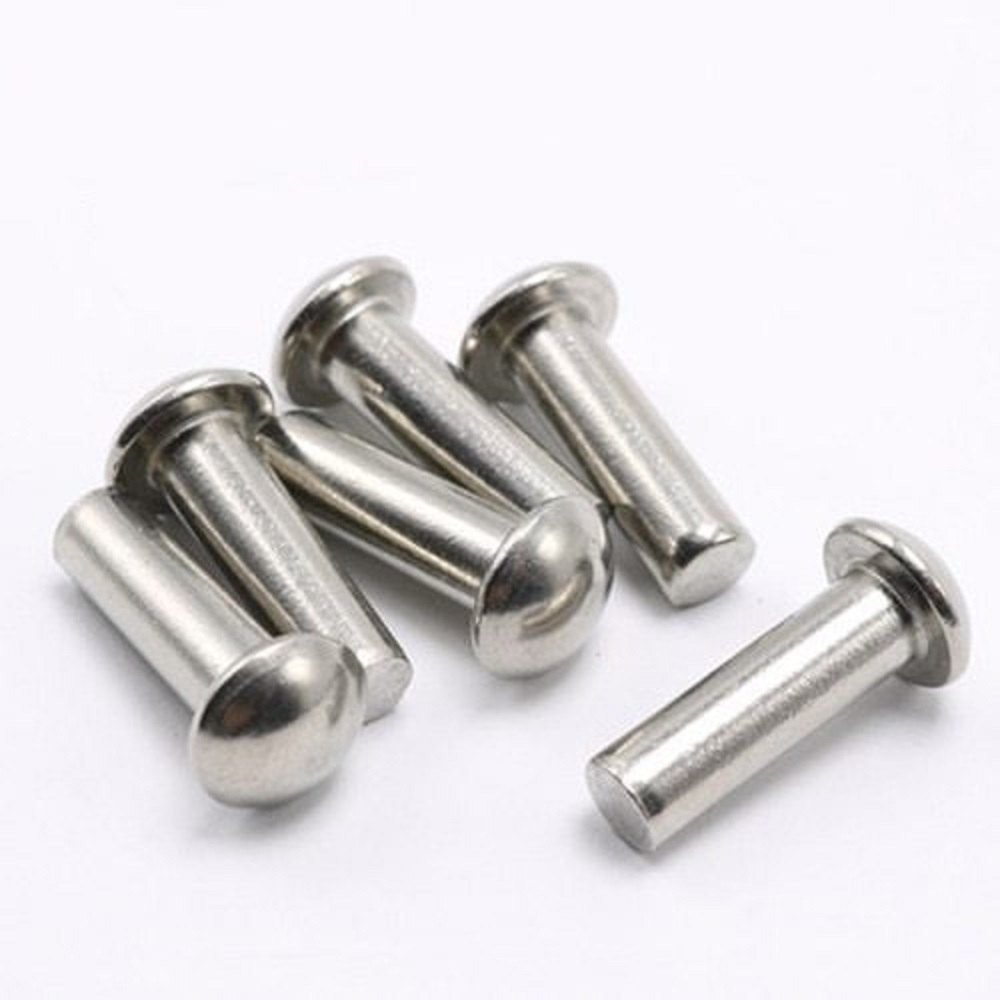
Premium A2 (304) and A4 (316) stainless steel Solid Rivets. Available in metric coarse threads and select UNC/BSW on request. Mill Test Certificates (MTC), strict dimensional tolerances, and fast dispatch from ready stock.
Stainless Steel Solid Rivets
TRSUTED SS Solid Rivets FOR DEMANDING APPLICATION
Key Specifications
Standards
-
Grades (Material)
A2 (304), A4 (316)
Strength Classes
-
Threads
Metric coarse (default). Fine/UNC/BSW available on request
Sizes
M6 to M 20 (others on request)
Lengths
-
Head
-
Marking
Grade/class & manufacturer ID as applicable
Certificates
MTC 3.1 / chemical composition & mechanicals available
Compliance
RoHS/REACH; generally non-magnetic in solution-annealed state (slight magnetism possible after cold-work)
Choosing the Right Stainless Steel Solid Rivets
Choosing the Right Solid Rivet
1) What is a solid rivet & when to use it?
A solid rivet is a one-piece fastener with a head at one end and a plain shank at the other.
The shank is plastically deformed (upset) using a hammer or rivet gun to form a second head, permanently clamping the materials together.
Use solid rivets when you need:
A permanent, vibration-resistant joint
High shear strength with no threads
A fastener that will not loosen under shock or vibration
A solution that can work in tight, low-profile spaces once set
Typical applications:
Structural sheet joints (bridges, structures, railway, heavy fabrication)
Aerospace & automotive (skins, frames, chassis, brackets)
Crane booms, truck bodies, wagons
General sheet metal work where high shear and fatigue resistance are required
Solid rivets require access to both sides of the joint (to buck the tail), unlike pop/blind rivets.
2) Head style – appearance, clearance & load spread
Common solid rivet head types:
Snap / Round / Universal head
Dome-shaped head with good load spread and fatigue resistance.
Very common in structural and aerospace joints.
Countersunk (CSK) head
Head sits flush with the surface in a countersunk hole.
Used where aerodynamics, appearance, or clearance are important (skins, covers, sliding surfaces).
Pan / Flat head (various low-profile heads)
Lower profile than snap/universal, but still gives good bearing area.
Used where you have some but not much head height available.
Selection:
General high-shear structural joints → Snap / round / universal head.
Flush surfaces (aero skins, panels, door edges) → Countersunk.
Limited clearance, but not fully flush → Pan/flat/low-profile head.
3) Diameter & length – grip and joint thickness
Solid rivets are specified by:
Shank diameter (e.g. 3 mm, 4 mm, 5 mm, 6 mm, etc.)
Shank length (before setting)
a) Diameter (strength & hole size)
Larger diameter → higher shear and tensile capacity.
Hole size should be just over the rivet diameter (close fit) to minimise slop and improve fatigue performance.
Very rough guidance (final choice by drawing/design):
Thin sheets, light structural joints → 3–4 mm
Medium brackets, vehicle work, heavier sheet joints → 4–5 mm
Heavy structural fabrications → 5–8 mm+, as per design
b) Length (grip length + upset allowance)
Rivet length must be enough for:
Total material thickness (grip): sum of all sheets/plates
Extra shank length to form the tail head (upset)
Rule of thumb (approximate):
Shank length ≈ Grip thickness + 1.3–1.6 × rivet diameter
This provides enough material to form a proper second head.
Too short → Small or incomplete tail head → weak joint.
Too long → Excess material → distorted head, risk of bending.
Mechanical Properties (Guide)
Mechanical Properties (Guide) – Solid Rivets
Solid rivets are designed primarily as shear fasteners (especially in lap joints), but they also carry tensile load.
Joint strength comes from both the rivet material and the clamped plates.
1) Strength behaviour
For a given rivet size & material (e.g. Ø5 mm steel rivet):
Shear strength
Force required to shear the rivet across the joint plane.
Solid rivets can give very good shear performance due to continuous cross-section and close fit.
Tensile (pull-out) strength
Force required to tear the head off or pull the rivet through the plate.
Depends on head size, plate thickness/material, and rivet material.
In general:
Shear strength ≈ 60–70% of tensile strength for many ductile metals (very rough rule; actual values come from manufacturer data and standards).
6000+ Products
Trusted by 2000+ Clients
40+ Years of Experience
Exporting to 12+ Countries
What We Do
From a vast manufacturing facility situated in GIDC Wadhwan, Gujarat to strategic
sales offices in Mumbai and Chennai, we design, produce, and deliver a wide array of stainless steel
fasteners, hex bolts, machine screws, socket screws, washers, nuts, self‑tapping screws, threaded rods,
anchor fasteners, and specialty material products, engineered for demanding sectors like petrochemicals,
pharmaceuticals, automotive, and construction.
Our Legacy & Mission
Founded on a vision of precision and service, we have consistently expanded our
capabilities to meet evolving industrial needs. Our commitment to "We Deliver Quality" reflects in the
long-term relationships we build with clients across India and abroad.
Frequently Asked Questions
What is a solid rivet?
A solid rivet is a one-piece fastener with a factory-formed head at one end and a plain shank at the other.
During installation, the shank is upset (hammered or pressed) to form a second head, permanently clamping the materials together.
When should I use solid rivets instead of bolts or pop rivets?
Use solid rivets when you need:
A permanent, vibration-resistant joint
Very good shear strength and fatigue resistance
A low-profile, snag-free fastening once set
They are preferred in:
Aerospace, automotive, rail, truck body and structural fabrication
Bridges, cranes, and heavy steel structures
Thin sheet joints where threads do not work well
Pop rivets are best when you have access from one side only; solid rivets need access to both sides.
What are the main head types for solid rivets?
Common head styles:
Snap / Round / Universal head
Dome-shaped, good load spread and fatigue performance.
General choice for structural and aerospace joints.
Countersunk (CSK) head
Sits flush with the surface in a countersunk hole.
Used where aerodynamics, appearance, or clearance are important (skins, doors, panels).
Pan / Flat / Low-profile heads
Lower height than round heads.
Used where there is limited headroom but you don’t need fully flush.
Are solid rivets stronger than pop rivets?
In many structural and fatigue-sensitive applications, solid rivets provide higher shear strength and better fatigue performance than standard pop rivets, because:
They have a solid, continuous shank
They are typically installed in tight-fitting holes
There is no hollow section in the main load path
However, actual performance depends on size, material, and joint design, so engineers should always refer to proper design data.
How do solid rivets behave under vibration?
Very well – when correctly sized and installed:
The joint is clamped tightly with permanent deformation of the shank.
There are no threads to loosen.
That’s why solid rivets are widely used in aircraft, rail, and heavy equipment where vibration and fatigue are critical factors.


