


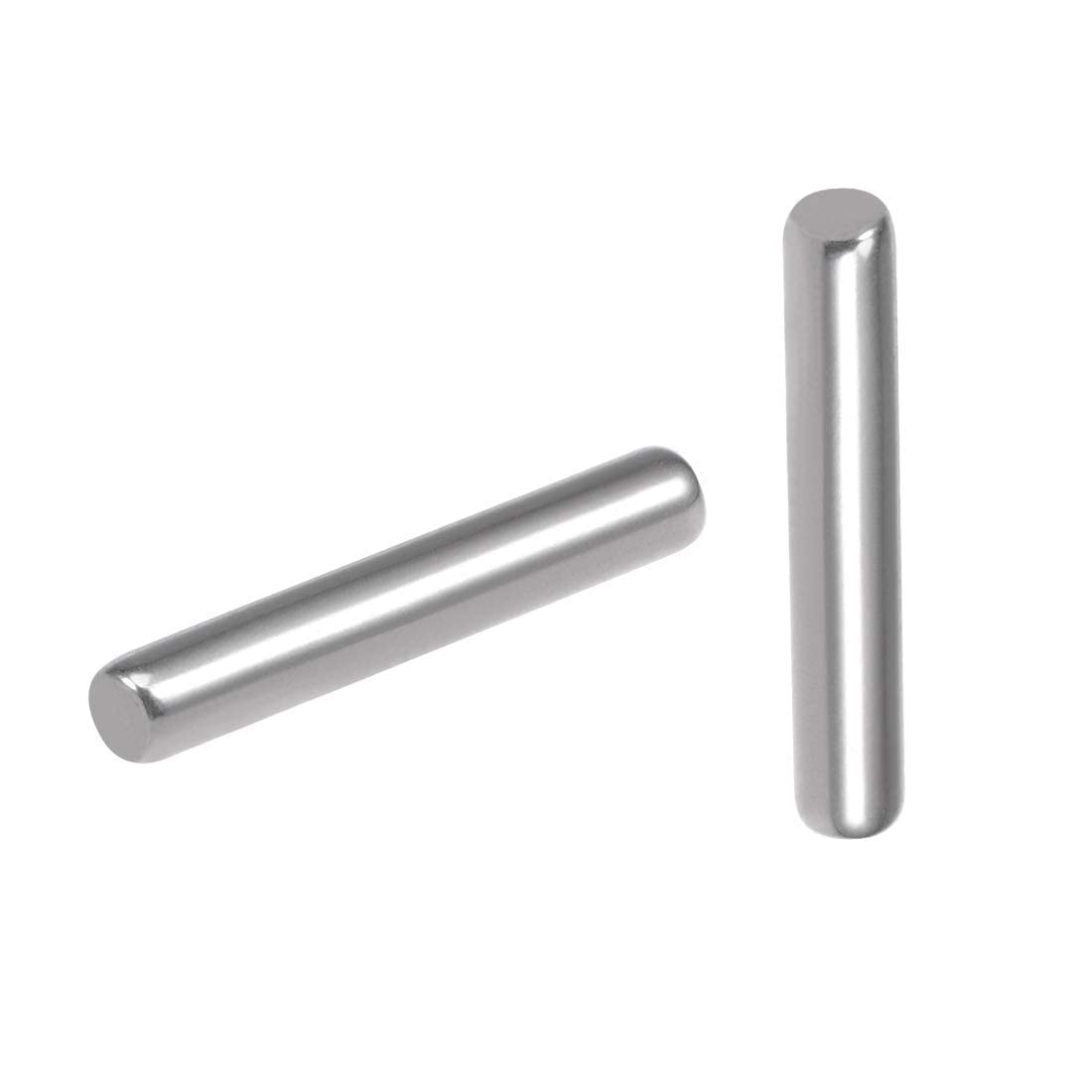
Premium A2 (304) and A4 (316) stainless steel Solid Dowell pin. Available in metric coarse threads and select UNC/BSW on request. Mill Test Certificates (MTC), strict dimensional tolerances, and fast dispatch from ready stock.
Stainless Steel Solid Dowell Pin
TRSUTED SS Solid Dowell Pin FOR DEMANDING APPLICATION
Key Specifications
Standards
-
Grades (Material)
A2 (304), A4 (316)
Strength Classes
-
Threads
Metric coarse (default). Fine/UNC/BSW available on request
Sizes
M6 to M 20 (others on request)
Lengths
-
Head
-
Marking
Grade/class & manufacturer ID as applicable
Certificates
MTC 3.1 / chemical composition & mechanicals available
Compliance
RoHS/REACH; generally non-magnetic in solution-annealed state (slight magnetism possible after cold-work)
Choosing the Right Stainless Steel Solid Dowell Pin
Choosing the Right Solid Dowel Pin
1) What is a solid dowel pin & when to use it?
A solid dowel pin is a precise, cylindrical pin used mainly for:
Accurate location and alignment of two or more parts
Repeatable assembly (you can disassemble and reassemble without losing position)
Taking shear loads between components (instead of the bolts taking all shear)
Use a solid dowel pin when you need:
Exact positioning of plates, housings, dies, jigs, flanges, etc.
To relieve bolts/screws from shear, allowing them to focus on clamping.
High repeatability for parts that are assembled and dismantled often (tooling, fixtures).
Typical applications:
Gearbox housings and covers
Motor/gearbox location on base plates
Punches, dies, and jigs
Flanges and precision mechanical assemblies
Machinery alignment (bearing blocks, rails, brackets)
2) Diameter & fit – locating vs removable
Dowel pins are all about fit. You normally decide:
Which side is press fit / interference (fixed in one part)
Which side is slip fit (assembly slides over the pin)
Common practice:
One part (e.g. base plate or housing) → press fit hole
Mating part (e.g. cover or bracket) → close clearance / slip fit hole
Fits (conceptual):
Press fit side:
Hole often H7 or similar, pin m6 or slightly oversized, giving light interference.
Slip fit side:
Hole with small clearance (e.g. H7/H8 vs nominal pin) for easy assembly but no noticeable play.
Do not treat dowel pins like “loose” pins – their job is precise location.
3) Length – engagement & handling
Solid dowel pins are specified by diameter × length (e.g. 8 × 40 mm).
Choose length so that:
The pin engages deep enough in each component:
Rule of thumb: each side often has ≥ 1× pin diameter engagement in the material, total pin length typically 2–3× diameter (or per drawing).
A small part of the pin may protrude slightly to aid removal (or you use threaded extraction type pins in tooling).
Too short → weak location, limited shear area.
Too long → risk of bending or interference with other parts.
For high-precision or OEM designs, follow the drawing’s specified length exactly.
Mechanical Properties (Guide)
Mechanical Properties (Guide) – Solid Dowel Pins
Dowel pins do not use bolt-style property classes (like 8.8, A2-70).
They are defined by material, hardness, and dimensional tolerance.
Their main duties are location and shear transfer, not clamping.
Hardened Steel Solid Dowel Pins
Material: High-carbon / alloy steel, hardened & tempered.
Typical properties (conceptual):
High Rockwell hardness (often in the high 50s–60s HRC, depending on standard/spec).
High yield and tensile strength suitable for shear transfer and wear resistance.
Precision ground to diameter tolerance (often m6 or similar).
Performance notes:
Excellent shear capacity when sized correctly and fitted in close-tolerance holes.
High fatigue resistance in applications with repeated loading (gearbox alignment, rotating equipment).
Surface hardness and finish minimise fretting wear between pin and hole.
Stainless Steel Solid Dowel Pins
Material: Austenitic or martensitic stainless steels, depending on manufacturer/spec.
Typical properties:
Corrosion-resistant in many environments (water, mild chemicals, food wash-down, marine atmospheres).
Mechanical strength sufficient for general locating & moderate shear loads.
May be hardened/treated to improve wear and strength (depending on grade).
6000+ Products
Trusted by 2000+ Clients
40+ Years of Experience
Exporting to 12+ Countries
What We Do
From a vast manufacturing facility situated in GIDC Wadhwan, Gujarat to strategic
sales offices in Mumbai and Chennai, we design, produce, and deliver a wide array of stainless steel
fasteners, hex bolts, machine screws, socket screws, washers, nuts, self‑tapping screws, threaded rods,
anchor fasteners, and specialty material products, engineered for demanding sectors like petrochemicals,
pharmaceuticals, automotive, and construction.
Our Legacy & Mission
Founded on a vision of precision and service, we have consistently expanded our
capabilities to meet evolving industrial needs. Our commitment to "We Deliver Quality" reflects in the
long-term relationships we build with clients across India and abroad.
Frequently Asked Questions
What is a solid dowel pin?
A solid dowel pin is a precision-ground cylindrical pin used mainly for accurate location, alignment, and shear transfer between two or more components.
It does not clamp parts (like a bolt) – it locates and supports them, while screws/bolts provide the clamping force.
When should I use dowel pins instead of just bolts or screws?
Use dowel pins when you need:
Precise, repeatable alignment of parts (e.g. housings, covers, jigs, fixtures).
To relieve bolts from shear, letting them focus on clamping.
The ability to dismantle and reassemble parts without losing position.
Without dowel pins, the joint may rely on bolt clearance and can shift slightly each time you assemble it.
How long should a dowel pin be?
The pin must engage sufficient depth in both parts:
Each side typically has at least 1× pin diameter engagement (or as per drawing).
Overall length is chosen so the pin sits fully in both parts, with either:
Flush ends, or
A small projection for removal (if not a threaded-extraction type pin).
Too short = weak location & low shear area.
Too long = risk of bending or interfering with other parts.
Do I need to ream the holes for dowel pins?
Ideally, yes:
Dowel pins are precision ground, so they work best in reamed holes.
Drilled holes alone can be slightly tapered, oversize, or rough, which reduces accuracy and holding power.
For accurate location and proper press/slip fit, the holes should be reamed to the specified tolerance (e.g. H7) and matched with the pin tolerance (e.g. m6).
Are dowel pins mainly for location, or can they carry load too?
Both – but primary function is location:
They give precise alignment between parts.
They can carry significant shear load when sized and fitted correctly.
In many good designs, bolts provide clamping, and dowel pins take most of the shear.


