


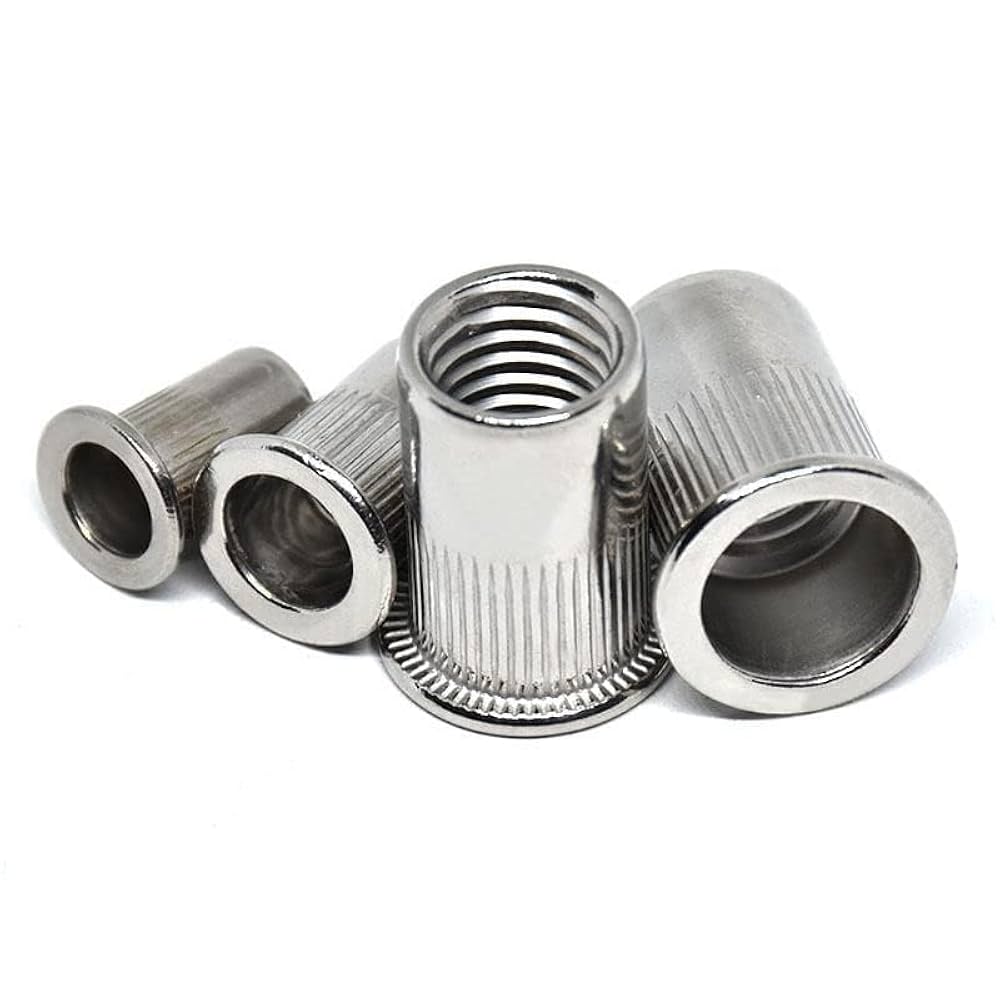
Premium A2 (304) and A4 (316) stainless riveting nuts. Available in metric coarse threads and select UNC/BSW on request. Mill Test Certificates (MTC), strict dimensional tolerances, and fast dispatch from ready stock.
DIN 660
Stainless Steel Riveting Nuts
TRSUTED SS RIVETING NUT FOR DEMANDING APPLICATION
Key Specifications
Standards
DIN 660
Grades (Material)
A2 (304), A4 (316)
Strength Classes
-
Threads
Metric coarse (default). Fine/UNC/BSW available on request
Sizes
M6 to M 20 (others on request)
Lengths
-
Head
-
Marking
Grade/class & manufacturer ID as applicable
Certificates
MTC 3.1 / chemical composition & mechanicals available
Compliance
RoHS/REACH; generally non-magnetic in solution-annealed state (slight magnetism possible after cold-work)
Choosing the Right Stainless Steel Riveting Nuts
What is a riveting nut & when to use it?
A riveting nut (rivet nut / rivnut / nutsert) is a blind, threaded insert that is crimped into a thin sheet or hollow section to create a permanent internal thread.
Use a rivet nut when:
The base material is too thin to tap a normal thread.
You have access from one side only (blind installation – tubes, box sections, closed profiles).
You want a strong, reusable thread in sheet metal, profiles, or plastic.
Typical applications:
Sheet metal panels, enclosures, cabinets
Automotive body and structural components
Furniture, appliances, HVAC ducts, electrical boxes
Any situation where you want a thread in thin material with one-side access
Environment & corrosion – material choice
Choose rivet nut material to suit the environment and match the screw:
Steel, zinc-plated
For indoor or dry environments.
Economical; commonly used with carbon steel screws.
Stainless steel A2 (304)
For indoor/outdoor, mildly to moderately corrosive environments.
Use with A2 stainless screws/bolts.
Stainless steel A4 (316)
For marine, coastal, chemical, chloride-rich environments.
Use with A4 stainless screws/bolts.
Aluminium rivet nuts
For lightweight assemblies and when fastening into soft or non-ferrous materials (aluminium profiles, composites).
Lower strength vs steel/stainless.
Rule of thumb:
Standard indoor fabrications → zinc-plated steel rivet nut
Stainless assemblies / outdoor → A2
Marine / harsh chemical → A4
Head style – flange type
Head type controls bearing area and appearance on the surface:
Flat / low-profile head
Sits almost flush on the surface.
Good where space is tight or appearance matters.
Bearing area is smaller → use on stiffer materials or when loads are moderate.
Large flange / wide flange head
Bigger bearing surface spreads the load more.
Better on thin, soft, or weaker materials (thin sheet, plastics, softer alloys).
More resistant to pull-through and surface deformation.
Countersunk / CSK head
Sits flush in a countersunk hole.
Used where a flat outer surface is required (panels, visible surfaces).
Requires proper countersink preparation in the sheet.
Body / shank style – round vs hex
The body style affects spin-out resistance (nut rotating in the sheet):
Round smooth body
Basic option; relies mainly on upset bulge and friction.
Suitable for harder materials or lighter loads.
Round knurled or ribbed body
Knurls bite into the parent material for better anti-rotation.
Good for higher torque applications in thin sheet.
Hex body rivet nuts
Installed in hex punched holes.
Best anti-rotation performance – body locks like a hex nut in a hex hole.
Ideal when you expect higher tightening torques or repeated assembly/disassembly.
Selection tip:
For soft sheet / higher torque / frequent use → knurled or hex body.
For simple, light-duty fixing in harder metal → smooth or light knurl is usually enough.
Open-end vs closed-end rivet nuts
Open-end rivet nut
Thread is open at the bottom.
Standard choice for most applications.
Allows long screws/studs to pass through.
Closed-end rivet nut
Bottom is closed.
Protects the thread from dirt, moisture, or fluid ingress.
Prevents screws from protruding into sealed cavities.
Good for fluid-containing parts, sealed boxes, cosmetic surfaces.
Mechanical Properties (Guide)
Rivet nuts are limited not only by thread strength, but also by pull-out strength and spin-out resistance in the parent material.
The joint capacity is a combination of:
Nut material & thread size
Grip range & upset quality
Base material thickness & strength
Head and body style (flange size, knurls, hex body, etc.)
Typical behaviour (simplified):
Steel, zinc-plated rivet nuts
Nut body strength roughly comparable to a low/medium carbon steel nut of similar size.
Often paired with 8.8 screws in general fabrication.
In thin sheet, the weakest link is usually pull-out / tear-out of the sheet, not thread shear.
A2 (304) stainless rivet nuts
Higher corrosion resistance, good overall mechanical strength.
Used with A2-70 screws/bolts.
Suitable for outdoor and industrial environments.
A4 (316) stainless rivet nuts
Best corrosion resistance, especially in marine/chemical settings.
Used with A4-70 / A4-80 screws depending on design.
Slightly tougher to set (harder material), so tooling and setting force must be correct.
6000+ Products
Trusted by 2000+ Clients
40+ Years of Experience
Exporting to 12+ Countries
What We Do
From a vast manufacturing facility situated in GIDC Wadhwan, Gujarat to strategic
sales offices in Mumbai and Chennai, we design, produce, and deliver a wide array of stainless steel
fasteners, hex bolts, machine screws, socket screws, washers, nuts, self‑tapping screws, threaded rods,
anchor fasteners, and specialty material products, engineered for demanding sectors like petrochemicals,
pharmaceuticals, automotive, and construction.
Our Legacy & Mission
Founded on a vision of precision and service, we have consistently expanded our
capabilities to meet evolving industrial needs. Our commitment to "We Deliver Quality" reflects in the
long-term relationships we build with clients across India and abroad.
Frequently Asked Questions
What is a riveting nut (rivet nut / rivnut)?
A riveting nut is a blind, threaded insert that is crimped into thin sheet or hollow sections.
Once set, it provides a permanent internal thread so you can use a normal screw/bolt, even when you only have access from one side.
When should I use a rivet nut instead of a weld nut or tapped hole?
Use a rivet nut when:
The material is too thin to tap threads.
You have access only from one side (box sections, tubes, closed profiles).
Welding is not possible or not desired (painted, coated, anodised parts; heat-sensitive zones).
You want to avoid distortion, heat marks, and extra welding operations.
Use a weld nut when you have two-sided access and welding is part of your normal process.
What materials are rivet nuts available in?
Common options:
Steel, zinc-plated – for indoor / dry environments, very common and economical.
Stainless A2 (304) – for indoor-outdoor general corrosion resistance, used with A2 screws.
Stainless A4 (316) – for marine, coastal, chemical, or chloride-rich environments, used with A4 screws.
Aluminium – for lightweight assemblies, especially in aluminium profiles and softer materials.
Choose material to match the environment and ideally the screw/bolt material.
What is “grip range” and why is it important?
The grip range is the minimum and maximum sheet thickness in which a particular rivet nut will set correctly.
If the sheet is thinner than the grip range → the nut can crush or distort the material.
If the sheet is thicker than the grip range → the nut won’t collapse fully and may spin or pull out.
Always select a rivet nut whose grip range matches your actual material thickness (including any backing plates).
What is the difference between round, knurled and hex body rivet nuts?
Round smooth body – basic option for light to medium loads in harder sheets.
Round knurled / ribbed body – knurls bite into the material and give better anti-rotation; good for higher torque in thin sheet.
Hex body – installed in a hex punched hole; gives maximum anti-rotation and is ideal where higher tightening torques or repeated use are expected.


