


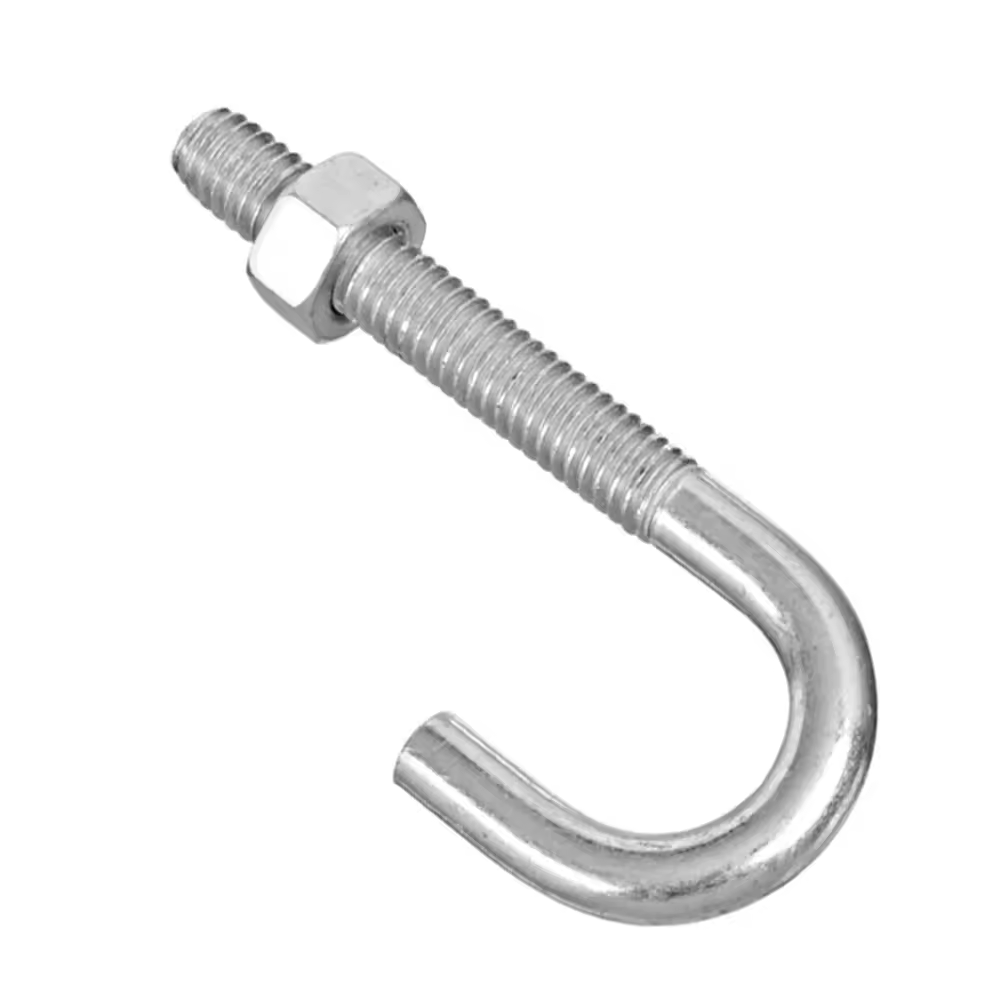
Premium A2 (304) and A4 (316) stainless steel J bolt. Available in metric coarse threads and select UNC/BSW on request. Mill Test Certificates (MTC), strict dimensional tolerances, and fast dispatch from ready stock.
Stainless Steel J Bolt
TRSUTED SS J Bolt FOR DEMANDING APPLICATION
Key Specifications
Standards
-
Grades (Material)
A2 (304), A4 (316)
Strength Classes
-
Threads
Metric coarse (default)
Sizes
M 6 to M 24 (others on request)
Lengths
-
Head
-
Marking
Grade/class & manufacturer ID as applicable
Certificates
MTC 3.1 / chemical composition & mechanicals available
Compliance
RoHS/REACH; generally non-magnetic in solution-annealed state (slight magnetism possible after cold-work)
Choosing the Right Stainless Steel J Bolt
Choosing the Right J-Bolt (J-Type Anchor Bolt)
1) What is a J-bolt & when to use it?
A J-bolt is an anchor bolt with a threaded straight leg on one side and a curved “J”-shaped hook on the other.
The hook end is normally cast into concrete or hooked around reinforcement/steel, while the threaded end is used with nuts & washers to hold down structures.
Use a J-bolt when you need a fixed anchor in concrete for:
Base plates & structural columns
Machinery skids and equipment frames
Poles, sign boards, masts, and gantries
Pipe supports, platforms, handrails, and guards
The curved “J” provides a larger bearing area in concrete versus a simple straight bar, improving resistance to pull-out.
2) Environment & corrosion – material / finish selection
Choose the material based on exposure and design life:
Carbon steel (plain / zinc plated / hot-dip galvanized)
Standard option in general civil & structural foundations
HDG (hot-dip galvanized) is widely used for outdoor foundations (columns, poles, etc.)
A2 (304) stainless J-bolt
For indoor & general outdoor environments where corrosion control is important
Suitable for stainless base plates, food plant interiors, and clean environments
A4 (316) stainless J-bolt
For marine, coastal, chemical, and chloride-rich environments
Ideal for jetties, waterfront structures, treatment plants, chemical plants, poolside foundations
Rule of thumb:
General structural foundations → HDG carbon steel J-bolts
Stainless equipment / clean or corrosion-sensitive areas → A2 stainless
Harsh marine / high-chloride / chemical → A4 stainless
Always match nuts & washers to the same material/finish (HDG with HDG, A2 with A2, A4 with A4).
3) Diameter – choosing the right size
Select bolt diameter (M10, M12, M16, M20, M24, etc.) based on:
Required tension (uplift) and shear capacity
Weight & size of the connected structure or equipment
Wind, seismic, and dynamic loads, according to structural design
Typical ranges (just as a guide; final by engineer):
Light poles, small supports, light equipment → M10–M16
Structural columns, heavier equipment, gantries → M16–M24+, as per calculation
4) Hook length & embedment depth – key to holding power
For J-bolts, the curved hook and embedment depth are critical:
Hook portion (curved “J”)
Provides a mechanical key in the concrete
Longer, well-shaped hooks improve resistance to pull-out and straighten-out
Embedment depth (hef)
Vertical depth of the hook into the concrete
Influences concrete breakout and bond capacity
Correct design must consider:
Bolt diameter
Required load and safety factors
Concrete strength, thickness, edge distance & spacing
Too short hook or shallow embedment → risk of pull-out or concrete breakout under tension.
Mechanical Properties (Guide)
Mechanical Properties (Guide) – J-Bolts (Anchor J-Bolts)
A J-bolt’s performance is controlled by steel strength and concrete capacity.
Even strong steel can fail by anchor pull-out, hook straightening or concrete breakout if embedment and edge distance are insufficient.
Stainless J-Bolts – A2 / A4
A2-70 & A4-70 J-bolts
Material:
A2 (304) or A4 (316) stainless steel
Property class: 70
Minimum tensile strength ≈ 700 MPa
Typical proof strength ≈ 450 MPa
Use with: A2-70 / A4-70 nuts and washers of matching grade
Typical applications
A2 J-bolts:
Anchoring stainless structures, supports, equipment bases in normal environments
When aesthetics and corrosion control are both important
A4 J-bolts:
Anchoring structures and equipment in marine, coastal, or chemical atmospheres
Foundations in water treatment, offshore platforms, chemical plants, pool decks, etc.
A4-80 J-bolts (if used)
Material: high-strength A4 (316) stainless
Property class: 80
Minimum tensile strength ≈ 800 MPa
Typical proof strength ≈ 600 MPa
Used where higher tensile capacity and superior corrosion resistance are both required.
6000+ Products
Trusted by 2000+ Clients
40+ Years of Experience
Exporting to 12+ Countries
What We Do
From a vast manufacturing facility situated in GIDC Wadhwan, Gujarat to strategic
sales offices in Mumbai and Chennai, we design, produce, and deliver a wide array of stainless steel
fasteners, hex bolts, machine screws, socket screws, washers, nuts, self‑tapping screws, threaded rods,
anchor fasteners, and specialty material products, engineered for demanding sectors like petrochemicals,
pharmaceuticals, automotive, and construction.
Our Legacy & Mission
Founded on a vision of precision and service, we have consistently expanded our
capabilities to meet evolving industrial needs. Our commitment to "We Deliver Quality" reflects in the
long-term relationships we build with clients across India and abroad.
Frequently Asked Questions
What is a J-bolt?
A J-bolt is an anchor bolt with a threaded straight leg and a curved “J”-shaped hook on the other end.
The hook end is cast into concrete, and the threaded end is used with nuts and washers to hold down base plates, columns, poles, and equipment.
Where are J-bolts commonly used?
Typical uses include anchoring:
Structural steel columns and base plates
Machinery skids and equipment bases
Poles, masts, sign boards, and gantries
Pipe rack supports, platforms, handrails, and guards
They provide a permanent, cast-in concrete anchor for many steel structures and machines.
Should I choose carbon steel, A2, or A4 stainless J-bolts?
Carbon steel (often hot-dip galvanized)
Standard for general structural and civil foundations.
A2 (304) stainless
For clean interiors and normal outdoor environments where corrosion control is important.
A4 (316) stainless
For marine, coastal, chemical, or chloride-rich environments.
Always match nuts & washers to the same material/finish.
How are J-bolts installed in new foundations?
They are used as cast-in anchors:
J-bolts are fixed to a template at the required spacing and projection.
Concrete is poured, fully covering the hooked part of the bolt.
After curing, the threaded ends are used to mount and level the base plate with nuts and washers.
Correct positioning of the template is critical for bolt alignment and spacing.
Are J-bolts suitable for both tension and shear loads?
Yes, but capacity must be verified by design.
J-bolts can resist:
Tension (uplift) through embedment and hook shape
Shear through bearing against the concrete and base plate
However, the controlling failure mode may be concrete breakout, pull-out, bending of the bolt, or steel failure, so proper engineering checks are required for heavily loaded bases


