


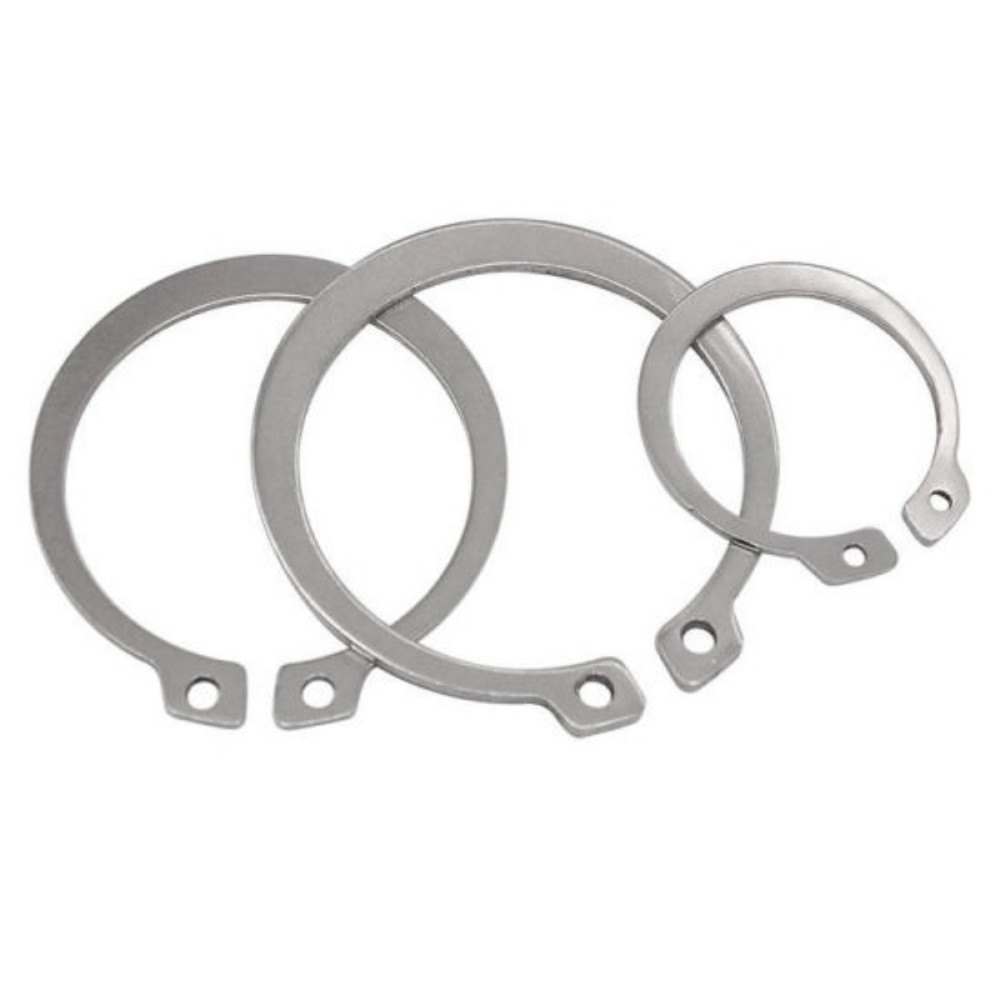
Premium A2 (304) and A4 (316) stainless steel Internal Circlip. Available in metric coarse threads and select UNC/BSW on request. Mill Test Certificates (MTC), strict dimensional tolerances, and fast dispatch from ready stock.
DIN 472
Stainless Steel Internal Circlip
TRSUTED SS Intenral Circlip FOR DEMANDING APPLICATION
Key Specifications
Standards
DIN 472
Grades (Material)
A2 (304), A4 (316)
Strength Classes
-
Threads
Metric coarse (default). Fine/UNC/BSW available on request
Sizes
M6 to M 20 (others on request)
Lengths
-
Head
-
Marking
Grade/class & manufacturer ID as applicable
Certificates
MTC 3.1 / chemical composition & mechanicals available
Compliance
RoHS/REACH; generally non-magnetic in solution-annealed state (slight magnetism possible after cold-work)
Choosing the Right Stainless Steel Internal Circlip
Choosing the Right Internal Circlip
1) What is an internal circlip & when to use it?
An internal circlip is a C-shaped spring steel ring that fits into a groove inside a bore or housing.
It acts as an axial retainer to stop components from moving out of a bore.
Use an internal circlip when you need to retain parts inside a housing, such as:
Bearings, bushes, seals inside a housing or hub
Gears, sprockets, pulleys within a recess
Spacers, washers, or sleeves located axially inside a bore
Most industrial internal circlips follow DIN 472 (internal circlips for bores).
2) Bore diameter & standard (DIN 472)
The first selection is always the bore (housing) diameter:
Internal circlips are specified by bore diameter, e.g.:
“Internal Circlip for Ø40 mm bore – DIN 472”
The circlip is designed to expand into the groove for that bore size and provide the correct radial preload and axial retaining force.
Simple rule:
Find your bore diameter (e.g. 20, 30, 40, 80 mm).
Choose “Internal Circlip for Ø… mm bore – DIN 472” in the required material.
Never mix sizes – a wrong circlip will either sit loose or be overstressed.
3) Groove design inside the bore
The housing groove is critical to performance:
Groove diameter, width and flank angle are defined in DIN 472 (or matching standard).
The groove must be machined accurately so the circlip:
Seats fully in the groove
Projects inward enough to act as a shoulder and retain the component
Key points:
Groove must be free from burrs and sharp edges.
Depth must allow the circlip to sit flush enough while still having sufficient radial projection to hold the retained part.
For high loads/speeds, follow groove dimensions exactly as per standard or drawing.
4) Material & corrosion resistance
Internal circlips are commonly available in:
Carbon spring steel (standard)
The most widely used option
Usually supplied phosphated, blackened, oiled, or lightly zinc-coated
Suitable for gearboxes, automotive, machinery where environment is dry or lubricated
Stainless spring steel
For humid, marine, food, chemical, and wash-down environments
Used with stainless housings and components
Provides better long-term corrosion resistance than carbon steel circlips
Selection guide:
Inside sealed, oily or protected housings → Carbon spring steel internal circlip is usually adequate.
In corrosive, wet, or sanitary environments → Stainless internal circlip is preferred.
Mechanical Properties (Guide)
Stainless Steel Internal Circlips
Material: stainless spring steel (grade depends on manufacturer – often a martensitic or austenitic stainless selected for spring properties).
Properties:
Good corrosion resistance in humid, marine, and wash-down environments
Adequate spring behaviour for retaining tasks
Slightly different modulus and yield compared to carbon steel, but designed to give comparable retaining force for the specified bore size
Performance notes:
Ideal when:
Rust staining is unacceptable
Equipment is regularly subjected to cleaning fluids, saltwater, or chemicals
Best used with stainless housings/components for consistent corrosion performance.
6000+ Products
Trusted by 2000+ Clients
40+ Years of Experience
Exporting to 12+ Countries
What We Do
From a vast manufacturing facility situated in GIDC Wadhwan, Gujarat to strategic
sales offices in Mumbai and Chennai, we design, produce, and deliver a wide array of stainless steel
fasteners, hex bolts, machine screws, socket screws, washers, nuts, self‑tapping screws, threaded rods,
anchor fasteners, and specialty material products, engineered for demanding sectors like petrochemicals,
pharmaceuticals, automotive, and construction.
Our Legacy & Mission
Founded on a vision of precision and service, we have consistently expanded our
capabilities to meet evolving industrial needs. Our commitment to "We Deliver Quality" reflects in the
long-term relationships we build with clients across India and abroad.
Frequently Asked Questions
What is an internal circlip?
An internal circlip is a C-shaped spring steel ring that fits into a machined groove inside a bore or housing.
It prevents components inside the bore (bearings, bushes, gears, spacers, etc.) from moving out axially.
How do I select the correct internal circlip size?
Internal circlips are specified by the bore diameter:
Example: “Internal Circlip for Ø40 mm bore – DIN 472” fits a 40 mm bore.
Selection steps:
Confirm your bore diameter (e.g., 20, 30, 40 mm).
Choose the circlip for that bore size in the required standard and material.
What is DIN 472?
DIN 472 is the standard for internal circlips for bores.
It defines:
Circlip dimensions (diameter, thickness, lug shape)
Groove dimensions (width, diameter, tolerances)
Proper fit and seating in the bore
Using a DIN 472 circlip + DIN 472 groove ensures correct fit and reliable retention.
When should I use stainless internal circlips instead of carbon steel?
Use stainless internal circlips when:
The environment is humid, marine, or outdoors
The application is in food, pharma, or wash-down equipment
You are using stainless housings/components and want uniform corrosion resistance
For sealed, lubricated, or protected interiors (gearboxes, engines, etc.), carbon spring steel circlips are usually sufficient.
How do I install an internal circlip correctly?
Use internal circlip pliers (tips close to compress the circlip).
Compress the circlip just enough to fit into the bore.
Position it at the groove and gently release, allowing it to expand into the groove.
Ensure it is fully seated all around.
Avoid over-compressing or twisting – this can permanently weaken or deform the ring.


