


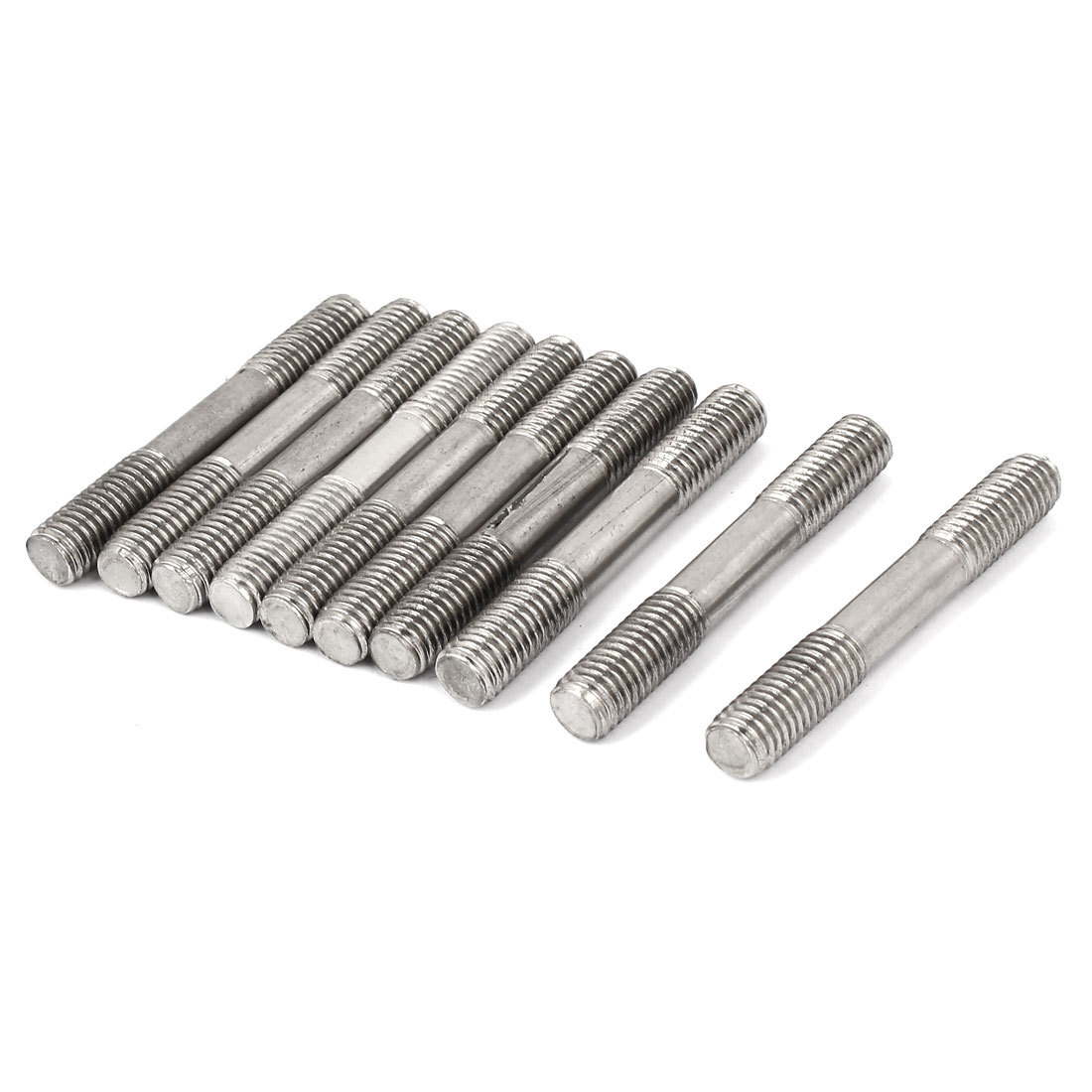
Premium A2 (304) and A4 (316) stainless steel Half Threaded Rod. Available in metric coarse threads and select UNC/BSW on request. Mill Test Certificates (MTC), strict dimensional tolerances, and fast dispatch from ready stock.
DIN 939
Stainless Steel Half Threaded Rod
TRSUTED SS Half Threaded Rod FOR DEMANDING APPLICATION
Key Specifications
Standards
DIN 939
Grades (Material)
A2 (304), A4 (316)
Strength Classes
-
Threads
Metric coarse (default). Fine/UNC/BSW available on request
Sizes
M1.6 to M 70, 3/16" to 2.1/2" (others on request)
Lengths
50-2000mm
Head
-
Marking
Grade/class & manufacturer ID as applicable
Certificates
MTC 3.1 / chemical composition & mechanicals available
Compliance
RoHS/REACH; generally non-magnetic in solution-annealed state (slight magnetism possible after cold-work)
Choosing the Right Stainless Steel Half Threaded Rod
Choosing the Right Half Threaded Rod (Partially Threaded Stud)
1) What is a half threaded rod & when to use it?
A half threaded rod (partially threaded stud) is a bar with:
Threads only on one or both ends,
A plain shank in the middle (unthreaded portion).
Use a half threaded rod instead of a fully threaded rod when you need:
A smooth shank in the shear or bearing zone,
Better alignment and fit in holes or flanges,
Higher bending/shear performance compared to fully threaded rod of same nominal size.
Typical applications:
Flange connections (pipe flanges, structural flanges)
Machinery and equipment mounting (studs in tapped holes)
Structural splices & brackets where the central portion works in shear/bearing
Automotive, valve, and pump studs (stud ends into housing, other end with nut)
Simple rule:
Pure tension / hanger / general use → full threaded rod
Shear + tension / precision fit / repeated assembly → half threaded rod (stud)
2) Environment & corrosion – material choice (A2 vs A4 vs Carbon Steel)
Choose the material like other fasteners:
Carbon steel (plain / zinc / HDG)
General structural, machinery, and civil work
HDG for outdoor steel, structural baseplates, heavy frames
A2 (304) stainless half threaded rod
For indoor and general outdoor assemblies
Flange studs, machinery studs, general fabrications where 304 is sufficient
A4 (316) stainless half threaded rod
For marine, coastal, poolside, and chemical environments
Flanges and equipment in water treatment, food & pharma, chemical, offshore
Match with same-grade nuts and washers:
A2 stud + A2 nuts & washers
A4 stud + A4 nuts & washers
HDG stud + HDG nuts & washers
3) Thread length vs plain shank – how much thread do you need?
For half threaded rods, two things matter:
Thread length at each end
Length of the plain shank
Threaded length should cover:
Thickness of nuts + washers
Thickness of flange/plate/clamp
Plus 2–3 visible threads beyond each nut
Plain shank should:
Sit in the shear/bearing zone (through the flange/plate/part)
Provide better bearing and less damage to holes compared to threads
Improve alignment across matched holes
Common approaches:
For flange studs:
One end shorter thread to screw into a tapped hole or nut-welded plate
Other end longer thread for nut + washer + adjustment
For through-studs:
Threaded ends sized so that only the unthreaded portion lies inside the joint.
4) Diameter & length – structural and practical considerations
Select diameter (M8, M10, M12, M16, M20, etc.) based on:
Required tensile and shear capacity
Bolt spacing and number of studs in the joint
Standards (flange tables, design codes)
Length is chosen so that:
The plain shank is in the load-transferring zone
You have enough thread engagement at each end
Nuts/washer stacks fit correctly with a few exposed threads
Compared to full threaded rod:
Half threaded rods offer better fatigue performance and cleaner shear behaviour in many flange and structural applications.
Mechanical Properties (Guide)
Mechanical Properties (Guide) – Stainless Half Threaded Rods
Half threaded rods share the same property classes as standard bolts/studs.
The unthreaded shank improves behaviour in shear and fatigue, but tensile capacity is determined by the threaded section and property class.
A2-70 Stainless Half Threaded Rods
Material: A2 (304) stainless steel
Property class: 70
Minimum tensile strength ≈ 700 MPa
Typical proof strength ≈ 450 MPa
Use with: A2-70 nuts and A2 washers
Typical applications:
Flange studs, equipment studs, and structural joints in non-marine environments
Stainless fabrication where a plain shank in the joint is preferred over full thread
A4-70 Stainless Half Threaded Rods
Material: A4 (316) stainless steel
Property class: 70
Same mechanical strength level as A2-70 with better pitting/chloride resistance
Use with: A4-70 nuts and A4 washers
Applications:
Marine/coastal/chemical flange joints and equipment studs
Stainless pipelines, tanks, and process equipment
A4-80 Stainless Half Threaded Rods (if used)
Material: high-strength A4 (316)
Property class: 80
Minimum tensile strength ≈ 800 MPa
Typical proof strength ≈ 600 MPa
Applications:
Highly loaded flange joints in aggressive environments
When higher strength is needed in the same diameter with corrosion resistance
6000+ Products
Trusted by 2000+ Clients
40+ Years of Experience
Exporting to 12+ Countries
What We Do
From a vast manufacturing facility situated in GIDC Wadhwan, Gujarat to strategic
sales offices in Mumbai and Chennai, we design, produce, and deliver a wide array of stainless steel
fasteners, hex bolts, machine screws, socket screws, washers, nuts, self‑tapping screws, threaded rods,
anchor fasteners, and specialty material products, engineered for demanding sectors like petrochemicals,
pharmaceuticals, automotive, and construction.
Our Legacy & Mission
Founded on a vision of precision and service, we have consistently expanded our
capabilities to meet evolving industrial needs. Our commitment to "We Deliver Quality" reflects in the
long-term relationships we build with clients across India and abroad.
Frequently Asked Questions
What is a half threaded rod?
A half threaded rod (partially threaded stud) is a bar that is threaded only on one or both ends, with a plain, unthreaded shank in the middle.
It works like a stud bolt where the shank sits in the joint and the threads are used only for nuts or tapped holes.
How is a half threaded rod different from a fully threaded rod?
Half threaded rod (stud):
Has an unthreaded shank where it passes through the joint.
Threads are only at the ends.
Better for shear, bearing and alignment in flanges and structural joints.
Fully threaded rod:
Threaded along the entire length.
Used where the rod is mainly in tension (hangers, anchors, general supports).
In joints with shear or frequent assembly/disassembly, half threaded rods are usually preferred.
Where are half threaded rods commonly used?
ypical applications include:
Flange connections (pipe flanges, structural flanges)
Machinery & equipment studs screwed into tapped housings
Base frames and brackets where the shank bears in the hole
Automotive, valves, pumps, and gearboxes as permanent studs
They are chosen where you want a smooth shank in the joint and threads only where nuts are used.
Why would I choose a half threaded rod instead of a fully threaded rod?
Advantages of half threaded rods:
Better shear & bearing behaviour – shank carries shear instead of threads.
Less damage to holes and mating parts (no threads rubbing inside the hole).
Better alignment between parts, especially in flanges.
Often better fatigue performance in dynamic joints.
Fully threaded rods are simpler and more flexible, but for engineered joints, studs/half threaded rods are usually preferred.
Can half threaded rods be used as studs in tapped holes?
Yes – this is a very common use:
One end of the stud is screwed into a tapped hole in a housing, block, or flange.
The other end remains outside and takes a nut + washer.
This allows repeated assembly/disassembly of the nut without wearing the base material’s threads.


