


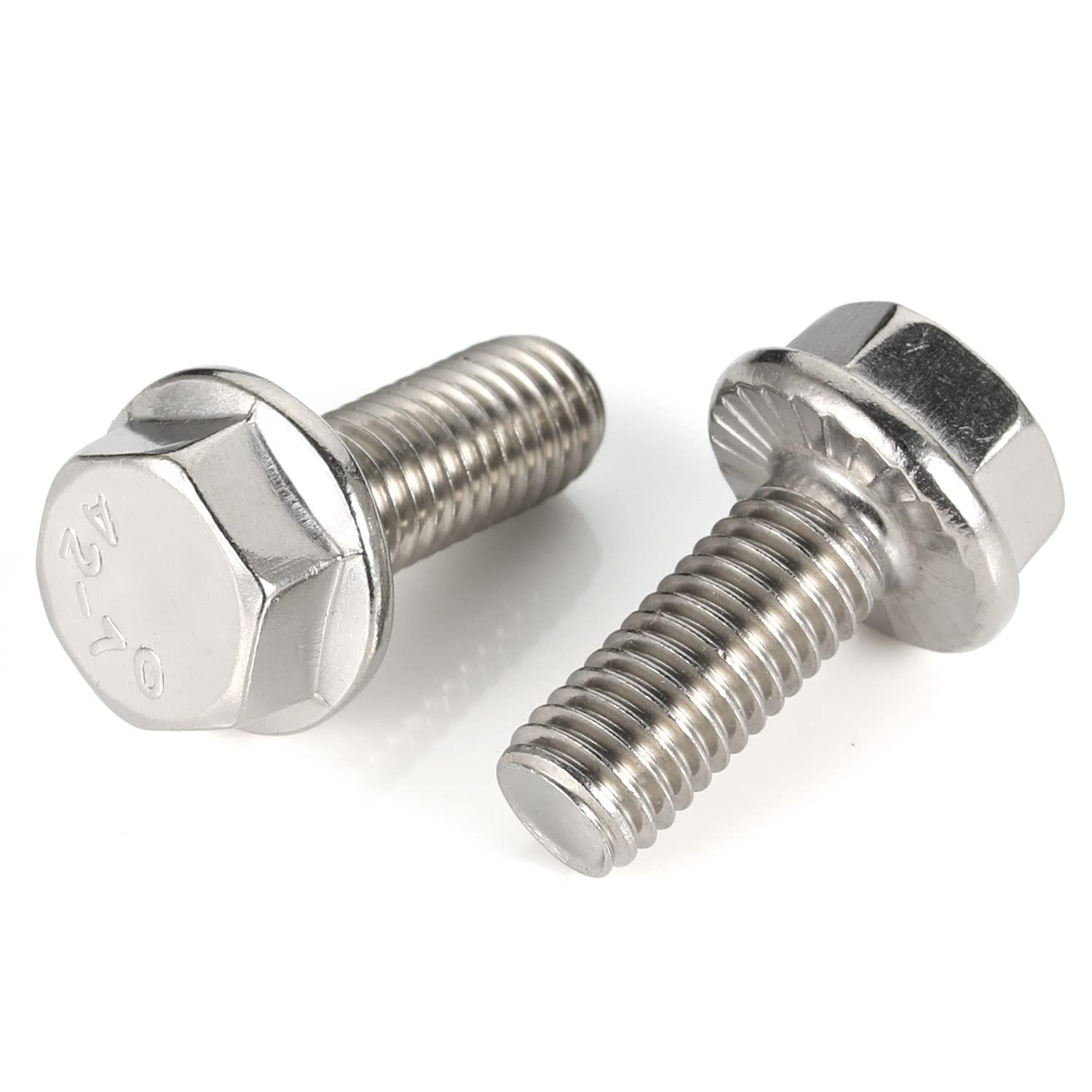
Premium A2 (304) and A4 (316) stainless steel flange bolt. Available in metric coarse threads and select UNC/BSW on request. Mill Test Certificates (MTC), strict dimensional tolerances, and fast dispatch from ready stock.
DIN 6921
Stainless Steel Flange Bolt
TRSUTED SS Flange Bolt FOR DEMANDING APPLICATION
Key Specifications
Standards
DIN 6921
Grades (Material)
A2 (304), A4 (316)
Strength Classes
A2-70, A4-70 and A4-80
Threads
Metric coarse (default). Fine/UNC/BSW available on request
Sizes
M5 to M 20 (others on request)
Lengths
12-100 mm (others on request)
Head
-
Marking
Grade/class & manufacturer ID as applicable
Certificates
MTC 3.1 / chemical composition & mechanicals available
Compliance
RoHS/REACH; generally non-magnetic in solution-annealed state (slight magnetism possible after cold-work)
Choosing the Right Stainless Steel Flange Bolt
choosing the right flange bolt
What is a flange bolt & when to use it?
A flange bolt is a hex (or hex-flange) head bolt with an integrated washer face (flange) under the head.
Use a flange bolt when you want:
Faster assembly – no separate washer to handle
Larger bearing area under the head
More even load distribution on the clamped part
Option of serrated flange for extra anti-loosening under vibration
Typical applications:
Automotive & machinery assemblies
Fabricated frames, brackets, guards, covers
Sheet metal, housings, engine/body parts
Anywhere you’d normally use hex bolt + washer and want a more compact, quicker solution
Environment & corrosion – A2 vs A4 stainless
For stainless flange bolts:
Indoors / general outdoor → A2 (304) flange bolt
General machinery, fabrication, plant equipment, structures
Marine / coastal / chloride / chemical → A4 (316) flange bolt
Marine hardware, coastal structures, cooling towers, chemical plants, poolside
Always try to match material across the joint:
A2 flange bolt with A2 nuts & washers (where extra washers are used)
A4 flange bolt with A4 nuts & washers
Plain flange vs serrated flange
Plain (smooth) flange bolt
Flange acts like a built-in flat washer
Spreads load and helps protect painted/plated/soft surfaces
Ideal for visible joints and surfaces where you don’t want marks
Serrated flange bolt
Flange has radial serrations under the head
Serrations bite into the mating surface to resist loosening under vibration
Not recommended on soft, visible or painted surfaces (will mark/remove coating)
Simple rule:
Painted/visible/soft surfaces → Plain flange bolt
Hidden steel surfaces + vibration → Serrated flange bolt directly on steel (no washer under serrations)
Strength & matching with nuts
Treat flange bolts like standard hex bolts from a strength point of view:
General-purpose stainless joints →
Use A2-70 or A4-70 flange bolts with matching A2/A4-70 nuts
Higher clamp load / more critical stainless joints →
Use A4-80 flange bolts (if specified) with suitable A4 nuts
Key point:
Nut property class should match or exceed the bolt property class.
The flange does not increase tensile strength – it improves bearing area and anti-loosening.
Mechanical Properties (Guide)
Mechanical Properties (Guide) – Stainless Steel Flange Bolts
Flange bolts follow the same property class system as standard stainless hex bolts.
The head design (with flange, plain or serrated) changes how load is applied, not the basic tensile class.
A2-70 Flange Bolts
Material: A2 (304) stainless steel
Property class: 70
Minimum tensile strength: ≈ 700 MPa
Typical proof strength: ≈ 450 MPa
Use with: A2-70 nuts and appropriate washers (if required).
Applications:
General machinery, fabrication, sheet metal, brackets, guards
Indoor and standard outdoor environments
A4-70 Flange Bolts
Material: A4 (316) stainless steel
Property class: 70
Same mechanical level as A2-70 with better corrosion resistance
Use with: A4-70 nuts (and A4 washers if used).
Applications:
Marine, coastal, food & chemical environments
Outdoor installations exposed to salt, chlorides, aggressive cleaners
A4-80 Flange Bolts (if available/used)
Material: A4 (316) high-strength stainless
Property class: 80
Minimum tensile strength: ≈ 800 MPa
Applications:
More highly loaded stainless joints where both strength and corrosion resistance are critical
Key mechanical notes:
For any given size (e.g., M10 A4-70 flange bolt), capacity is comparable to a standard M10 A4-70 hex bolt.
Joint performance depends on:
Bolt property class & diameter
Matching nut & washer selection
Contact surface under the flange (painted/steel/soft material)
Use of serrations (for anti-loosening) or additional locking methods
6000+ Products
Trusted by 2000+ Clients
40+ Years of Experience
Exporting to 12+ Countries
What We Do
From a vast manufacturing facility situated in GIDC Wadhwan, Gujarat to strategic
sales offices in Mumbai and Chennai, we design, produce, and deliver a wide array of stainless steel
fasteners, hex bolts, machine screws, socket screws, washers, nuts, self‑tapping screws, threaded rods,
anchor fasteners, and specialty material products, engineered for demanding sectors like petrochemicals,
pharmaceuticals, automotive, and construction.
Our Legacy & Mission
Founded on a vision of precision and service, we have consistently expanded our
capabilities to meet evolving industrial needs. Our commitment to "We Deliver Quality" reflects in the
long-term relationships we build with clients across India and abroad.
Frequently Asked Questions
What is a flange bolt?
A flange bolt is a hex bolt with a built-in washer face (flange) under the head.
The flange:
Spreads the load over a larger area
Often eliminates the need for a separate washer
Can be plain (smooth) or serrated (anti-loosening)
When should I use a flange bolt instead of a normal hex bolt + washer?
Use a flange bolt when you want:
Faster assembly – only one piece to handle
More compact design (no loose washer)
More consistent bearing area under the head
Optional extra anti-loosening with serrated flange
Use hex bolt + washer when you need very large bearing area or special washers (spring, Belleville, etc.).
What’s the difference between a plain flange and a serrated flange?
Plain flange bolt:
Smooth underside
Acts like an integrated flat washer
Good for painted, plated or softer surfaces where you don’t want marks
Serrated flange bolt:
Has radial serrations under the head
Serrations bite into the surface to help prevent loosening under vibration
Not recommended on visible, painted or soft surfaces (it will leave marks/remove coating)
Can flange bolts be reused?
Yes, if:
Threads are clean and undamaged
The flange face (and serrations, if present) is not badly worn
The bolt is not bent or heavily corroded
For critical or high-vibration joints, it’s safer to replace bolts and nuts if there is any doubt.
Do serrated flange bolts damage the surface?
Yes – this is how they work.
The serrations are designed to cut slightly into the mating surface to prevent rotation.
Use them only where surface marking is acceptable (hidden joints, structural steel, non-decorative areas).


