


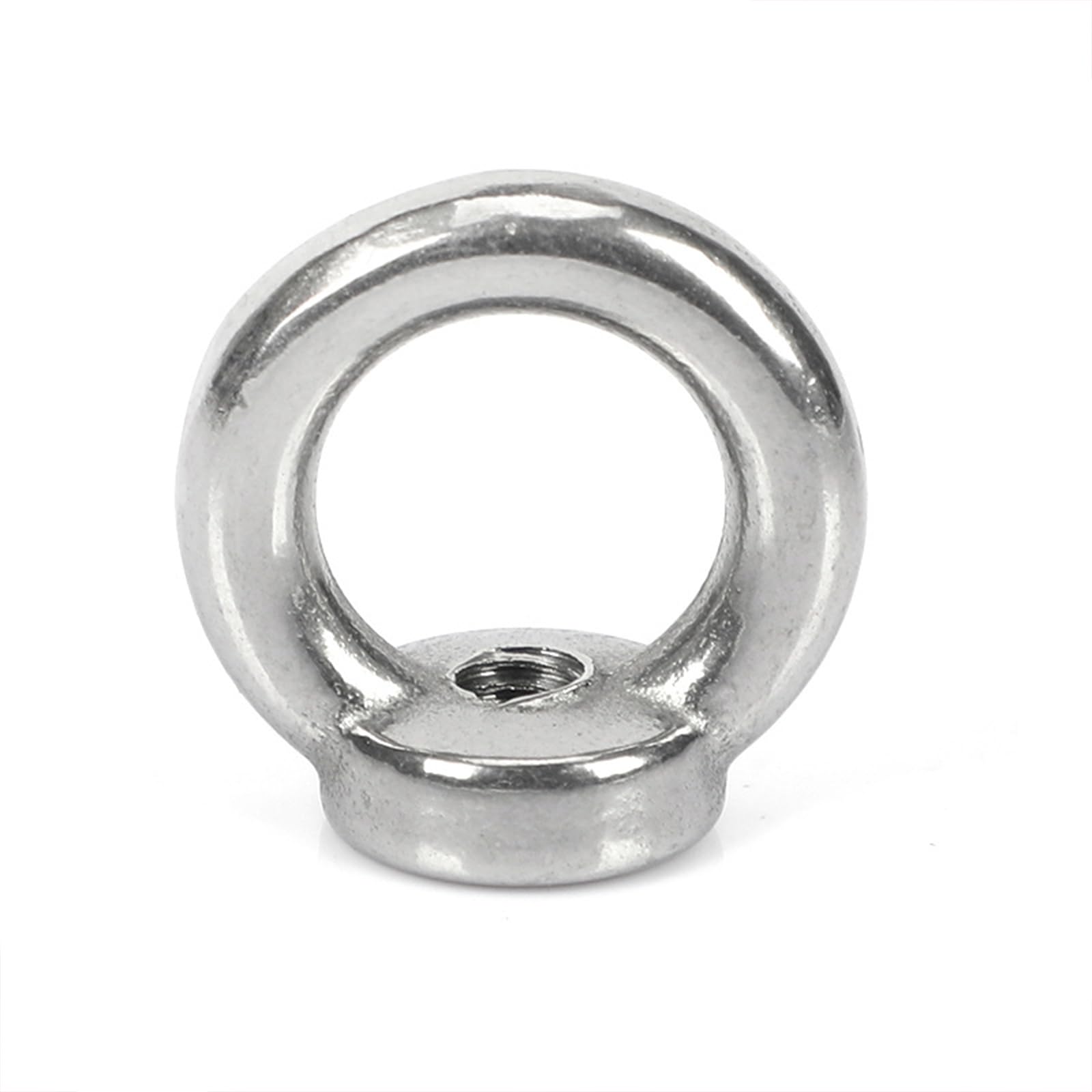
Premium A2 (304) and A4 (316) stainless eye nuts. Available in metric coarse threads and select UNC/BSW on request. Mill Test Certificates (MTC), strict dimensional tolerances, and fast dispatch from ready stock.
DIN 582
Stainless Steel Eye Nuts
TRSUTED SS EYE NUT FOR DEMANDING APPLICATION
Key Specifications
Standards
DIN 582
Grades (Material)
A2 (304), A4 (316)
Strength Classes
-
Threads
Metric coarse (default). Fine/UNC/BSW available on request
Sizes
M6 to M 20 (others on request)
Lengths
-
Head
-
Marking
Grade/class & manufacturer ID as applicable
Certificates
MTC 3.1 / chemical composition & mechanicals available
Compliance
RoHS/REACH; generally non-magnetic in solution-annealed state (slight magnetism possible after cold-work)
Choosing the Right Stainless Steel Eye Nuts
What is an eye nut & when to use it?
An eye nut is a nut with a threaded hole and an integral lifting eye/ring.
Use an eye nut when you need:
A lifting or anchoring point on a threaded stud/bolt.
To lift, guide, secure or tie down equipment, plates, machines, structures.
A removable lifting point (unlike a fixed pad-eye or welded lug).
Common uses:
Lifting machinery, plates, fabrications (with slings, hooks, shackles).
Rigging, anchoring, guy wires, safety lines.
Temporary lifting points on structures or equipment.
Important: For lifting, eye nuts must be rated and marked (WLL / SWL) and used as per manufacturer’s instructions.
Environment & corrosion – material choice
Indoors / general outdoor → A2 (304) eye nut
Marine / coastal / chloride / chemical exposure → A4 (316) eye nut
Use A2 for workshop, plant, general structures, normal outdoor use.
Use A4 for marine, coastal, food, chemical, and chloride-rich environments.
Match eye nut material with bolt/stud material where possible to reduce galvanic issues:
A2 eye nut with A2 studs
A4 eye nut with A4 studs
Standard & type (e.g., DIN 582 lifting eye nuts)
For lifting, the most common pattern is:
DIN 582 – Lifting Eye Nut
Metric threads (e.g., M6, M8, M10, M12, M16, etc.).
Each size has a Rated Working Load Limit (WLL) for straight pull, defined by the standard/manufacturer.
Other non-lifting / hardware eye nuts may not be rated for lifting – use them only for non-load-critical anchoring/tying.
Rule of thumb:
For overhead lifting, use DIN 582 or equivalent rated eye nuts only, with visible marking and WLL.
For simple tie-down or guide applications (no overhead lifting), you can use standard hardware eye nuts (but still respect reasonable loads).
Load direction & how the eye nut is used
Rated lifting eye nuts like DIN 582 are tested for specific load directions:
Ideal / safest → In-line (straight) tension along the bolt/stud axis.
The WLL may be reduced when:
Load is applied at an angle.
Side loading or multi-leg slings are used.
Always check and respect:
Manufacturer’s load charts for 0°, 45°, 90° load angles.
Correct seating: the eye nut must bear fully on the supporting surface (no gaps).
Never:
Use eye nuts with bent studs, or
Allow the eye to bear on only one side – it should sit fla
Mechanical Properties (Guide)
Eye nuts for lifting are not only defined by the material property class, but by their tested Working Load Limit (WLL).
WLL is based on:
Material strength
Cross-section of the ring
Design & safety factor (usually ≥4x or 5x against failure)
A2 Stainless Lifting Eye Nuts (DIN 582)
Material: A2 (304) stainless steel
Typical usage:
Lifting points in general industrial environments
Machinery handling, plant maintenance, indoor/outdoor where corrosion is moderate
A4 Stainless Lifting Eye Nuts (DIN 582)
Material: A4 (316) stainless steel
Typical usage:
Lifting points in marine, coastal, and chemical environments
Food/pharma plants and any area with high corrosion risk
Key mechanical points:
WLL (Working Load Limit) is marked on rated eye nuts (e.g., DIN 582), depending on size (M6, M8, M10, M12, etc.).
The eye nut is designed with a safety factor on ultimate strength (standard dependent), so never exceed the WLL.
WLL is valid only when:
The eye nut is properly installed and seated.
Load is applied within permitted angle limits.
The supporting structure and stud have adequate strength and are correctly designed.
For non-lifting eye nuts (hardware type), there may be no WLL marking, and they should not be used for overhead lifting. Their “mechanical properties” are then simply based on the stainless steel grade and thread size but not certified for lifting safety factors.
6000+ Products
Trusted by 2000+ Clients
40+ Years of Experience
Exporting to 12+ Countries
What We Do
From a vast manufacturing facility situated in GIDC Wadhwan, Gujarat to strategic
sales offices in Mumbai and Chennai, we design, produce, and deliver a wide array of stainless steel
fasteners, hex bolts, machine screws, socket screws, washers, nuts, self‑tapping screws, threaded rods,
anchor fasteners, and specialty material products, engineered for demanding sectors like petrochemicals,
pharmaceuticals, automotive, and construction.
Our Legacy & Mission
Founded on a vision of precision and service, we have consistently expanded our
capabilities to meet evolving industrial needs. Our commitment to "We Deliver Quality" reflects in the
long-term relationships we build with clients across India and abroad.
Frequently Asked Questions
What is an eye nut?
An eye nut is a nut with a threaded hole and an integral ring/eye on top.
It is used to create a lifting or anchoring point on a threaded stud or bolt – for hooks, shackles, chains, or ropes.
Can all eye nuts be used for lifting?
No.
Rated lifting eye nuts (e.g., DIN 582) are designed, tested and marked with a Working Load Limit (WLL) and are suitable for lifting when used correctly.
Non-rated / hardware eye nuts are meant for anchoring, tie-down, guiding, or securing, but must not be used for overhead lifting.
Always check if the eye nut is marked and specified for lifting before using it to hoist loads.
What is DIN 582?
DIN 582 is a standard for lifting eye nuts with metric threads.
DIN 582 eye nuts:
Are designed and tested for lifting applications
Have specified WLLs for each thread size (M6, M8, M10, M12, etc.)
Are typically marked with size and/or WLL and sometimes manufacturer’s mark
If you require certified lifting points, choose DIN 582 (or equivalent) eye nuts.
How do I select the correct size of eye nut?
Base your choice on:
The Working Load Limit (WLL) you need (for lifting eye nuts).
The thread size of the stud/bolt (M8, M10, M12, M16, etc.).
The strength of the stud and base material (they must also be able to handle the load).
For lifting: never choose by thread size alone – always check the WLL table for that size and material.
Can I load an eye nut at an angle, or only straight up?
Rated eye nuts (like DIN 582) are strongest in straight (in-line) loading.
When you apply angled loads, the allowable WLL is reduced.
Side-loading or multi-leg slings can significantly reduce capacity and cause dangerous bending.
Always follow the manufacturer’s load chart for different angles, and avoid severe side loading.


