


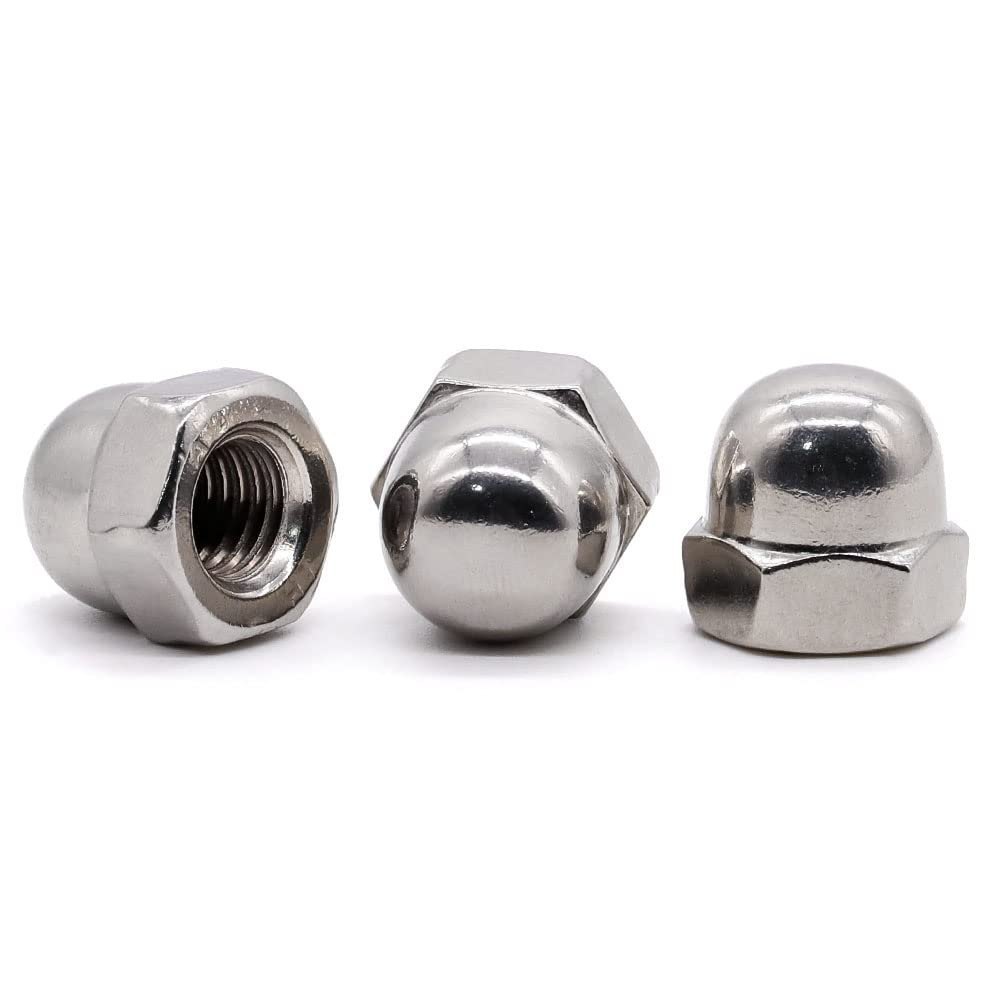
Premium A2 (304) and A4 (316) stainless steel dom nuts. Available in metric coarse threads and select UNC/BSW on request. Mill Test Certificates (MTC), strict dimensional tolerances, and fast dispatch from ready stock.
DIN 1587
Stainless Steel Dom Nuts
TRSUTED SS DOM NUT FOR DEMANDING APPLICATION
Key Specifications
Standards
DIN 1587
Grades (Material)
A2 (304), A4 (316)
Strength Classes
-
Threads
Metric coarse (default). Fine/UNC/BSW available on request
Sizes
M 6 to M 20
Lengths
-
Head
-
Marking
Grade/class & manufacturer ID as applicable
Certificates
MTC 3.1 / chemical composition & mechanicals available
Compliance
RoHS/REACH; generally non-magnetic in solution-annealed state (slight magnetism possible after cold-work)
Choosing the Right Stainless Steel Dom Nuts
Function: when to use a dom nut
Use a dom (dome / acorn) nut when you need:
Safety – to cover sharp bolt/stud ends and avoid injuries.
Aesthetics – clean, finished look on visible assemblies (railings, furniture, covers, panels).
Thread protection – protect exposed threads from dirt, damage, and corrosion.
Dom nuts are not usually chosen as primary high-strength structural nuts unless the design specifically allows it (limited thread engagement).
Environment & corrosion
Indoors / general outdoor → A2 (304) Dom nut
Marine / coastal / chloride / chemical exposure → A4 (316) Dom nut
Use A2 for most machinery, furniture, decorative metalwork, general outdoor use.
Use A4 for marine hardware, outdoor stainless structures near sea, swimming pools, chemical plants, etc.
Choosing the right size & thread engagement
Key points for dom nuts:
Ensure correct thread size & pitch (e.g., M8×1.25 bolt with M8×1.25 dom nut).
Check bolt projection:
The bolt must not bottom out inside the dome.
There should be enough thread engagement between bolt and nut to safely take the load.
Rule of thumb:
Aim for at least full nut height worth of thread engagement (or as per design/standard).
Avoid using dom nuts alone in highly loaded structural joints where full-height hex nuts are specified.
Application type
Light to medium duty + visible joints →
→ Dom nut alone may be sufficient (guard covers, railings, furniture, signage, enclosures).
Higher load or safety-critical joints →
→ Use standard hex nut or lock nut for load, and dom nut only as a cover (sometimes double-nutting: hex nut for clamping, dom nut as cap).
Thread form & standards
Default → Metric coarse thread (better for general use and galling resistance).
Use metric fine / UNC / UNF only when:
Matching existing bolts, studs, or tapped holes
Design specifically calls for fine pitch
Always match diameter + pitch + thread standard between bolt and dom nut.
Aesthetics & safety considerations
Dom nuts are ideal where people can touch or brush past the connection (handrails, walkways, equipment guards).
They give a smooth, rounded finish, hiding exposed threads.
Also help reduce snagging on clothing or materials.
Reusability
Standard dom nuts (without nylon insert) can be reused if:
Threads are not damaged
The nut has not been overloaded, deformed, or severely corroded.
As with any nut:
For critical or safety-related joints, consider using new dom nuts when reassembling.
Mechanical Properties (Guide)
Dom nuts follow the same property classes as equivalent stainless hex nuts (e.g., A2-70, A4-70).
However, due to the dome shape and sometimes reduced thread height, they are generally treated as light to medium-duty fastening solutions unless specified otherwise.
A2-70 Dom nuts
Material: A2 (304) stainless steel
Property class: 70
Intended to be used with A2-70 bolts (700 MPa tensile class).
Suitable for:
General indoor and outdoor use
Decorative / safety covers on machinery, railings, furniture, panels.
A4-70 Dom nuts
Material: A4 (316) stainless steel
Property class: 70
Intended to be used with A4-70 bolts (700 MPa tensile class).
Suitable for:
Marine and coastal environments
Chemical / chloride-rich environments
Outdoor stainless structures where corrosion resistance is critical.
Note: In high-load structural joints, a full-height hex nut (ISO 4032 / DIN 934) is normally selected as the main load-bearing nut. A dom nut may be used in addition, primarily for protection and appearance.
Simple selection guide
Indoor / architectural / general machinery, light–medium duty →
→ A2-70 Dom nut with matching A2-70 bolt.
Marine, coastal, chemical, pool-side, outdoor stainless structures →
→ A4-70 Dom nut with A4-70 bolt.
High-load or structural joints →
→ Use standard hex nut for strength, and dom nut only as a protective or decorative cover (if needed).
6000+ Products
Trusted by 2000+ Clients
40+ Years of Experience
Exporting to 12+ Countries
What We Do
From a vast manufacturing facility situated in GIDC Wadhwan, Gujarat to strategic
sales offices in Mumbai and Chennai, we design, produce, and deliver a wide array of stainless steel
fasteners, hex bolts, machine screws, socket screws, washers, nuts, self‑tapping screws, threaded rods,
anchor fasteners, and specialty material products, engineered for demanding sectors like petrochemicals,
pharmaceuticals, automotive, and construction.
Our Legacy & Mission
Founded on a vision of precision and service, we have consistently expanded our
capabilities to meet evolving industrial needs. Our commitment to "We Deliver Quality" reflects in the
long-term relationships we build with clients across India and abroad.
Frequently Asked Questions
What is a dom nut and why is it used?
A dom nut (also called dome nut or acorn nut) is a hex nut with a closed, rounded top.
It is mainly used to:
Cover sharp bolt/stud ends for safety
Give a clean, finished look on visible joints
Protect threads from damage, dirt, and corrosion
Where are dom nuts typically used?
Common applications include:
Railings, handrails, balustrades
Furniture, fixtures, signage, displays
Machine guards, covers, and panels
Any joint where the fastener is visible or accessible to people and you want safety + aesthetics.
Should I choose A2 or A4 stainless steel dom nuts?
A2 (304) → For indoor, general outdoor, and mildly corrosive environments (standard structural work, furniture, railings, general fabrication).
A4 (316) → For marine, coastal, poolside, chemical, or chloride-rich environments where corrosion resistance must be higher.
If the application is near the sea, in coastal cities, around swimming pools, or chemical plants, choose A4 dom nuts.
Are dom nuts as strong as standard hex nuts?
Dom nuts follow similar property classes (e.g., A2-70, A4-70), but:
Their thread height is sometimes more limited due to the dome shape.
They are usually used in light to medium-duty joints or as a protective cap.
For high-load or structural joints, a full-height hex nut is normally used as the main load-bearing nut. A dom nut may be added for protection and appearance if required.
How do I make sure a dom nut fits correctly?
Check two things:
Thread size & pitch – e.g., M8×1.25 bolt must use an M8×1.25 dom nut.
Bolt projection –
The bolt/stud must not bottom out inside the dome.
There should be enough thread engagement between the nut and bolt to carry the load.
If the stud is too long, trim it or use a standard hex nut + dom nut combination.


