


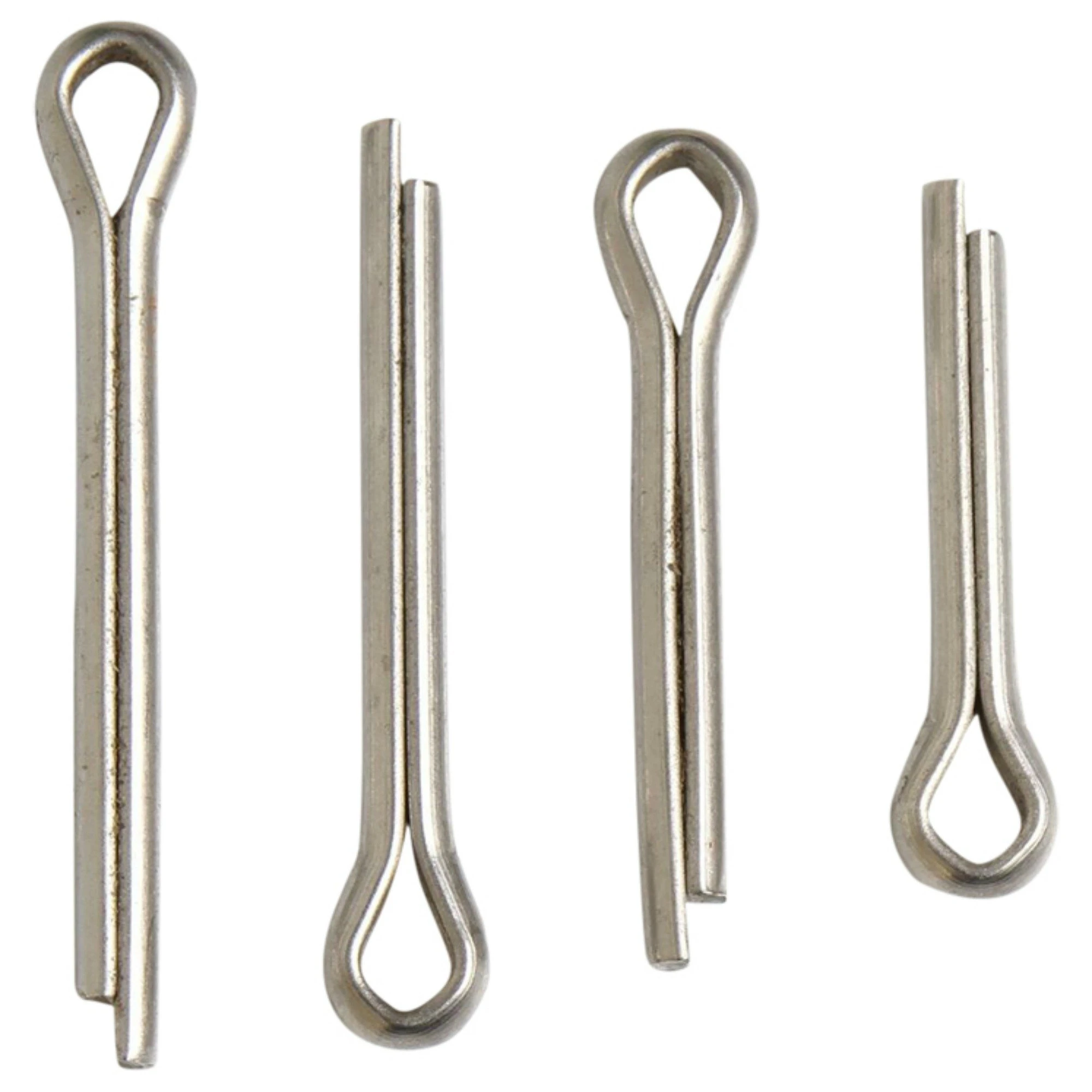
Premium A2 (304) and A4 (316) stainless steel Cotter pin. Available in metric coarse threads and select UNC/BSW on request. Mill Test Certificates (MTC), strict dimensional tolerances, and fast dispatch from ready stock.
DIN 94
Stainless Steel Cotter Pin
TRSUTED SS Cotter pin FOR DEMANDING APPLICATION
Key Specifications
Standards
-
Grades (Material)
A2 (304), A4 (316)
Strength Classes
-
Threads
Metric coarse (default). Fine/UNC/BSW available on request
Sizes
-
Lengths
-
Head
-
Marking
Grade/class & manufacturer ID as applicable
Certificates
MTC 3.1 / chemical composition & mechanicals available
Compliance
RoHS/REACH; generally non-magnetic in solution-annealed state (slight magnetism possible after cold-work)
Choosing the Right Stainless Steel Cotter Pin
Choosing the Right Cotter Pin (Split Pin)
1) What is a cotter pin & when to use it?
A cotter pin (also called a split pin) is a U-shaped, folded wire pin with two tines (legs) that are bent apart after installation to prevent a nut, pin, or component from coming loose.
Use a cotter pin when you need:
A cheap, simple mechanical lock to back up a nut or clevis pin
A fail-safe to stop parts falling off even if the nut loosens
A visual, easy-to-inspect locking method
Typical applications:
Securing castellated nuts on shafts, axles, steering components
Locking clevis pins, hinge pins, linkages, and shackles
Agricultural machinery, automotive, cranes, lifting tackle, general plant maintenance
Cotter pins are locking/retaining devices, not primary load-carrying fasteners.
2) Type & form – classic split pin vs others
On your site, “cotter pin” will usually mean the classic split pin:
Straight body with a rounded head/eye at one end
Two parallel legs, factory folded together
After insertion, legs are spread apart to lock the assembly
Related but different products (usually separate items):
R-clips / R-pins / Hitch pins – quick-release spring clips
Hairpin cotter pins – spring-wire style, no leg bending
For this page, focus on standard split cotter pins for use with slotted nuts, clevis pins, and drilled bolts.
3) Diameter – matching the drilled hole
Cotter pins are specified by wire diameter × length (e.g. 3.2 × 40 mm).
Diameter selection:
Choose a cotter pin diameter that fits snugly but not tightly in the hole.
The pin should slide through easily before bending the legs, without too much clearance.
Guideline:
Hole Ø ≈ slightly larger than pin diameter
Example: Hole ~3.3–3.5 mm → use 3.2 mm cotter pin
Do not force an oversize pin (legs will deform before they seat)
Undersize pins can rattle, wear the hole, and offer weaker locking.
Always match pin size to hole diameter in bolt/clevis or as per drawing.
Mechanical Properties (Guide)
Mechanical Properties (Guide) – Cotter Pins
Cotter pins are safety / locking devices.
They are not designed to carry high primary loads; instead, they prevent nuts or pins from loosening or coming out.
1) General behaviour
Key functional requirements:
Ductility:
Must bend without cracking.
Must withstand minor vibration and handling without snapping.
Toughness:
Should not shear off easily under moderate impact or accidental pulls.
Corrosion resistance:
Must last the service life of the joint in that environment so that the lock remains effective.
Cotter pins do not use bolt property classes like 8.8; they are typically made from low or medium-strength ductile wire (mild steel, stainless, brass) processed for good formability.
6000+ Products
Trusted by 2000+ Clients
40+ Years of Experience
Exporting to 12+ Countries
What We Do
From a vast manufacturing facility situated in GIDC Wadhwan, Gujarat to strategic
sales offices in Mumbai and Chennai, we design, produce, and deliver a wide array of stainless steel
fasteners, hex bolts, machine screws, socket screws, washers, nuts, self‑tapping screws, threaded rods,
anchor fasteners, and specialty material products, engineered for demanding sectors like petrochemicals,
pharmaceuticals, automotive, and construction.
Our Legacy & Mission
Founded on a vision of precision and service, we have consistently expanded our
capabilities to meet evolving industrial needs. Our commitment to "We Deliver Quality" reflects in the
long-term relationships we build with clients across India and abroad.
Frequently Asked Questions
What is a cotter pin and what does it do?
A cotter pin (split pin) is a U-shaped, folded wire pin that is inserted through a cross hole in a bolt, shaft, or clevis pin.
After insertion, the two legs are bent apart, so the pin cannot slip out and the nut or clevis pin cannot come loose.
Is a cotter pin a load-carrying fastener?
No.
The bolt, shaft or clevis pin carries the main load.
The cotter pin is a locking/retaining device whose job is simply to:
Stop the nut from backing off, or
Stop the clevis pin from sliding out.
Where are cotter pins commonly used?
You’ll find cotter pins in:
Castellated/slotted nuts on shafts and axles
Clevis and hinge pins in linkages and levers
Agricultural machinery, trailers, cranes, construction equipment
General plant maintenance and mechanical assemblies
Anywhere you need a simple, mechanical safety lock to prevent accidental loosening.
How long should a cotter pin be?
After insertion, you need enough length beyond the nut/clevis to bend both legs:
Typically you want 1.5–2 × pin diameter worth of leg length sticking out to bend around/along the nut or shaft.
Too short → legs won’t bend properly, lock is weak.
Too long → legs must be trimmed or very neatly bent to avoid snagging.
How do I remove a cotter pin?
Use pliers to straighten the bent legs as much as possible.
Pull the pin out from the head side (you may need to twist it slightly).
If it’s heavily corroded or deformed, you might need to cut the legs and push the remaining piece through.
Usually cotter pins are considered single-use and replaced rather than reused.


