


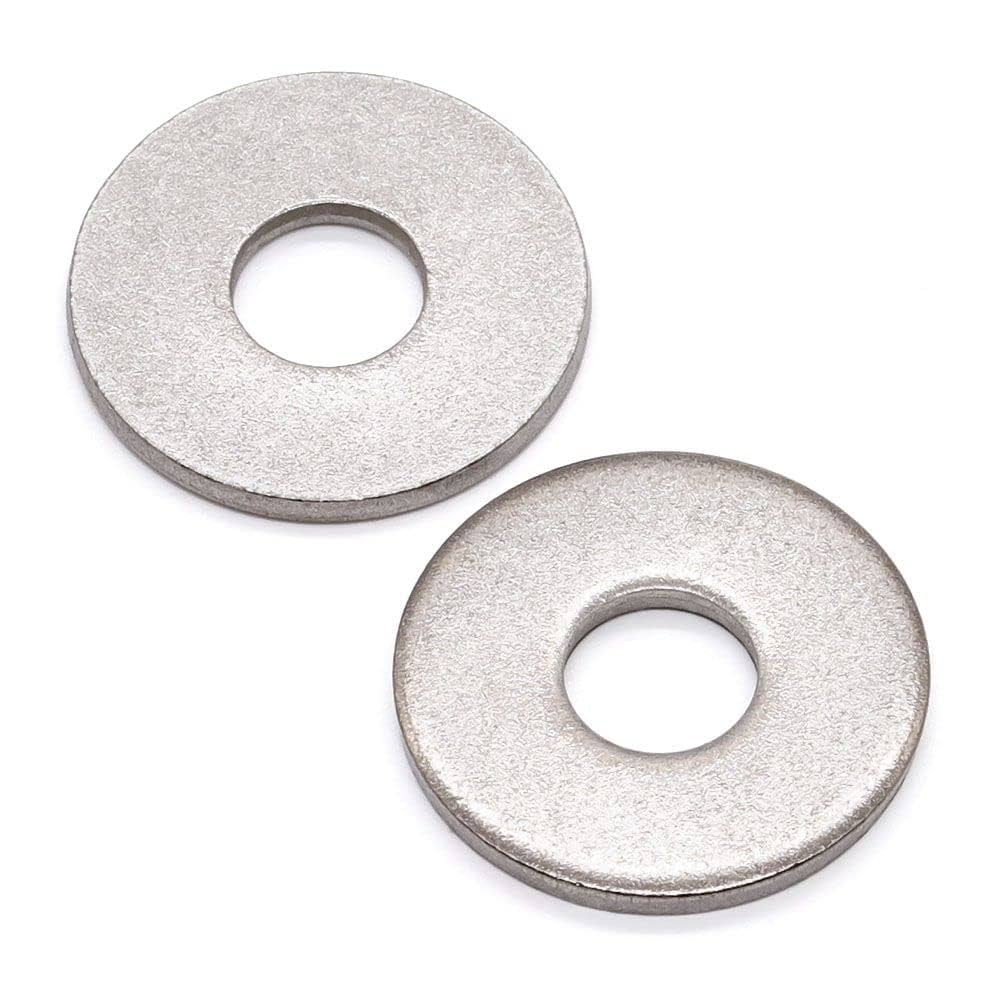
Premium A2 (304) and A4 (316) stainless steel Big OD Washer. Available in metric coarse threads and select UNC/BSW on request. Mill Test Certificates (MTC), strict dimensional tolerances, and fast dispatch from ready stock
DIN 9021
Stainless Steel Big OD Washer
TRSUTED SS Big OD Washer FOR DEMANDING APPLICATION
Key Specifications
Standards
-
Grades (Material)
A2 (304), A4 (316)
Strength Classes
-
Threads
Metric coarse (default). Fine/UNC/BSW available on request
Sizes
M1.6 to M 70, 3/16" to 2.1/2" (others on request)
Lengths
-
Head
-
Marking
Grade/class & manufacturer ID as applicable
Certificates
MTC 3.1 / chemical composition & mechanicals available
Compliance
RoHS/REACH; generally non-magnetic in solution-annealed state (slight magnetism possible after cold-work)
Choosing the Right Stainless Steel Big OD Washer
Choosing the Right Big OD Washer
(Large Outside Diameter / Penny / Fender / Repair Washer)
1) What is a Big OD washer & when should you use it?
A Big OD washer is a plain washer with a much larger outside diameter than standard.
It is designed to:
Spread load over a much larger area
Reinforce thin or soft materials (sheet metal, plastics, timber, composites)
Cover oversized, slotted or slightly damaged holes
Prevent pull-through of the nut/bolt head
Use a Big OD washer when:
You are bolting through thin sheet, soft material or insulation panels
The hole is oversized or slotted, and you need more bearing area
You want to repair/cover a damaged hole without reworking the part
You need to reduce local crushing and deformation under the bolt head or nut
Typical applications:
Sheet-metal ducting, cladding, roofing & facades
Electrical/AC brackets, light supports, cable trays
Timber fixing & plywood panels
Automotive & bodywork (fender washers)
Repair/maintenance jobs where a normal washer is too small
2) Big OD vs standard washer – what’s the difference?
Standard plain washer (normal OD):
Used for general bolting with normal plate thickness.
Spreads load but within a limited area.
Big OD washer (large OD / penny / fender washer):
Has a much larger outside diameter for the same bolt size.
Spreads load over a wider area, which:
Reduces bearing pressure,
Protects thin or soft substrates,
Minimises pull-through and local deformation.
Rule of thumb:
Normal plates & sections → standard washer.
Thin sheet / soft material / slotted or oversized holes → Big OD washer.
Mechanical Properties (Guide)
Mechanical Properties (Guide) – Big OD Washer
Big OD washers are primarily about bearing area and stiffness, not about high tensile strength like bolts. The key properties are material grade, hardness, thickness, and OD relative to the load.
1) Mild steel Big OD washers (standard)
Typical characteristics:
Material: low carbon steel.
Usually non-hardened or lightly cold-worked.
Suitable for light-to-medium duty load spreading applications.
Functional behaviour:
Good for distributing clamping force on:
Thin steel sheet,
Aluminium panels,
Plastics,
Timber & plywood.
Under higher bolt preload, thin MS Big OD washers can:
Dish/bend slightly,
Indent into very soft material beneath.
For highly loaded structural joints, a standard thin Big OD washer may not be enough – consider thicker or hardened options.
2) Hardened / structural Big OD washers
Some Big OD washers are manufactured from higher strength or hardened steel, especially for heavier structural or anchoring applications.
Typical characteristics:
Made from medium carbon or alloy steel, properly heat-treated.
Higher hardness and better resistance to bearing deformation.
Often thicker than standard fender/penny washers.
Functional behaviour:
Can carry higher compressive bearing loads without significant permanent deformation.
Better suited for:
Anchor bolt plates,
Heavy equipment fixings,
High-tension joints where a large bearing area is required.
When used with high-tensile bolts, hardened Big OD washers help prevent embedment and loss of preload.
3) Stainless steel Big OD washers (A2 / A4)
Typical characteristics:
Material: A2 (304) or A4 (316) stainless steel.
Provide medium to high bearing strength plus excellent corrosion resistance.
Functional behaviour:
Ideal for:
Stainless façades & cladding,
Outdoor brackets and signages,
Food & pharma plant structures,
Marine & coastal fixtures.
On very soft substrate (wood, plastic), they still may indent if very high preload is applied; in that case, a thicker Big OD washer or small backing plate may be preferred.
6000+ Products
Trusted by 2000+ Clients
40+ Years of Experience
Exporting to 12+ Countries
What We Do
From a vast manufacturing facility situated in GIDC Wadhwan, Gujarat to strategic
sales offices in Mumbai and Chennai, we design, produce, and deliver a wide array of stainless steel
fasteners, hex bolts, machine screws, socket screws, washers, nuts, self‑tapping screws, threaded rods,
anchor fasteners, and specialty material products, engineered for demanding sectors like petrochemicals,
pharmaceuticals, automotive, and construction.
Our Legacy & Mission
Founded on a vision of precision and service, we have consistently expanded our
capabilities to meet evolving industrial needs. Our commitment to "We Deliver Quality" reflects in the
long-term relationships we build with clients across India and abroad.
Frequently Asked Questions
What is a Big OD washer?
A Big OD washer is a plain washer with a much larger outside diameter than standard.
It is designed to:
Spread load over a wider area
Protect thin or soft materials
Help prevent bolt/nut pull-through
Cover oversized, slotted or slightly damaged holes
When should I use a Big OD washer instead of a normal washer?
Use a Big OD washer when:
You are bolting through thin sheet metal, aluminium, plastic, plywood, MDF, or insulation panels
The hole is oversized or slotted, and you want more bearing area
The surface is weak or flexible, and you want to reduce local deformation
You are doing repair work and need to cover a damaged or enlarged hole
For normal plates and sections with standard holes, a standard washer is usually enough.
For thin/soft or problematic holes, a Big OD washer is the better choice.
What are Big OD washers commonly used for?
Typical applications:
Ducting, cladding, roofing and façade panels
AC brackets, cable trays, small supports
Automotive & bodywork (often called fender washers)
Timber & plywood fixings
Maintenance/repair jobs on thin or damaged sheet
Anywhere a normal washer is too small or might cut into the material, a Big OD washer helps.
How do I choose the correct size Big OD washer?
Look at three dimensions:
Inner diameter (ID)
Must fit the bolt size (M6, M8, M10, etc.) with reasonable clearance.
Don’t pick an ID that is too loose.
Outer diameter (OD)
Larger OD = more load spreading.
Choose OD based on sheet thickness, material softness and hole size.
Thickness
Thin washers for light-duty, cosmetic, low-load applications.
Thicker washers where loads are higher or the substrate is very soft, to avoid bending.
If a customer says “M8 bolt in thin sheet – hole is a bit big”, you recommend a Big OD washer for M8 with OD large enough to cover and spread load.
Are Big OD washers structural? Can they carry heavy loads?
Standard Big OD washers are intended mainly for load spreading on light-to-medium duty joints.
Thin ones can dish or bend under very high preload or heavy loads.
For heavier structural loads or anchor bolts, use:
Thicker/hardened Big OD washers, or
Plate/square washers or backing plates designed for structural bearing.


