


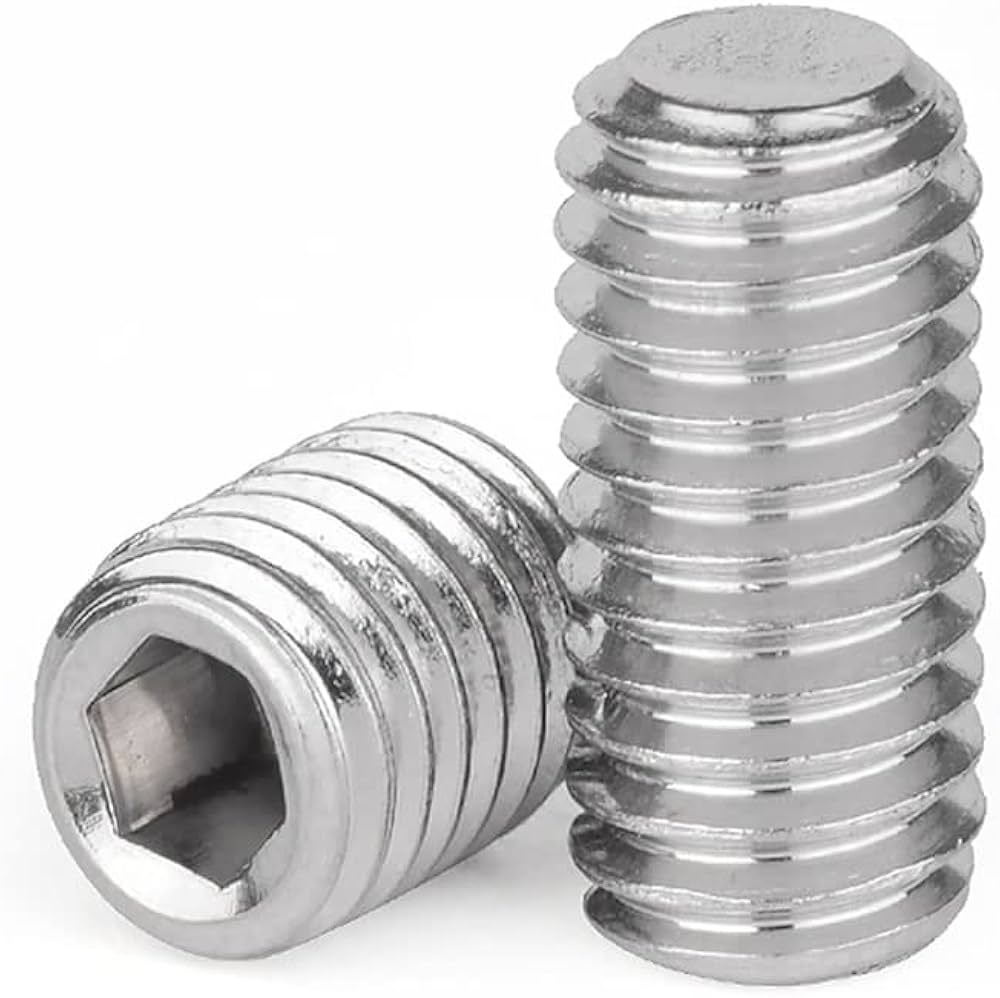
Premium A2 (304) and A4 (316) stainless steel Allen Grub- flat point. Available in metric coarse threads and select UNC/BSW on request. Mill Test Certificates (MTC), strict dimensional tolerances, and fast dispatch from ready stock.
DIN 913
Stainless Steel Allen Grub – Flat Point
TRSUTED SS Allen Grub- flat point FOR DEMANDING APPLICATION
Key Specifications
Standards
-
Grades (Material)
A2 (304), A4 (316)
Strength Classes
-
Threads
Metric coarse (default). Fine/UNC/BSW available on request
Sizes
M1.6 to M 70, 3/16" to 2.1/2" (others on request)
Lengths
-
Head
-
Marking
Grade/class & manufacturer ID as applicable
Certificates
MTC 3.1 / chemical composition & mechanicals available
Compliance
RoHS/REACH; generally non-magnetic in solution-annealed state (slight magnetism possible after cold-work)
Choosing the Right Stainless Steel Allen Grub – Flat Point
What is an Allen grub – flat point & when to use it?
An Allen grub screw (socket set screw) – flat point is a headless screw with an internal hex (Allen) drive and a flat end face (no cone, no cup).
Use a flat point grub screw when you want to:
Lock or position parts but with minimal marking or damage on the mating surface
Bear against a flat surface (e.g. flats on shafts, keys, pads, inserts)
Keep the fastener completely recessed inside a tapped hole (no head projection)
Typical applications:
Locking collars, knobs, levers against a shaft flat
Adjusting stops and end positions (limit screws, stop screws)
Clamping on softer surfaces where cones/cups would dig in too aggressively
Repeated adjustments where you don’t want deeper and deeper indentations each time
Flat point = gentlest contact of all grub screw styles.
2) Environment & corrosion
Indoor / dry / general machinery:
Use hardened alloy steel flat point grub screws, black / oiled finish.
Ideal for adjustment screws, collars, knobs, stops on mild steel components.
Outdoor / damp / mild chemical exposure / stainless assemblies:
Use A2 (304) stainless flat point grubs.
Good for stainless shafts, outdoor equipment, food equipment (non-marine).
Marine / chloride / strong chemical / wash-down:
Use A4 (316) stainless flat point grubs.
Best for marine shafts, coastal mechanisms, chemical and wash-down areas.
Rule of thumb:
Priority = strength & hardness in dry conditions → alloy steel
Priority = corrosion resistance in wet/chemically aggressive conditions → A2 / A4 stainless
3) Point style – why flat point vs cup / cone / dog?
Flat point (your product here):
End face is flat, making full-face contact with the mating surface.
Gives gentle, non-cutting pressure rather than penetration.
Ideal when you:
Want to avoid deep marks in a shaft
Are bearing on a machined flat, key, pad, or insert
Need frequent adjustment without progressively damaging the surface
Compared to:
Cup point:
Biting edge, more grip, more surface indentation.
Good general lock on plain shafts.
Cone point:
Sharp tip, maximum penetration and grip, maximum surface damage.
For high-torque, high-vibration, more permanent locking.
Dog point:
Cylindrical tip fits into holes/slots for positive index.
So, if the customer says: “It must hold, but I don’t want to destroy or crater the surface” → flat point is the right style.
Mechanical Properties (Guide)
Mechanical Properties (Guide) – Allen Grub Screw – Flat Point
Set screws (grub screws) are typically made either from hardened alloy steel or from stainless steel. Flat point versions share the same body properties as cup/cone, but with a different tip geometry.
1) Alloy steel flat point grub screws (hardened)
Typical characteristics:
Manufactured from medium or alloy steel, heat treated and tempered.
Often supplied to hardness around 45H (per set-screw standards), meaning:
Surface hardness in the mid-40s to low-50s HRC range
High tensile and shear strength for the threaded section
Functional behaviour:
Very good resistance to thread stripping and bending.
Flat tip is less likely to cut or gouge the surface, but still gives a solid, non-deforming contact area.
Ideal for industrial machinery where high strength and repeated adjustments are required.
2) Stainless steel flat point grub screws (A2 / A4)
Typical characteristics:
Material: A2 (304) or A4 (316) stainless steel.
Lower hardness than fully hardened alloy steel, but with:
Good tensile strength (A2-70 / A4-70 ≈ 700 MPa)
Excellent corrosion resistance for appropriate environments
Functional behaviour:
Best wherever rust and staining must be avoided (stainless shafts, food processing, marine, outdoor).
Flat tip distributes load more gently on polished or corrosion-sensitive surfaces.
3) Functional performance & limits
For a correctly sized and installed flat point grub screw:
Holding function is a mix of:
Normal force from tightening,
Frictional resistance at the flat contact,
Any geometric support (like shaft flats or keys).
Flat point is not intended to dig in like cone/cup points, so for purely friction-based grip on a round shaft, its holding power is limited.
Typical failure/slip scenarios:
Screw loosens under vibration if not tightened correctly or without thread-locker.
Friction slip between flat point and shaft if the contact surface is smooth, especially at high torque.
Thread stripping in the hub if engagement length is inadequate or material is too soft.
Good practice:
Use thread-locker for vibration-prone assemblies.
Use shaft flats, keys, or pads rather than relying solely on friction on a round shaft.
Don’t overtighten small grub screws; use appropriate torque and correct Allen key.
6000+ Products
Trusted by 2000+ Clients
40+ Years of Experience
Exporting to 12+ Countries
What We Do
From a vast manufacturing facility situated in GIDC Wadhwan, Gujarat to strategic
sales offices in Mumbai and Chennai, we design, produce, and deliver a wide array of stainless steel
fasteners, hex bolts, machine screws, socket screws, washers, nuts, self‑tapping screws, threaded rods,
anchor fasteners, and specialty material products, engineered for demanding sectors like petrochemicals,
pharmaceuticals, automotive, and construction.
Our Legacy & Mission
Founded on a vision of precision and service, we have consistently expanded our
capabilities to meet evolving industrial needs. Our commitment to "We Deliver Quality" reflects in the
long-term relationships we build with clients across India and abroad.
Frequently Asked Questions
What is an Allen grub screw – flat point?
An Allen grub screw (socket set screw) – flat point is a headless screw with an internal hex (Allen) drive and a flat end face.
It is designed to press against a surface (shaft flat, key, pad, stop) to hold or position parts without digging in like a cone or cup point.
Where are flat point grub screws commonly used?
Knobs, levers, and handles clamped onto a shaft flat
Shaft collars and bushes where frequent repositioning is required
Adjustable stops and limit screws in machinery and guides
Applications where you want locking or positioning but with minimal surface damage
They are popular in adjustable mechanisms and fine settings where the screw is often moved and reset.
Will a flat point grub screw damage the shaft or surface?
Far less than cup or cone points:
A flat point presses rather than penetrates.
On a machined flat, it leaves minimal marking under normal torque.
On a round shaft with no flat, it may still leave slight marks, but much lighter than cone/cup points.
For very sensitive surfaces, use flat point and, if needed, a pad or insert between screw and surface.
Is a flat point grub screw strong enough to hold on a round shaft?
It can hold on a round shaft, but:
Holding power is mainly friction-based, because it does not bite into the surface.
For high torque or heavy vibration, you may need:
A shaft flat where the screw presses, and/or
A key/keyway, or
A clamping hub instead of relying on friction alone.
So for light to medium duty or positioning → flat point alone can be fine.
For high torque → use flats/keys/clamps plus the flat point screw as a positioner/lock.
Do flat point grub screws need a shaft flat to work properly?
They work best on a shaft flat:
The flat prevents the screw from “walking” around the shaft curvature.
Load is spread over a flat-to-flat contact → better holding and less marking.
They can be used on plain round shafts, but for better reliability and less slip, a flat or keyway is recommended.


