


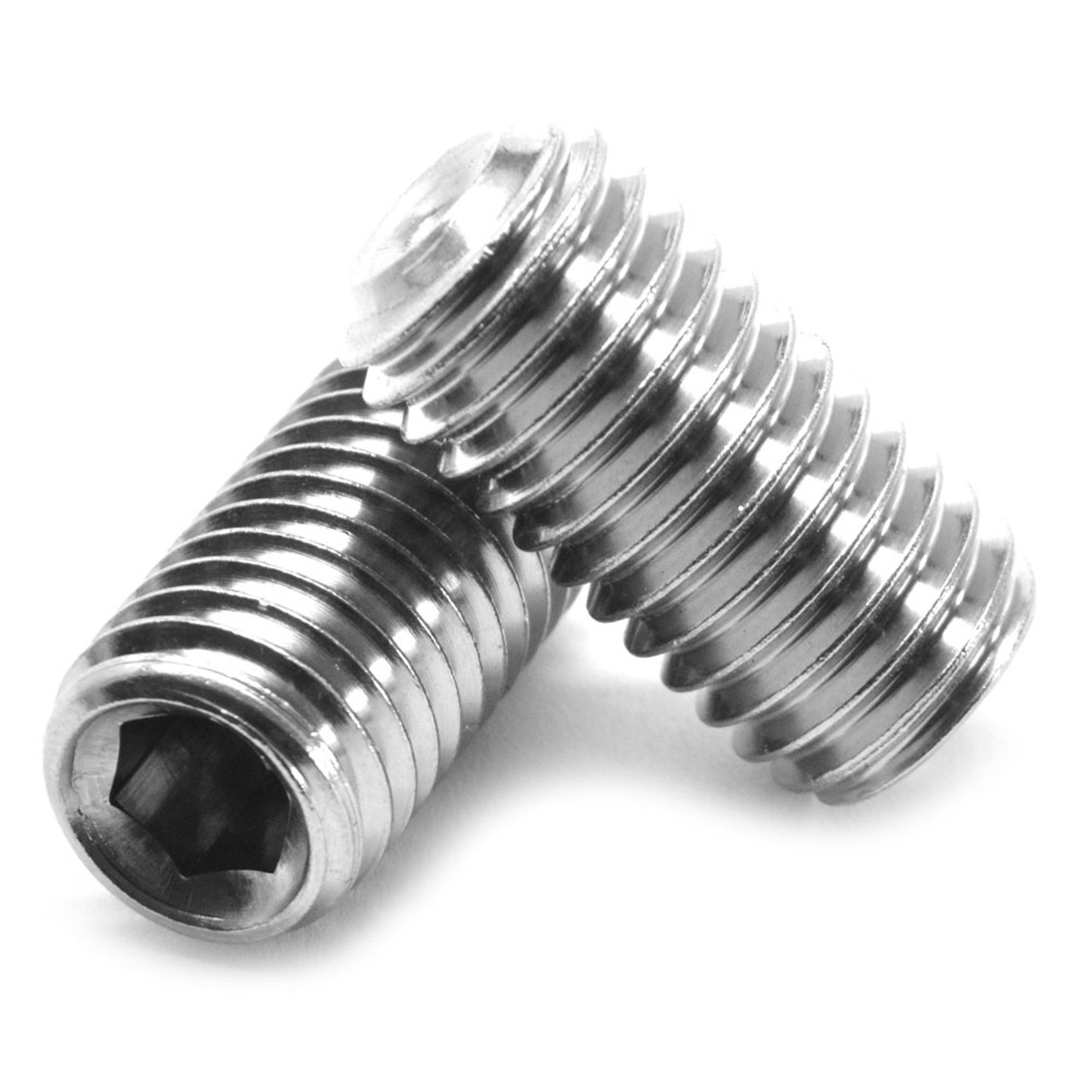
Premium A2 (304) and A4 (316) stainless steel Allen Grub- cup point. Available in metric coarse threads and select UNC/BSW on request. Mill Test Certificates (MTC), strict dimensional tolerances, and fast dispatch from ready stock.
DIN 916
Stainless Steel Allen Grub – Cup Point
TRSUTED SS Allen Grub- cup point FOR DEMANDING APPLICATION
Key Specifications
Standards
-
Grades (Material)
A2 (304), A4 (316)
Strength Classes
-
Threads
Metric coarse (default). Fine/UNC/BSW available on request
Sizes
M1.6 to M 70, 3/16" to 2.1/2" (others on request)
Lengths
-
Head
-
Marking
Grade/class & manufacturer ID as applicable
Certificates
MTC 3.1 / chemical composition & mechanicals available
Compliance
RoHS/REACH; generally non-magnetic in solution-annealed state (slight magnetism possible after cold-work)
Choosing the Right Stainless Steel Allen Grub – Cup Point
Choosing the Right Allen Grub – Cup Point (Socket Set Screw)
1) What is an Allen grub – cup point & when to use it?
An Allen grub screw (socket set screw) – cup point is a headless screw with an internal hex drive and a hollow, concave tip (cup).
Use a cup point grub screw when you want to:
Lock one part onto another shaft (e.g., hub on shaft, collar on shaft)
Prevent rotation or sliding of components on a shaft/key
Have the screw sit fully below or flush with the surface (no projecting head)
Typical applications:
Couplings, collars, gears, pulleys on shafts
Lever arms, knobs, handles fixed to shafts
Machine tool fixtures and jigs
Locking adjustments on mechanical linkages
Cup point is the most common general-purpose point for set screws because:
The cup bites into the shaft slightly, giving good holding power
Contact is more localized than flat point, but less aggressive than cone or dog point
2) Environment & corrosion
Indoor / dry / machinery:
Use alloy steel (hardened) grub screws – cup point, usually black or lightly oiled.
Ideal for machine tools, automations, fixtures, couplings, collars in non-corrosive areas.
Outdoor / damp / mild chemical exposure / stainless shafts:
Use A2 (304) stainless grub screws – cup point.
Suitable for stainless shafts, outdoor mechanisms, light food plant applications.
Marine / chloride / aggressive wash-down:
Use A4 (316) stainless grub screws – cup point.
For marine shafts, coastal equipment, chemical/fume areas, food & pharma wash-down where corrosion is critical.
Simple rule:
High strength, dry indoor → alloy steel cup point
Corrosion resistance needed → A2 or A4 stainless cup point
3) Point style – why cup point (vs flat, cone, dog point)?
Cup point (your product):
End of the screw is concave, forming a cup.
Edge of the cup bites into the shaft surface, giving good resistance to rotation.
Best for general locking applications on shafts and collars.
Compared to:
Flat point:
End is flat → less damage to surface but lower holding power.
Used where frequent adjustment or minimal marking is required.
Cone point:
Sharp tip digs in deeply → maximum holding, but more shaft damage.
Used for permanent or high-vibration locking.
Dog point:
Cylindrical tip that fits into a hole or groove → positive drive location.
Used for indexing or precise location.
If a customer doesn’t specify, cup point is the default “locking on shaft” choice.
4) Length & thread engagement
Grub screws are specified as thread size × overall length (e.g. M6 × 10, M10 × 16).
When choosing length:
Ensure there is enough thread engagement in the tapped hole:
In steel: typically at least 1× screw diameter engagement as a practical rule.
In softer materials (aluminium, brass) → 1.5× diameter or more is safer.
Headless design means:
Once installed, the top of the grub screw can sit flush or slightly below the surface, so it doesn’t interfere with other parts.
Avoid:
Too short → limited engagement, risk of thread stripping.
Too long → screw may protrude out the other side or foul on rotating/adjacent parts.
Mechanical Properties (Guide)
Mechanical Properties (Guide) – Allen Grub Screw – Cup Point
Set screws (grub screws) are typically made from hardened steel or stainless, with properties optimised for surface hardness and strength rather than just property class like 8.8/10.9.
1) Alloy steel grub screws (hardened)
Typical characteristics:
Made from alloy or medium-carbon steel, heat-treated and tempered.
Often supplied to a hardness class similar to 45H (as per set screw standards), which corresponds roughly to mid-40s to low-50s HRC.
This gives:
High surface hardness → cup edge can bite into shaft.
Good tensile and shear strength along the threaded body.
Behaviour:
Excellent for locking and resisting rotation.
More resistant to tip wear and deformation under repeated tightening/loosening.
Should not be used where corrosion is severe unless surface-treated or in controlled conditions.
2) Stainless steel grub screws (A2 / A4)
Typical characteristics:
Material: A2 (304) or A4 (316) stainless.
Lower surface hardness than fully hardened alloy set screws, but:
Good corrosion resistance
Adequate strength for many locking applications
Typical strength:
A2-70 / A4-70 → tensile strength approx. 700 MPa range.
Proof strength lower than high-grade alloy, but usually sufficient for most collars, knobs, and medium-duty couplings.
Behaviour:
Ideal where rust and staining must be avoided (stainless shafts, food and pharma, marine).
May deform slightly more at the cup edge in very high-torque situations compared to hardened carbon steel.
6000+ Products
Trusted by 2000+ Clients
40+ Years of Experience
Exporting to 12+ Countries
What We Do
From a vast manufacturing facility situated in GIDC Wadhwan, Gujarat to strategic
sales offices in Mumbai and Chennai, we design, produce, and deliver a wide array of stainless steel
fasteners, hex bolts, machine screws, socket screws, washers, nuts, self‑tapping screws, threaded rods,
anchor fasteners, and specialty material products, engineered for demanding sectors like petrochemicals,
pharmaceuticals, automotive, and construction.
Our Legacy & Mission
Founded on a vision of precision and service, we have consistently expanded our
capabilities to meet evolving industrial needs. Our commitment to "We Deliver Quality" reflects in the
long-term relationships we build with clients across India and abroad.
Frequently Asked Questions
What is an Allen grub screw – cup point?
An Allen grub screw (socket set screw) – cup point is a headless screw with an internal hex (Allen) drive and a hollow, concave tip.
It is used mainly to lock components on a shaft (like collars, hubs, couplings) so they do not rotate or slide.
Where are cup point grub screws commonly used?
Shaft collars and couplings
Gears, pulleys, sprockets mounted on shafts
Knobs, levers, and handles fixed to shafts
Machine tool fixtures and jigs
Linkages and small mechanisms where a hidden locking screw is required
Anywhere you need a compact, headless fastener that can bite into a shaft and resist rotation.
Why choose a cup point instead of flat or cone point?
Cup point
Edge of the cup bites into the shaft surface.
Good balance of holding power and moderate shaft marking.
Best general-purpose choice for locking on shafts.
Flat point
Less shaft marking, but lower holding power.
Used where the shaft is softer or frequently adjusted.
Cone point
Maximum penetration and holding, but more shaft damage.
Used for very high vibration or “semi-permanent” locking.
So if nothing is specified, cup point is the standard recommendation.
Will a cup point grub screw damage the shaft?
Yes, some marking/indentation is expected:
The cup edge bites into the shaft to prevent slip.
This leaves a small dimple or ring mark.
If shaft damage must be minimal:
Use flat point grub screws, or
Provide a small drilled dimple where the cup sits, or
Use keys, splines, or clamps instead of relying only on grub screws.
What thread type should I use – metric coarse or fine / UNC?
Metric coarse is standard and recommended for:
Better resistance to damage and cross-threading.
Easier assembly.
Metric fine / UNC / UNF are used only when you must match existing tapped holes or OEM design.
If there is no specific drawing requirement, choose metric coarse.


