


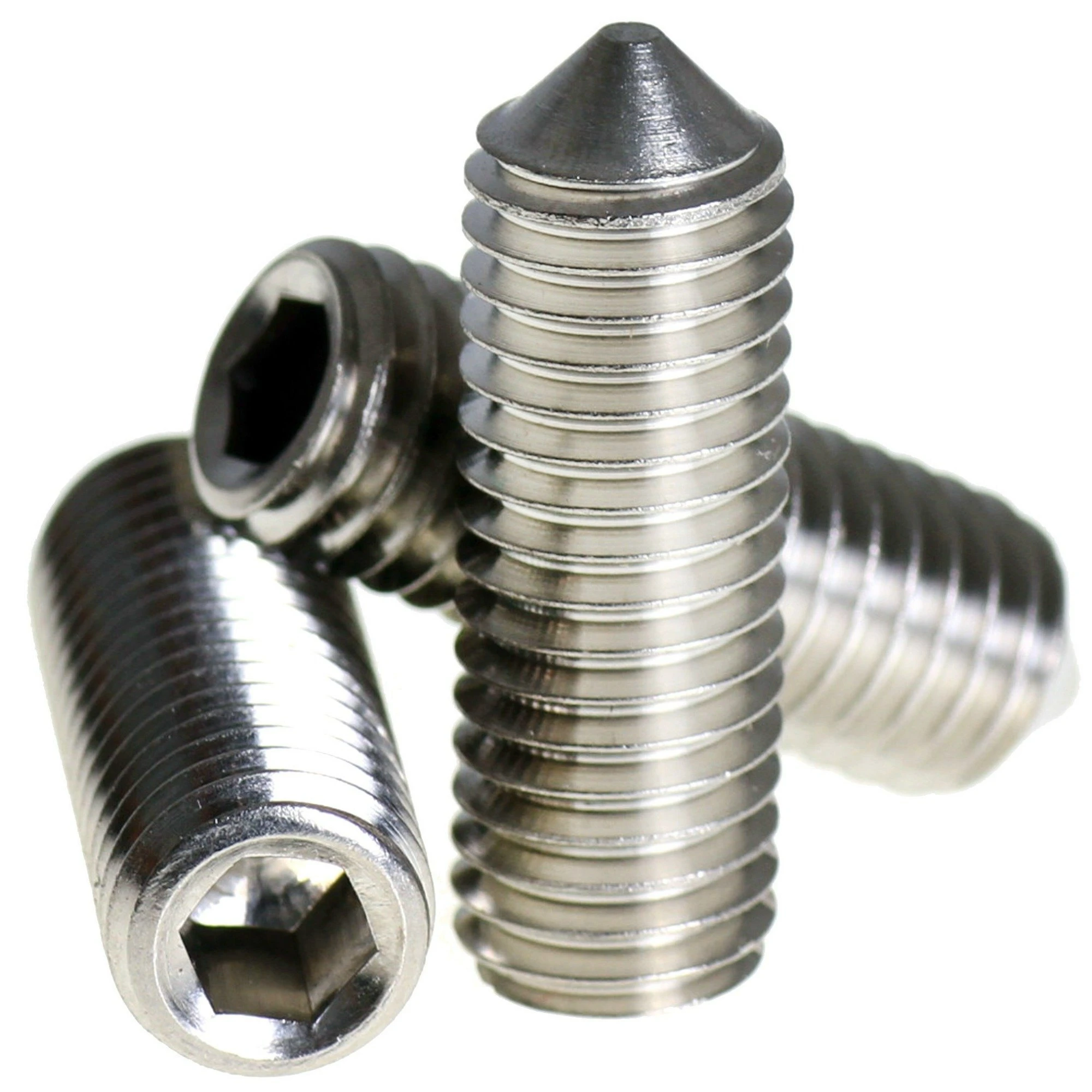
Premium A2 (304) and A4 (316) stainless steel Allen Grub- cone point. Available in metric coarse threads and select UNC/BSW on request. Mill Test Certificates (MTC), strict dimensional tolerances, and fast dispatch from ready stock.
DIN 914
Stainless Steel Allen Grub – Cone Point
TRSUTED SS Allen Grub- cone point FOR DEMANDING APPLICATION
Key Specifications
Standards
-
Grades (Material)
A2 (304), A4 (316)
Strength Classes
-
Threads
Metric coarse (default). Fine/UNC/BSW available on request
Sizes
M1.6 to M 70, 3/16" to 2.1/2" (others on request)
Lengths
-
Head
-
Marking
Grade/class & manufacturer ID as applicable
Certificates
MTC 3.1 / chemical composition & mechanicals available
Compliance
RoHS/REACH; generally non-magnetic in solution-annealed state (slight magnetism possible after cold-work)
Choosing the Right Stainless Steel Allen Grub – Cone Point
1) What is an Allen grub – cone point & when to use it?
An Allen grub screw (socket set screw) – cone point is a headless screw with an internal hex drive and a sharp, conical tip.
Use a cone point grub screw when you want:
Maximum holding power on a shaft or component
A point that penetrates or seats into a dimple / groove for positive locking
A hidden, flush fastener (no head projection) with very strong resistance to rotation/slip
Typical applications:
High-torque couplings, gears, pulleys and sprockets on shafts
Critical position locking where slippage cannot be tolerated
Indexing / positioning into pre-drilled dimples or grooves on a shaft
High-vibration equipment, where set screws must not creep
Cone point is the aggressive locking option – it digs in deeper than cup point, giving more grip but also more shaft marking.
2) Environment & corrosion
Indoor / dry / high-torque machinery:
Use hardened alloy steel cone point grub screws (usually black/oiled).
Perfect for industrial drives, couplings, machine tools, heavy mechanisms.
Outdoor / damp / stainless shafts:
Use A2 (304) stainless cone point grub screws.
Good for stainless transmissions, outdoor mechanisms, general food equipment.
Marine / chloride / chemical / wash-down:
Use A4 (316) stainless cone point grub screws.
For marine shafts, coastal drives, chemical plant linkages, food & pharma wash-down.
Simple rule:
Maximum mechanical grip, dry indoor → alloy steel cone point
Corrosion resistance priority → A2 / A4 stainless cone point
3) Point style – why cone point vs cup / flat / dog?
Cone point (your product here):
Sharp conical tip that bites deeply into the mating part.
Best when you want very high resistance to rotation and axial slip.
Ideal for permanent or semi-permanent locking where some shaft damage is acceptable.
Compared to other types:
Cup point:
Hollow cup with biting edge.
Good all-round holding, less penetration than cone.
Better when you want strong grip but moderate shaft marking.
Flat point:
Flat end, low marking, weakest grip.
For frequent adjustment or when shaft must stay relatively smooth.
Dog point / half-dog:
Cylindrical tip that fits into holes/slots.
Used for indexing and positive location, not just friction grip.
If someone says “I don’t want it to move at all”, and shaft damage is okay → cone point is usually the right answer.
Mechanical Properties (Guide)
Mechanical Properties (Guide) – Allen Grub Screw – Cone Point
Set screws are usually hardened steel or stainless, optimized for tip hardness and overall strength. Values below are conceptual for your website.
1) Alloy steel cone point grub screws (hardened)
Typical characteristics:
Made from medium / alloy steel, heat-treated and tempered.
Often equivalent to hardness class 45H:
Surface hardness roughly in the mid-40s to low-50s HRC.
This provides:
High tip hardness → cone point can cut into shaft and resist wear.
Good tensile and shear strength along the threaded portion.
Functional behaviour:
Excellent locking and resistance to slip, even under shock and vibration.
Highly suitable for steel shafts and hubs in dry, indoor machinery.
Should be protected or avoided in aggressive corrosive environments unless treated.
2) Stainless steel cone point grub screws (A2 / A4)
Typical characteristics:
Material: A2 (304) or A4 (316) stainless.
Less hard than fully hardened alloy steel, but with good strength and corrosion resistance.
Strength (approx):
A2-70 / A4-70:
Tensile strength ≈ 700 MPa range.
Still more than adequate for most locking duties on stainless or mild steel shafts.
Functional behaviour:
Best where rust, staining and contamination must be avoided (stainless shafts, food & pharma equipment, marine use).
Cone tip will still bite the substrate, though it may deform slightly more under extreme torque compared to hardened alloy.
3) Functional performance & failure modes
For a properly sized and installed cone point grub screw:
Holding power depends on:
Screw size & material
The bite depth of the cone into shaft/dimple
Shaft material hardness
Presence of thread-locker and correct tightening torque
Typical failure/slip modes:
Grub screw loosening due to vibration or inadequate torque
Shaft material yielding at the cone seat (especially if shaft is soft)
Cone tip deforming/wearing after repeated over-tightening
Thread stripping in the hub if engagement length is too short
Best practice:
Use appropriate torque (not excessive) and correct Allen key size.
For very critical joints, use:
Dimpled shafts,
Key + cone point,
And medium-strength thread-locker.
6000+ Products
Trusted by 2000+ Clients
40+ Years of Experience
Exporting to 12+ Countries
What We Do
From a vast manufacturing facility situated in GIDC Wadhwan, Gujarat to strategic
sales offices in Mumbai and Chennai, we design, produce, and deliver a wide array of stainless steel
fasteners, hex bolts, machine screws, socket screws, washers, nuts, self‑tapping screws, threaded rods,
anchor fasteners, and specialty material products, engineered for demanding sectors like petrochemicals,
pharmaceuticals, automotive, and construction.
Our Legacy & Mission
Founded on a vision of precision and service, we have consistently expanded our
capabilities to meet evolving industrial needs. Our commitment to "We Deliver Quality" reflects in the
long-term relationships we build with clients across India and abroad.
Frequently Asked Questions
What is an Allen grub screw – cone point?
An Allen grub screw (socket set screw) – cone point is a headless screw with an internal hex (Allen) drive and a sharp, conical tip.
It’s mainly used to lock components on a shaft or in a fixed position by digging into the mating surface.
Where are cone point grub screws commonly used?
Couplings, gears, pulleys and sprockets on shafts
Shaft collars and hubs where movement must be prevented
Indexing / positioning parts using small dimples in the shaft
High-vibration and high-torque drives where slip is not acceptable
Anywhere you need maximum holding power from a headless screw.
Should I use a cone point grub screw with a keyway, or is it enough by itself?
For low to moderate torque, a cone point grub screw alone can be sufficient.
For higher torque or safety-critical drives, best practice is:
Use a keyway + key to transmit torque, and
Use the cone point grub to lock the hub in place and prevent movement / fretting.
So, in heavy-duty power transmission, the combination key + cone point grub is recommended.
What material should I choose – alloy steel or stainless steel?
Alloy steel (hardened)
Highest tip hardness and strength.
Best for indoor, dry, industrial machinery with steel shafts and hubs.
A2 (304) stainless
Corrosion-resistant, good for outdoor / damp / general stainless applications.
A4 (316) stainless
Maximum corrosion resistance, for marine, coastal, and chemical environments.
Need maximum grip & strength → hardened alloy steel.
Need corrosion resistance → A2 or A4 stainless.
How can I stop cone point grub screws from loosening due to vibration?
Tighten using the correct size Allen key and reasonable torque (do not over-torque small sizes).
Use a medium-strength thread-locker on the threads if necessary.
For extreme vibration, you can:
Use two grub screws (jam screw method – one on top of the other), and/or
Combine keyway + cone point + thread-locker.


