


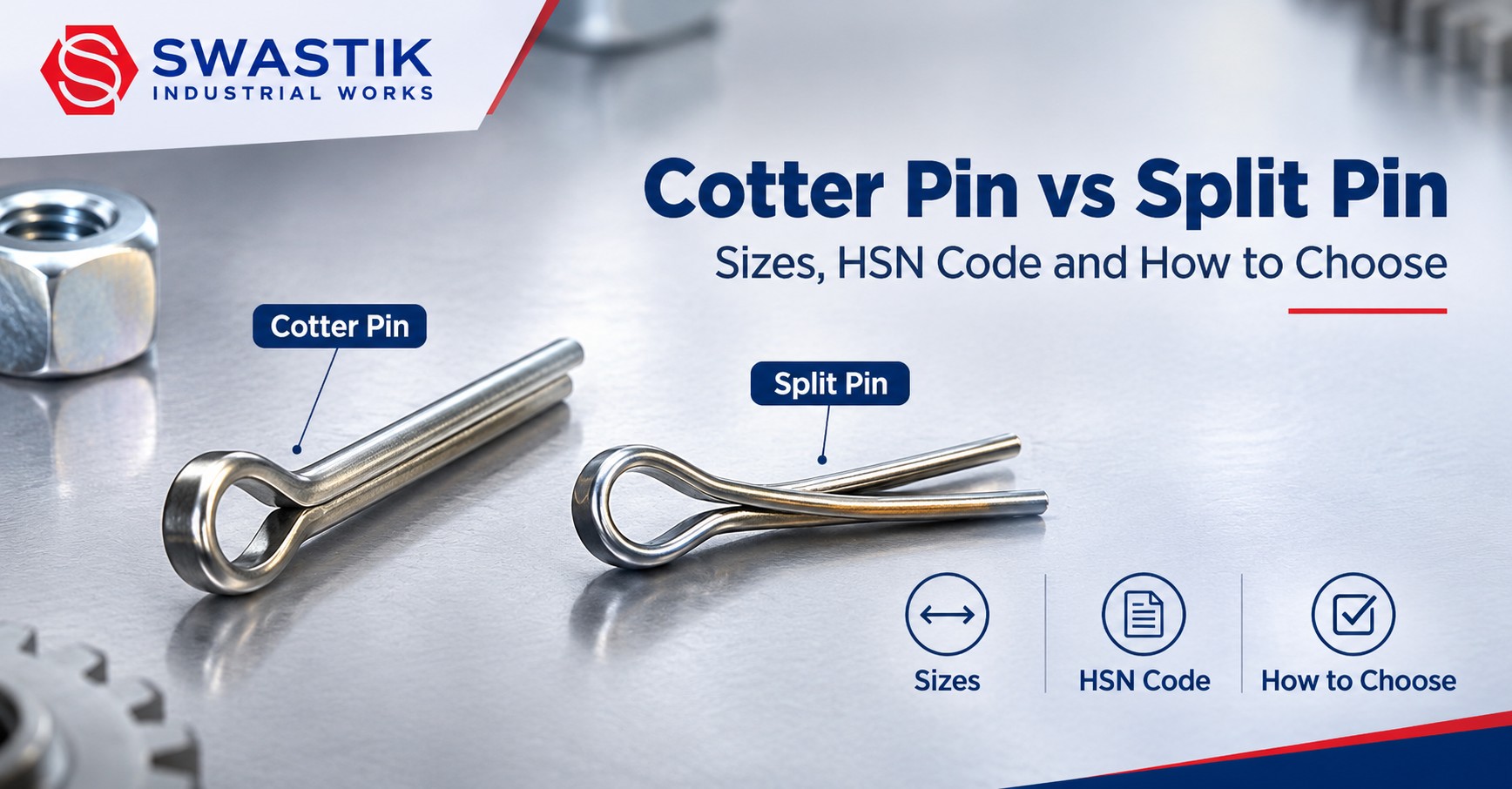
A cotter pin and a split pin are the same fastener. “Split pin” is the term used in Indian, ISO and DIN standards, and “cotter pin” is the American name. Both are a folded half-round wire with an eye and two legs, passed through a hole and bent open to lock a nut or pin. Choose by nominal size (the hole diameter), length, material (SS 304 or SS 316) and standard. In India they fall under HSN 7318 24 00.
This guide clears it up. It explains what a cotter pin is, how it differs from a split pin, how sizes work, which stainless steel grade to choose, the HSN code, and what to put in your RFQ.
1What Is a Cotter Pin (Split Pin) and How Does It Work?
A cotter pin is a simple locking device made from half-round wire folded in half. The two flat faces meet to form a round pin, and the fold forms a loop, called the eye, at one end. The pin goes through a cross-hole in a bolt, shaft or clevis pin, and the two legs are bent apart so it cannot slip out.
It does not clamp parts or carry load. Its job is to keep something else in place: a castle nut on a bolt, a clevis pin in a fork, a washer on an axle. That makes it a positive lock, because the nut cannot back off past the pin.
Locking castle nuts
Used on bolts and studs where a nut must not loosen under vibration.
Retaining clevis pins
Holds clevis and hinge pins in linkages, control rods and levers.
Securing axle assemblies
Keeps washers, wheels and collars from moving off axles and shafts.
2Cotter Pin vs Split Pin: Are They the Same?
Yes. For the fastener itself, the two names mean the same thing. Split pin is the term used in Indian, ISO and DIN standards. Cotter pin is the common American name and appears in ASME B18.8.1. Drawings and suppliers use both, sometimes in the same document.
| Term | What it is | Used for |
|---|---|---|
| Split pin | Folded half-round wire with an eye and two legs | Locking castle nuts and retaining clevis pins. The name used in IS and ISO standards. |
| Cotter pin | The same part, under its American name | Same use as a split pin |
| Cotter (wedge key) | Flat tapered steel wedge driven through a slot | Cotter joints and rod connections. A different part despite the similar name. |
| Spring pin / roll pin | Slotted tube pressed into a hole | Holding and locating parts. It does not lock a nut. |
Before you send an RFQ, check the drawing. If it shows a wedge-shaped key driven through a slot, you need a cotter. If it shows a folded wire with an eye, you need a split pin.
Which standard should you quote?
IS 549:2005 is the Indian standard for split pins and is identical to ISO 1234:1997. ISO 1234 replaces DIN 94. For American cotter pins, the reference is ASME B18.8.1. Use the standard written on your drawing.
3Cotter Pin Sizes: How to Read a Size Chart
Split pins are sized by nominal size, which equals the diameter of the hole the pin goes into. The wire is slightly thinner than the hole so the pin slides in. A 4 mm split pin therefore fits a 4 mm hole, even though the wire measures a little under 4 mm.
| Nominal size (hole Ø, mm) | Pin wire Ø max (mm) | Pin wire Ø min (mm) |
|---|---|---|
| 1 | 0.9 | 0.8 |
| 1.2 | 1.0 | 0.9 |
| 1.6 | 1.4 | 1.3 |
| 2 | 1.8 | 1.7 |
| 2.5 | 2.3 | 2.1 |
| 3.2 | 2.9 | 2.7 |
| 4 | 3.7 | 3.5 |
| 5 | 4.6 | 4.4 |
| 6.3 | 5.9 | 5.7 |
| 8 | 7.5 | 7.3 |
| 10 | 9.5 | 9.3 |
| 13 | 12.4 | 12.1 |
Typical values in millimetres as per ISO 1234 / IS 549:2005. Confirm against the standard and your drawing before ordering.
A split pin is ordered by nominal size, length and material. The standard’s own example reads Split pin ISO 1234 – 5 × 50 – St, meaning nominal size 5 mm, length 50 mm, steel. For stainless steel, add the grade (SS 304 or SS 316) to the order text.
Measure the hole, not the bolt
Use a vernier caliper or pin gauge on the cross-hole to find the nominal size.
Choose the length
The pin must pass fully through the part and leave both legs free to bend, without fouling nearby parts.
Size up for heavy duty
For railway use and clevis pins under alternating transverse forces, ISO 1234 recommends the next larger split pin size.
4Which Material Is Right: SS 304 or SS 316?
Stainless steel split pins are usually made in SS 304 (A2) or SS 316 (A4). Zinc-plated mild steel and brass pins are also common but suit different conditions. Whichever you pick, match it to the bolt, nut and shaft it locks, so dissimilar metals do not promote corrosion between them.
Which Grade Should You Specify?
Select your operating environment
What To Do
- ✓Choose SS 304 for general indoor and outdoor machinery
- ✓Match the pin grade to the bolt and nut grade
Watch Out For
- ✕Sustained salt or chloride exposure
- ✕Plain mild steel pins in wet areas, which rust and can stain stainless parts
What To Do
- ✓Choose SS 316 near the sea, in chemical plants and in wet service
- ✓Keep pin, nut and bolt in the same grade
Watch Out For
- ✕Assuming any stainless grade will survive chlorides
- ✕Strong acids or hot chemicals, which need an engineer’s check of the grade
What To Do
- ✓Specify SS 304 or SS 316 as per your hygiene requirement
- ✓Ask about finish, packing and handling
Watch Out For
- ✕Contamination during storage, which affects the clean surface
- ✕Bent legs that leave crevices where residue can collect
5Cotter Pin HSN Code in India
Cotter pins and split pins sit under HS heading 7318: screws, bolts, nuts, rivets, cotters, cotter-pins, washers and similar articles of iron or steel. In India’s tariff, the specific line is 7318 24 00, cotters and cotter-pins.
| Item | HSN code |
|---|---|
| Cotters and cotter-pins (split pins) | 7318 24 00 |
| Rivets | 7318 23 00 |
| Circlips | 7318 29 10 |
GST on 7318 24 00 is currently listed at 18% (9% CGST + 9% SGST, or 18% IGST on inter-state supply). Classification and rates can change by notification, so confirm with your accountant or the latest CBIC notification before invoicing. For exports, the first six digits (7318 24) are common to the international HS system, and each destination country adds its own digits.
6How to Fit a Cotter Pin Correctly
1
Check the fit
The pin should slide through the hole with light resistance and no free play. A loose pin wears and rattles.
2
Seat the nut
Tighten a castle nut to the specified torque, then align the nearest slot with the cross-hole as your assembly specification allows.
3
Insert the pin
Push it through with the eye seated against the nut or part, so the legs emerge on the far side.
4
Bend the legs
Spread the legs apart, or fold one over the bolt end and the other back along the nut. Bend firmly once.
5
Inspect
Check that both legs are fully bent, with no cracks and no sharp ends that can snag.
Common Cotter Pin Mistakes to Avoid
Reusing a pin
ISO 1234 tests each leg for one bend-back without fracture, so the pin is designed for a single bend. Fit a new pin every time the joint is opened.
Wrong length
Too short and the legs cannot bend fully. Too long and they foul adjacent parts or snag on people and cables.
Mismatched material
A mild steel pin in a stainless steel assembly rusts and defeats the purpose of choosing stainless. Match the grades.
Treating it as a load-bearing part
A cotter pin locks a nut or pin. It is not meant to carry shear load. Use a correctly sized bolt or clevis pin for that.
Buying Cotter Pins in Bulk: What to Include in Your RFQ
A complete specification saves a round of back-and-forth and reduces the risk of receiving the wrong part. Include these in every request:
- Material grade (SS 304 or SS 316)
- Nominal size (hole diameter)
- Length
- Standard (IS 549, ISO 1234 or ASME B18.8.1)
- Quantity and delivery schedule
- Finish and packing requirements
- Documents needed, such as material test certificates
- Application and environment
For help with grades in general, see our guide on how to choose the right stainless steel fastener for industrial applications.
Swastik Industrial Works
Need Stainless Steel Cotter Pins or Split Pins?
Share your size, grade, quantity and standard, and our team will respond with a quotation. We have been manufacturing stainless steel fasteners in India since 1981.
- Est. 1981
- 6000+ products
- 2000+ clients
Frequently Asked Questions
Is a cotter pin the same as a split pin?
What size cotter pin do I need?
What is the HSN code for a cotter pin?
Can a cotter pin be reused?
Which is better for cotter pins, SS 304 or SS 316?
Is a spring pin the same as a cotter pin?
Which standards apply to split pins in India?
Conclusion
A cotter pin and a split pin are the same locking fastener, so the real decisions are size, length, material and standard. Size it by the hole, specify SS 304 or SS 316 to suit the environment, and quote the standard and HSN code clearly.
A complete specification at the RFQ stage is the simplest way to get the right pin on the first order.