


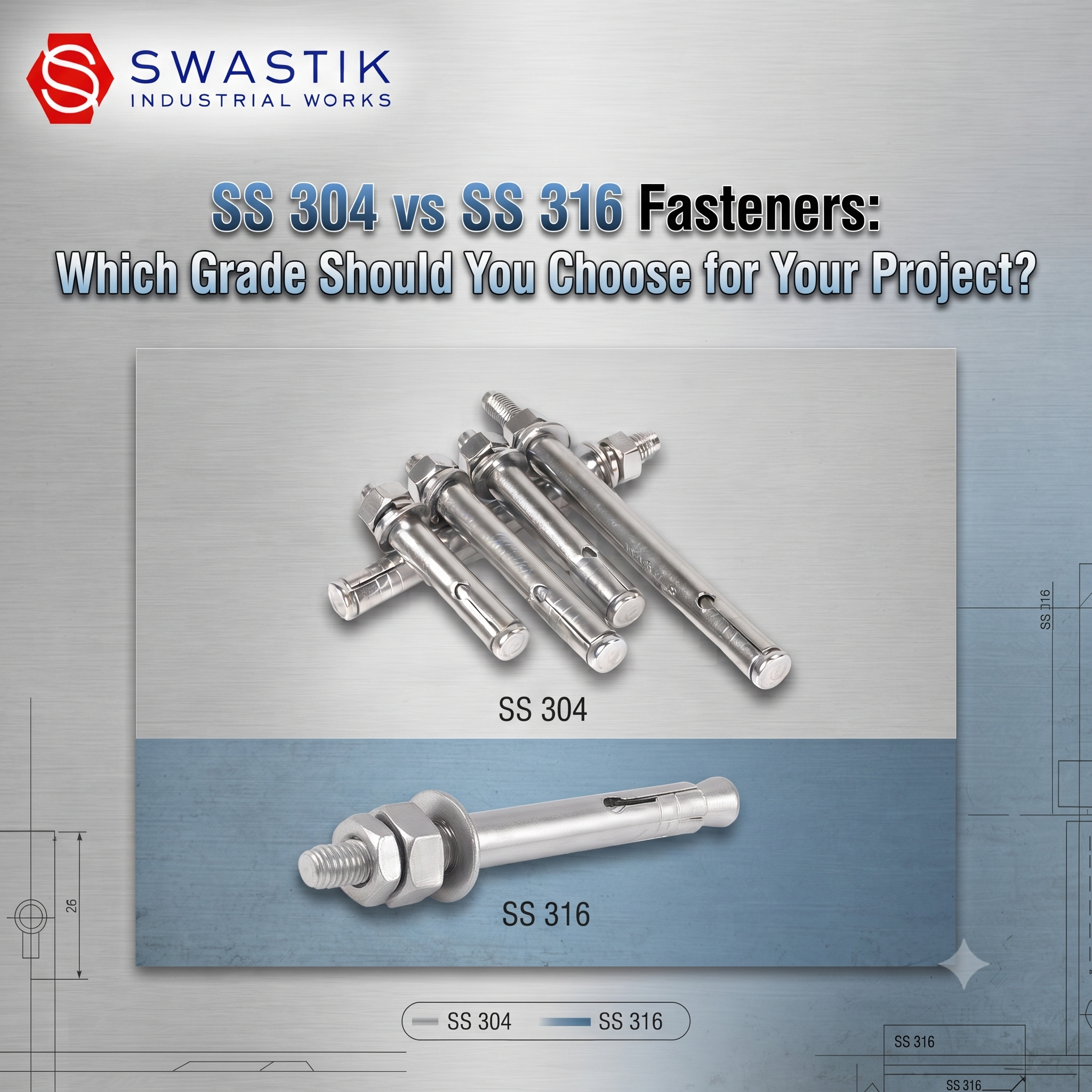
When you are buying stainless steel fasteners, one of the most common decisions is also one of the most important: should you choose SS 304 or SS 316? At first glance, both may look the same. They may both appear clean, bright and suitable for industrial work. But in actual use, the difference between these two grades can affect corrosion resistance, service life, maintenance cost and even the reliability of the joint.
The practical answer is this: SS 304 is suitable for many general-purpose applications, while SS 316 is usually preferred where the fastener will face coastal air, salt exposure, chemicals or more aggressive environments. You should not select either grade only because it is familiar or because it is available in stock. The right decision depends on where the fastener will be used, what it will be exposed to and how difficult it will be to replace later.
SS 304 is one of the most widely used stainless steel grades in the fastener industry. It offers good corrosion resistance in normal indoor, outdoor and mildly corrosive environments. For machinery, fabrication, general construction, equipment assembly, cabinets, panels, dry industrial spaces and many standard applications, SS 304 fasteners can be a sensible and cost-effective choice. If your project is not exposed to high chlorides, strong chemicals or continuous moisture, 304 may be more than adequate.
SS 316, on the other hand, contains molybdenum, which improves resistance to pitting and crevice corrosion in chloride-rich environments. This is why SS 316 fasteners are often recommended for marine, coastal, chemical, pharmaceutical, food processing, water treatment and outdoor infrastructure projects. In simple terms, if the fastener will sit near seawater, coastal humidity, chemical vapours or washdown conditions, SS 316 deserves serious consideration.
The mistake many buyers make is to compare only the price. SS 316 normally costs more than SS 304, but the purchase price of the fastener is not the full cost of the decision. If a lower-grade fastener corrodes in service, the real expense may include labour, shutdown time, replacement work, damage to the connected part, safety risk and loss of customer confidence. A small saving on the fastener can become a much larger loss at the site.
That said, SS 316 should not be specified blindly either. If the application is indoors, dry and non-aggressive, using SS 316 may not give a meaningful advantage. Good procurement is not about choosing the most expensive grade. It is about choosing the correct grade for the duty.
You should also remember that the grade is not the only specification. The product standard, thread pitch, dimensions, property class, finish, quantity tolerance and required certificates also matter. A buyer who writes only “SS 316 bolt” in a purchase inquiry has not fully defined the product. For a clear quotation, you should mention the size, length, thread, standard, quantity, application and whether documents such as material test certificates are required.
So how should you decide? Choose SS 304 when you need reliable stainless steel fasteners for general industrial use, indoor assemblies or environments with limited corrosion risk. Choose SS 316 when the installation is coastal, wet, chemically exposed or difficult to maintain. If the project has a formal engineering specification, follow that first.
At Swastik Industrial Works, we believe customers should not have to guess. If you are unsure whether SS 304 or SS 316 is suitable, share the application details with the supplier before placing the order. The right grade can protect your project, your timeline and your long-term cost.
As a practical rule, do not let the grade decision sit only with purchasing if the fastener is going into a demanding environment. Ask engineering, maintenance or the site team what the joint will actually face after installation. A fastener that is easy to buy but difficult to replace deserves a better upfront decision. This is where a manufacturer-led supplier becomes useful: the conversation moves from price alone to suitability, lifecycle and accountability. In stainless steel fasteners, the right grade is not just a material choice. It is a risk-control decision.