


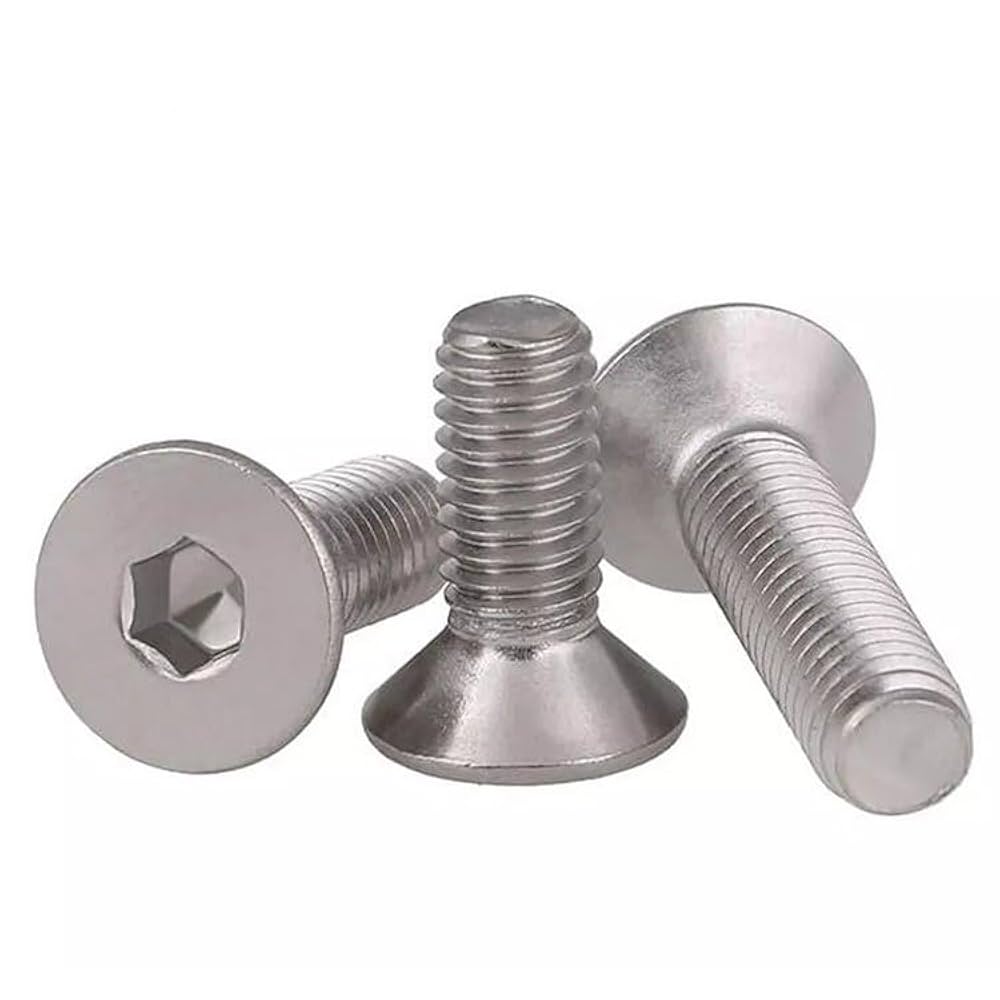
Premium A2 (304) and A4 (316) stainless steel Allen Csk. Available in metric coarse threads and select UNC/BSW on request. Mill Test Certificates (MTC), strict dimensional tolerances, and fast dispatch from ready stock.
DIN 7991
Stainless Steel Allen CSK
TRSUTED SS Allen Csk FOR DEMANDING APPLICATION
Key Specifications
Standards
-
Grades (Material)
A2 (304), A4 (316)
Strength Classes
-
Threads
Metric coarse (default). Fine/UNC/BSW available on request
Sizes
M1.6 to M 70, 3/16" to 2.1/2" (others on request)
Lengths
-
Head
-
Marking
Grade/class & manufacturer ID as applicable
Certificates
MTC 3.1 / chemical composition & mechanicals available
Compliance
RoHS/REACH; generally non-magnetic in solution-annealed state (slight magnetism possible after cold-work)
Choosing the Right Stainless Steel Allen CSK
Choosing the Right Allen CSK (Countersunk Socket Head Screw)
1) Environment & corrosion
Indoor / dry / general machinery (no major corrosion):
Use alloy steel countersunk socket screws (usually black/oiled or zinc plated).
Ideal for machines, fixtures, jigs, tooling, automation, where surfaces need to be flush.
Outdoor / damp / mild chemical exposure:
Use A2 (SS 304) Allen CSK screws.
For stainless fabrications, outdoor structures, general food equipment.
Marine / chloride / chemical / wash-down:
Use A4 (SS 316) Allen CSK screws.
For marine hardware, coastal environments, chemical plants, pharma & food wash-down.
Simple rule:
If max strength + dry conditions → Alloy steel (10.9 / 12.9).
If corrosion resistance is critical → A2 / A4 stainless.
2) Head style – when to use Allen CSK vs Allen cap
Allen CSK (countersunk, 90° head):
Head sits flush with the surface when used in a properly machined countersink.
Used where you need:
No projection above surface (covers, sliding parts, door panels, machine guards)
Clean, snag-free appearance
Clearance for movement (inside guides, rails, tracks)
Allen cap (socket head cap screw):
Taller cylindrical head, not flush.
Used where head height is allowed and maximum strength is required.
Use Allen CSK when:
Parts must be flush or low-profile.
There is enough material thickness to make a proper countersink without weakening the part.
3) Plate thickness & countersink design
Because Allen CSK screws are countersunk, correct design of the plate or part is critical:
The material must have enough thickness to hold the full depth of the countersink plus the threaded portion.
In very thin sheets, a deep countersink can seriously weaken the material → consider a washer plate, CSK washers, or use button head / low head socket instead.
Guidelines:
For structural or heavily loaded joints, avoid large diameter CSK screws in very thin plates.
The countersink cone (usually 90°) must be machined so the head bears fully and evenly – not just at the outer edge or tip.
Poor countersinking → point loading, loosening, head cracking or plate deformation.
Mechanical Properties (Guide)
Mechanical Properties (Guide) – Allen CSK Screws
Mechanical behaviour is similar to other socket screws of the same property class, but the countersunk head slightly changes how load is distributed into the part.Stainless steel Allen CSK (A2-70 / A4-70 / A4-80)
Approximate minimum values:
A2-70 / A4-70
Tensile strength ≈ 700 MPa
Proof strength ≈ 450 MPa
A4-80
Tensile strength ≈ 800 MPa
Proof strength ≈ 600 MPa
Behaviour:
Lower strength than high-grade alloy steels, but excellent corrosion resistance.
Good for stainless panels, covers, and structures where flush, aesthetic finish is needed.
Watch for thread galling in stainless-stainless assemblies – use lubricant/anti-seize and avoid very high-speed tightening.
3) Joint-level notes
For a correctly designed Allen CSK joint:
Tension capacity is governed by property class and core area, just like other bolts.
Head pull-through or plate cone cracking can be a concern if:
Plate is too thin, or
Countersink is too deep or too large.
For structural or highly loaded joints:
Ensure adequate plate thickness under the countersink.
Consider backing plates or using socket head caps instead if the material is thin.
6000+ Products
Trusted by 2000+ Clients
40+ Years of Experience
Exporting to 12+ Countries
What We Do
From a vast manufacturing facility situated in GIDC Wadhwan, Gujarat to strategic
sales offices in Mumbai and Chennai, we design, produce, and deliver a wide array of stainless steel
fasteners, hex bolts, machine screws, socket screws, washers, nuts, self‑tapping screws, threaded rods,
anchor fasteners, and specialty material products, engineered for demanding sectors like petrochemicals,
pharmaceuticals, automotive, and construction.
Our Legacy & Mission
Founded on a vision of precision and service, we have consistently expanded our
capabilities to meet evolving industrial needs. Our commitment to "We Deliver Quality" reflects in the
long-term relationships we build with clients across India and abroad.
Frequently Asked Questions
What is an Allen CSK screw?
An Allen CSK screw is a countersunk screw with an internal hex (Allen) drive.
The 90° conical head sits flush with the surface in a countersunk hole, and you tighten it with an Allen key/hex bit.
When should I use an Allen CSK instead of a normal Allen cap (socket head)?
Use Allen CSK when:
You need the head to be flush or below the surface (covers, sliding parts, door panels, guards).
There must be no projection that can snag, interfere, or catch.
Use Allen cap (socket head) when:
Head height is acceptable, and
You want maximum head strength and slightly simpler machining (no countersink).
Where are Allen CSK screws commonly used?
Machine guards, covers, and access panels
Sliding parts and guides where a flush surface is essential
Stainless enclosures and control panels
Architectural and furniture applications where appearance matters
Any place where a flat, snag-free surface is required after tightening.
Do Allen CSK screws weaken the plate because of the countersink?
They can, if the plate is too thin or the countersink is too deep:
The countersink removes material around the hole and reduces section thickness.
In very thin plates, this can make the joint weaker than a normal socket head with a washer.
For heavily loaded or structural joints:
Ensure sufficient plate thickness under the countersink.
Consider a thicker backing plate or use a socket head cap screw instead.
Do I need a washer under an Allen CSK head?
No washer is used under the countersunk head:
The head seats directly in the machined countersink.
But if the screw is going through a part with a nut on the other side:
Use a flat washer under the nut to protect the surface and spread load.


