


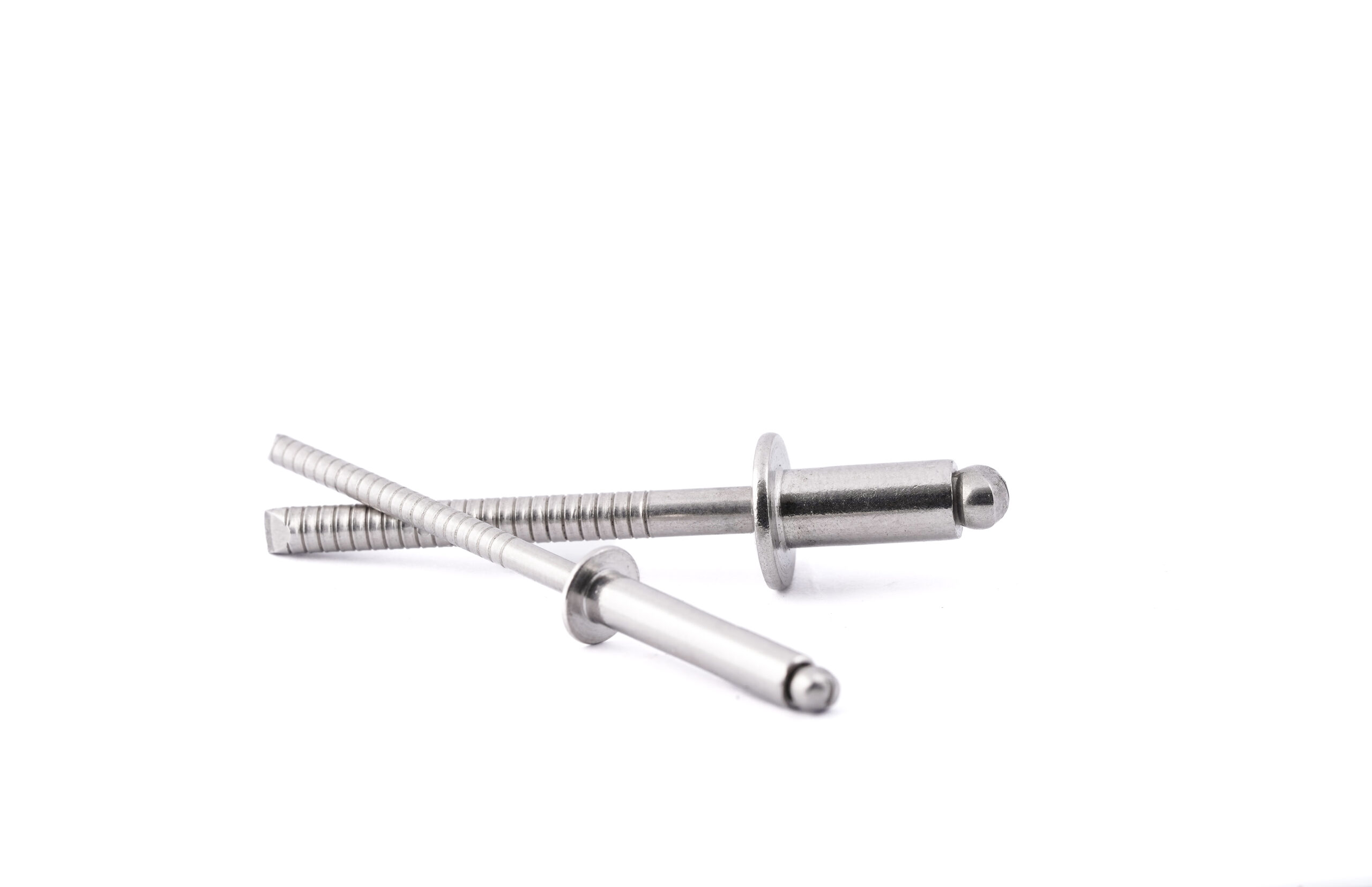
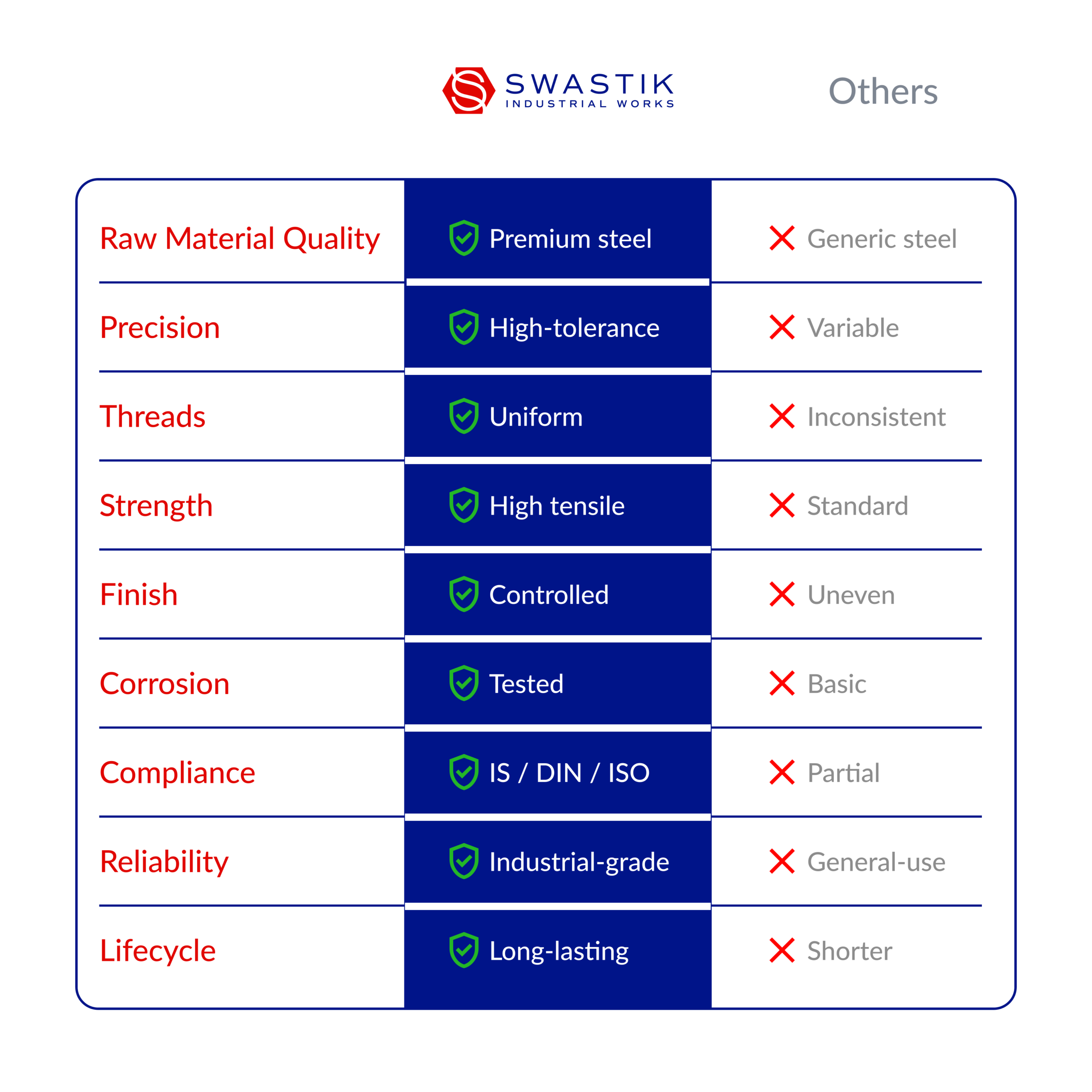

Premium A2 (304) and A4 (316) stainless steel Pop Rivets. Available in metric coarse threads and select UNC/BSW on request. Mill Test Certificates (MTC), strict dimensional tolerances, and fast dispatch from ready stock.
DIN 660
Stainless Steel Pop Rivets
TRSUTED SS Pop Rivets FOR DEMANDING APPLICATION
Key Specifications
Standards
DIN 660
Grades (Material)
A2 (304), A4 (316)
Strength Classes
-
Threads
Metric coarse (default). Fine/UNC/BSW available on request
Sizes
M6 to M 20 (others on request)
Lengths
-
Head
-
Marking
Grade/class & manufacturer ID as applicable
Certificates
MTC 3.1 / chemical composition & mechanicals available
Compliance
RoHS/REACH; generally non-magnetic in solution-annealed state (slight magnetism possible after cold-work)
Choosing the Right Stainless Steel Pop Rivets
Choosing the Right Pop Rivet (Blind Rivet)
1) What is a pop rivet & when to use it?
A pop rivet (blind rivet) is a two-piece fastener consisting of:
A rivet body (shell) inserted through the hole, and
A mandrel (stem) that is pulled by a rivet gun to expand and form the closing head.
Use pop rivets when:
You only have access from one side of the joint (blind side inaccessible).
You want a permanent, vibration-resistant fastening.
Welding, screwing or bolting is not practical or economical.
Typical applications:
Sheet metal fabrication (enclosures, cabinets, ducts, panels)
Automotive and bodywork
HVAC, cladding, roofing, signage
Appliances, electrical panels, light structural brackets
2) Material selection – body & mandrel
Choosing the right material combination is critical for strength and corrosion:
Common combinations
Aluminium body / steel mandrel
Light weight, easy setting, good for aluminium sheets and general indoor use.
All-aluminium (aluminium body + aluminium mandrel)
Maximum corrosion compatibility with aluminium parts, non-magnetic, used in light-duty, non-structural applications.
Steel body / steel mandrel (plated)
Higher shear & tensile strength, common in automotive & general steel fabrications.
Usually zinc-plated for basic corrosion resistance.
Stainless steel body / stainless mandrel
Best corrosion resistance and strength, ideal for marine, outdoor, food, and chemical environments.
Simple selection:
For aluminium panels, light indoor work → Alu/steel or all-alu pop rivet.
For general steel fabrications → Steel/steel pop rivet.
For harsh, marine, chemical, or stainless fabrications → A2/A4 stainless/stainless pop rivet.
Try to match rivet material to the sheets to reduce galvanic corrosion.
3) Grip range – the most important dimension
Every pop rivet size has a grip range: the minimum and maximum total material thickness it can clamp.
Example:
4.0 × 10 mm rivet → Grip range: 3–5 mm (just an example).
How to choose:
Add the thickness of all sheets being joined:
e.g. 1.5 mm + 2.0 mm = 3.5 mm total.
Select a rivet whose grip range covers 3.5 mm.
Do not choose a rivet where total thickness is below the minimum or above the maximum grip range.
If grip is too short → poor clinch, loose joint.
If grip is too long → rivet may not form correctly, weak or incomplete closure.
4) Diameter – hole size & joint strength
Pop rivets are specified by body diameter (e.g. 3.2 mm, 4.0 mm, 4.8 mm, 6.4 mm).
Hole size must match the rivet spec (usually slightly larger than rivet diameter).
E.g. 4.0 mm rivet → ~4.1–4.2 mm hole (refer to manufacturer data).
Guideline:
Thin sheets, light duty → 3.0 / 3.2 mm
General sheet metal, light structural brackets → 4.0 / 4.8 mm
Heavier duty, thicker stacks → 4.8 / 6.4 mm
Larger diameter = higher shear & tensile capacity, but always check actual data.
5) Head style – appearance & bearing area
Common head types:
Dome head (standard)
Slightly rounded, general purpose.
Suitable for most applications.
Countersunk / CSK head
Sits flush with the sheet surface after setting.
Good for smooth, flush finishes, sliding surfaces, or where appearance is important.
Large flange head
Larger head diameter to spread the load.
Ideal for soft or thin materials (plastics, thin aluminium, fibreglass) to reduce pull-through.
Selection:
Standard sheet-metal work → Dome head.
Flush surfaces & aesthetics → Countersunk.
Soft/weak materials & oversized holes → Large flange.’
Mechanical Properties (Guide)
Mechanical Properties (Guide) – Pop Rivets (Blind Rivets)
Pop rivets transfer load via the expanded body and retained mandrel in the joint.
Strength depends on material, diameter, and grip condition.
Typical Behaviour (conceptual – actual values from manufacturer)
For a given nominal size, e.g. 4.8 mm stainless pop rivet:
Shear strength
The load required to slide the plates past each other, cutting through the rivet cross-section.
Tensile strength
The load required to pull the rivet head through or pull off the mandrel joint.
Even for the same diameter, strengths vary greatly between:
Aluminium,
Steel,
Stainless rivets, and
Standard vs structural designs.
Manufacturers provide shear and tensile ratings per size & material; these should be used for critical designs.Stainless Steel Pop Rivets
Highest corrosion resistance and good strength.
Ideal for outdoor, marine, chemical, food & pharma environments.
Higher setting force required; needs more capable tool.
Structural Blind Rivets (if used)
6000+ Products
Trusted by 2000+ Clients
40+ Years of Experience
Exporting to 12+ Countries
What We Do
From a vast manufacturing facility situated in GIDC Wadhwan, Gujarat to strategic
sales offices in Mumbai and Chennai, we design, produce, and deliver a wide array of stainless steel
fasteners, hex bolts, machine screws, socket screws, washers, nuts, self‑tapping screws, threaded rods,
anchor fasteners, and specialty material products, engineered for demanding sectors like petrochemicals,
pharmaceuticals, automotive, and construction.
Our Legacy & Mission
Founded on a vision of precision and service, we have consistently expanded our
capabilities to meet evolving industrial needs. Our commitment to "We Deliver Quality" reflects in the
long-term relationships we build with clients across India and abroad.
Frequently Asked Questions
What is a pop rivet (blind rivet)?
A pop rivet, or blind rivet, is a two-piece fastener (rivet body + mandrel) used to permanently join materials when you can only access one side of the joint.
The mandrel is pulled by a rivet gun, which expands the rivet body and forms a closing head on the blind side.
When should I use pop rivets instead of screws or bolts?
Use pop rivets when:
You cannot reach the back side of the joint (blind access).
You want a permanent, tamper-resistant connection.
Sheets are too thin for good thread engagement.
Welding is not practical (heat, distortion, coating damage).
They’re ideal for sheet metal, enclosures, ducts, panels, cladding, bodywork, and appliances.
What is “grip range” and why is it important?
Grip range is the minimum and maximum total material thickness a rivet is designed to clamp.
If your stack is too thin → the rivet may not form correctly and can end up loose.
If your stack is too thick → the rivet won’t close properly or may fail during setting.
Always make sure your total material thickness falls within the specified grip range.
What’s the difference between dome head, countersunk head, and large flange head?
Dome head (standard)
Slightly rounded head, suits most applications.
Countersunk (CSK) head
Sits flush with the surface when installed in a countersunk hole.
Ideal where a smooth surface or clean appearance is required.
Large flange (wide head)
Larger bearing area to spread the load.
Best for soft or thin materials (plastics, thin aluminium, composites) and oversized holes.
Can pop rivets be used for watertight or airtight joints?
Standard pop rivets are not fully sealed – they can allow moisture or air through the center or around the body.
For sealing:
Use closed-end / sealed blind rivets, and/or
Combine with sealant, gasket, or sealing washers.
Always check the rivet type if your application needs water / air tightness.


