


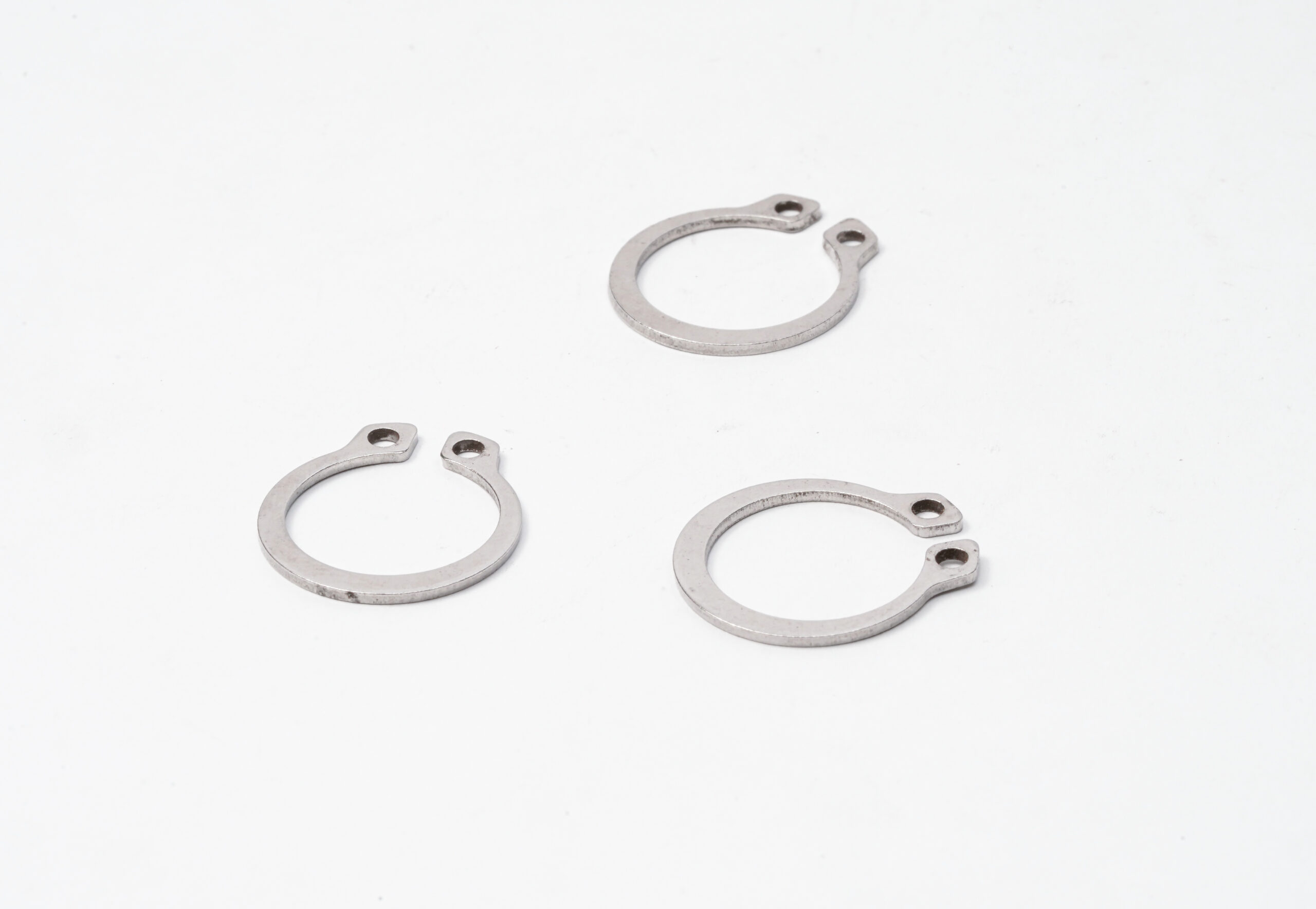
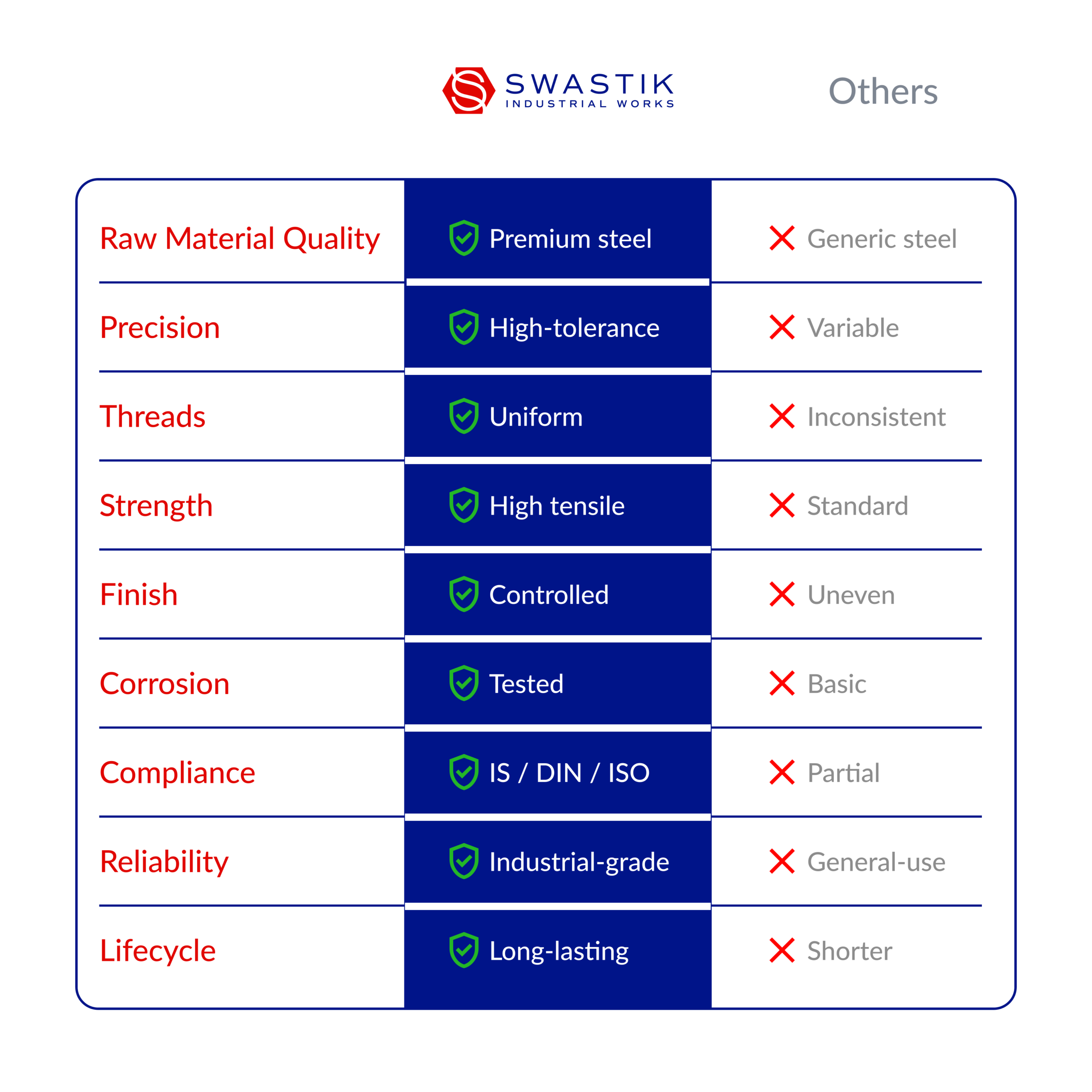

Premium A2 (304) and A4 (316) stainless steel External Circlip. Available in metric coarse threads and select UNC/BSW on request. Mill Test Certificates (MTC), strict dimensional tolerances, and fast dispatch from ready stock.
DIN 471
Stainless Steel External Circlip
TRSUTED SS External Circlip FOR DEMANDING APPLICATION
Key Specifications
Standards
DIN 471
Grades (Material)
A2 (304), A4 (316)
Strength Classes
-
Threads
Metric coarse (default). Fine/UNC/BSW available on request
Sizes
M6 to M 20 (others on request)
Lengths
-
Head
-
Marking
Grade/class & manufacturer ID as applicable
Certificates
MTC 3.1 / chemical composition & mechanicals available
Compliance
RoHS/REACH; generally non-magnetic in solution-annealed state (slight magnetism possible after cold-work)
Choosing the Right Stainless Steel External Circlip
Choosing the Right External Circlip
1) What is an external circlip & when to use it?
An external circlip is a C-shaped spring steel ring that fits into a groove on a shaft and prevents components from sliding off along the shaft.
Use an external circlip when you need a simple axial retainer instead of a nut/shoulder:
To locate bearings, bushes, gears, sprockets, pulleys on a shaft
To stop collars, washers or spacers from moving axially
When you want a compact, low-cost axial stop without machining large shoulders
Most industrial external circlips follow DIN 471 / ISO 8748 style (for shafts).
2) Shaft diameter & standard (DIN 471)
The first selection is always the shaft size:
External circlips are specified by shaft diameter (e.g. “External Circlip for 20 mm shaft – DIN 471”).
The circlip is designed to compress into the groove on that shaft size with correct preload and retaining force.
Simple rule:
Check your shaft nominal diameter (e.g. 15, 20, 25 mm).
Choose “External Circlip for Ø… mm shaft – DIN 471” to match.
Never force a circlip intended for a different shaft size – it will either be loose or overstressed.
3) Groove design – fit & retention
The shaft groove is just as important as the circlip:
Groove diameter & width must follow the corresponding standard (e.g. DIN 471 groove tables).
The groove defines:
Axial holding capacity (how much thrust load it can take)
How much the circlip protrudes beyond the shaft diameter to act as a shoulder.
Key points:
Groove must be machined accurately and free from burrs.
Depth must be sufficient so that the circlip sits properly while still projecting enough to retain the component.
For high loads or high speed, follow standard groove dimensions exactly – don’t improvise.
Mechanical Properties (Guide)
Avoid twisting or bending across the plane – this can distort the ring.
Mechanical Properties (Guide) – External Circlips
External circlips are spring elements, not simple rings.
They rely on elastic deformation to snap into the groove and provide a constant radial preload and axial retaining force.
Standard Carbon Spring Steel External Circlips
Base material: high-carbon or alloy spring steel, heat-treated.
Characteristics:
High elastic limit and good fatigue resistance.
Designed to open elastically during installation and return to original shape.
Hardened and tempered to a spring hardness range suitable for repeated flexing (typically in the mid-to-high Rockwell C range, exact value depends on manufacturer/standard).
Performance notes:
Provide reliable axial retention when used with correct groove size.
Suitable for a wide range of operating temperatures (approx. from sub-zero to moderately elevated temperatures, depending on material and finish).
Surface treatments (phosphate, oil, zinc, black oxide) offer basic corrosion and wear protection.
Stainless Steel External Circlips
Base material: stainless spring steel (specific grade varies by manufacturer).
Characteristics:
Good corrosion resistance in humid, marine and chemical environments.
Adequate spring properties for general retaining applications.
Slightly different modulus and yield vs carbon steels, but designed to meet comparable retaining performance for the given shaft size.
Performance notes:
Ideal where rust staining is not acceptable (food, pharma, marine, outdoor).
Used together with stainless shafts and components to maintain uniform corrosion resistance.
6000+ Products
Trusted by 2000+ Clients
40+ Years of Experience
Exporting to 12+ Countries
What We Do
From a vast manufacturing facility situated in GIDC Wadhwan, Gujarat to strategic
sales offices in Mumbai and Chennai, we design, produce, and deliver a wide array of stainless steel
fasteners, hex bolts, machine screws, socket screws, washers, nuts, self‑tapping screws, threaded rods,
anchor fasteners, and specialty material products, engineered for demanding sectors like petrochemicals,
pharmaceuticals, automotive, and construction.
Our Legacy & Mission
Founded on a vision of precision and service, we have consistently expanded our
capabilities to meet evolving industrial needs. Our commitment to "We Deliver Quality" reflects in the
long-term relationships we build with clients across India and abroad.
Frequently Asked Questions
What is an external circlip?
An external circlip is a C-shaped spring steel ring that fits into a machined groove on a shaft.
Its job is to stop components (bearings, gears, spacers, etc.) from sliding off axially along the shaft.
What is the difference between an external and an internal circlip?
External circlip:
Fits on the outside of a shaft (in a shaft groove).
Retains components on the outside of the shaft.
Internal circlip:
Fits on the inside of a bore/housing (in a housing groove).
Retains components inside a hole or bore.
How do I select the correct external circlip size?
External circlips are specified by the shaft diameter, not the groove diameter.
For example:
“External Circlip for Ø20 mm shaft – DIN 471” is used on a 20 mm shaft.
So the steps are:
Identify your shaft diameter (e.g. 12, 20, 35 mm).
Choose the circlip for that shaft size in the required standard/material.
What is DIN 471?
DIN 471 is a common standard for external circlips for shafts.
It defines:
Dimensions of the circlip (diameter, thickness)
Groove dimensions on the shaft (width, depth, tolerances)
General fit and functional requirements
Using a DIN 471 circlip with a DIN 471 groove guarantees a proper fit and predictable retaining capacity.
Can external circlips carry high loads?
Yes – within their design limits.
External circlips are designed to take axial thrust loads that keep components located on shafts.
However, their capacity depends on:
Shaft diameter & groove dimensions
Circlip cross-section and material
For very high or critical loads, you should:
Check the axial load ratings from the circlip manufacturer, and
Ensure the groove is machined exactly to standard.


