


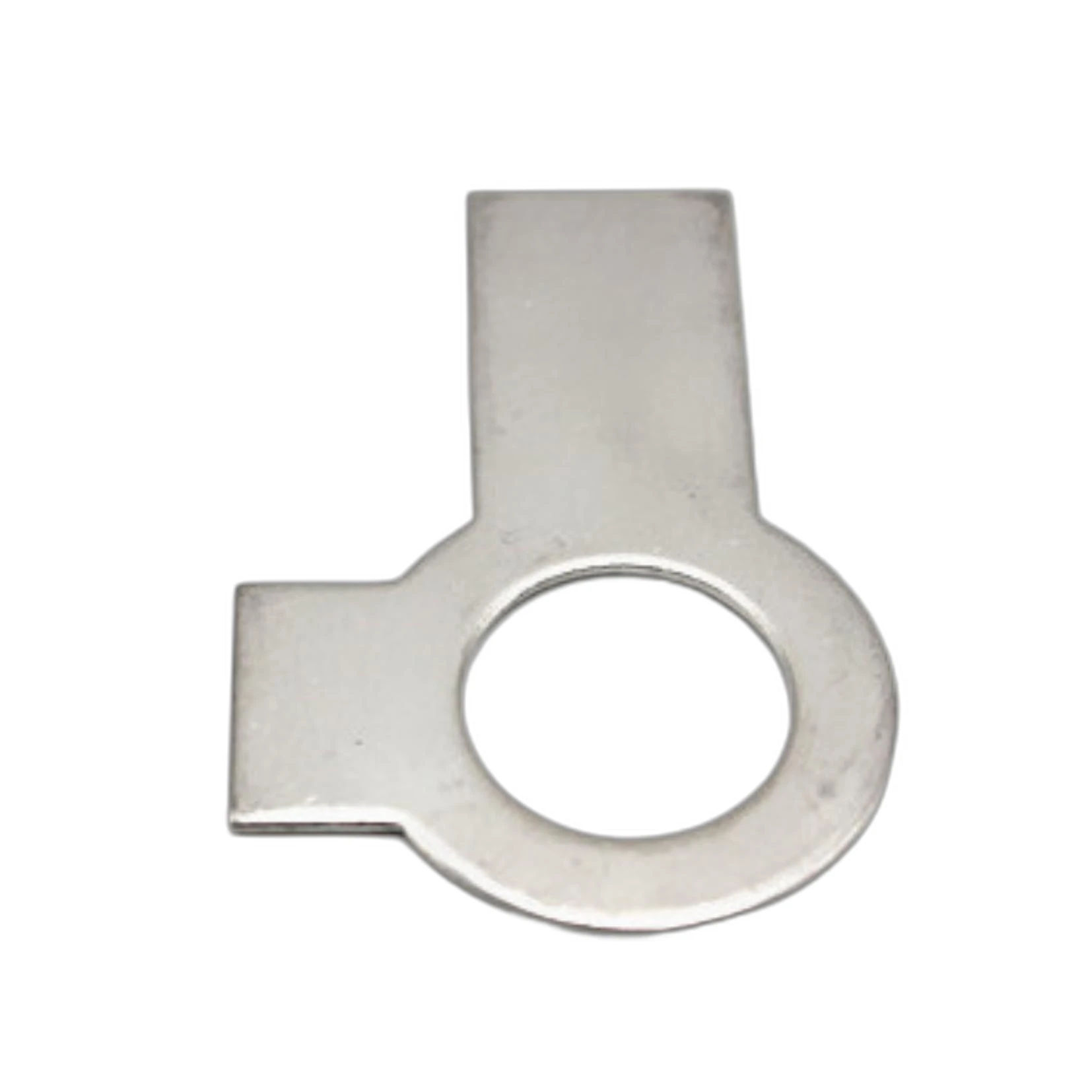
Premium A2 (304) and A4 (316) stainless steel Tab Washer. Available in metric coarse threads and select UNC/BSW on request. Mill Test Certificates (MTC), strict dimensional tolerances, and fast dispatch from ready stockM6 to M24
DIN 93/ DIN 463
Stainless Steel Tab Washer
TRSUTED SS Tab Washer FOR DEMANDING APPLICATION
Key Specifications
Standards
-
Grades (Material)
A2 (304), A4 (316)
Strength Classes
-
Threads
Metric coarse (default). Fine/UNC/BSW available on request
Sizes
M1.6 to M 70, 3/16" to 2.1/2" (others on request)
Lengths
-
Head
-
Marking
Grade/class & manufacturer ID as applicable
Certificates
MTC 3.1 / chemical composition & mechanicals available
Compliance
RoHS/REACH; generally non-magnetic in solution-annealed state (slight magnetism possible after cold-work)
Choosing the Right Stainless Steel Tab Washer
Choosing the Right Tab Washer
(Lock Washer with Bendable Tabs)
1) What does a tab washer do & when should you use it?
A tab washer is a thin lock washer with one or more bendable tabs that can be folded:
Up against a nut/bolt head flat
Or into a keyway / slot / hole in the mating part
Its job is to:
Mechanically lock the nut/bolt so it cannot rotate
Provide a positive, visible lock that’s easy to inspect
Prevent loosening in vibration, shock, or safety-critical applications
Use a tab washer when:
You need a firm mechanical lock, not just friction
The connection is safety-critical or difficult to re-tighten regularly
The design includes keyways, slots, or shoulders to locate the inner tab
You want a simple lock that doesn’t rely on friction or chemical thread-lockers
Typical applications:
Gearbox bearing lock nuts
Shaft nuts and hub nuts
Couplings, sprockets, pulleys
Railway, defence, heavy machinery & rotating equipment
2) Common types of tab washers – which to choose?
a) Single Tab Washer
Has one outer locking tab that is bent up against a nut/bolt flat.
Usually has an inner tab or tang that fits into a keyway or slot on the shaft or housing → prevents the washer itself from turning.
Use for:
Shaft nuts / lock nuts on bearings, gears, couplings.
Applications with a keyway or slot for the inner tab.
b) Double Tab Washer
Has two opposite outer tabs.
One or both tabs can be bent up against different flats of the nut.
Often also has an inner tab or locating feature.
Use for:
Heavier-duty applications where you want two locking points.
Places where the nut can be locked against two different flats for extra security.
c) Tab Washer with Multiple Outer Tabs / Star-Type Tabs
Several outer tabs around the OD → multiple locking options around the nut.
You choose the tab that aligns best with a nut flat and bend it up.
Use for:
General machinery where nut position can vary; having more tabs gives more flexibility.
3) Environment & corrosion – choosing material & finish
Indoor / dry / general machinery & gearboxes:
MS (mild steel) tab washers, often zinc-plated or oiled.
Suitable for gearboxes, shafts, bearings, couplings, internal machine assemblies.
Outdoor / exposed industrial environments:
Zinc-plated or thicker-coated MS tab washers.
Used in general outdoor machinery and structures, where corrosion protection is needed but not extreme.
Stainless / food / pharma / marine / chemical:
SS 304 (A2) tab washers – for stainless shafts and assemblies, general outdoor and food-grade use.
SS 316 (A4) tab washers – for coastal, marine and aggressive chemical environments.
Best practice: match tab washer material with the nut/bolt and environment to avoid galvanic corrosion and premature rusting.
Mechanical Properties (Guide)
Mechanical Properties (Guide) – Tab Washer
Tab washers are locking elements, not primary structural load carriers. Key properties are material strength, ductility for bending, and ability to maintain tab shape under service loads and vibration.
1) Mild Steel Tab Washers (Standard)
Typical characteristics:
Material: low or medium carbon steel, chosen for good formability and adequate strength.
Usually stamped and then heat-treated or work-hardened to balance ductility and stiffness.
Functional behaviour:
Outer locking tabs are bent up after tightening the nut/bolt.
Inner tab/tang fits into a keyway or locating slot, preventing rotation of the washer.
Once bent, the tabs provide a mechanical stop – nut cannot rotate without physically deforming the tab.
Design behaviour:
Must be ductile enough to bend once or twice without cracking.
Must be stiff enough that the tab holds its shape and does not spring back or fold under vibration.
In bending, the tab yields locally, then “locks” in place.
2) Stainless Steel Tab Washers (A2 / A4)
Typical characteristics:
Material: A2 (304) or A4 (316) stainless.
Provide corrosion resistance with good ductility for tab bending.
Functional behaviour:
Same locking principle as MS tab washers, with added corrosion protection.
Used on stainless shafts, marine drives, food and pharma machinery, where rust is unacceptable.
Special notes:
Stainless is tougher; bending force may be slightly higher than for mild steel.
Correct tab bending tools and technique help avoid local cracking, especially in cold environments.
3) Strength & performance in the joint
In a properly designed and installed tab washer system:
The nut or bolt is tightened to the required torque for preload.
After tightening, one or more tabs are bent up against flats of the nut/bolt head:
Any rotation of the nut tends to push against the tab, which is anchored at its inner tab/keyway.
Rotation can only happen if the tab is forced to plastically deform further, which requires substantial additional force.
Performance characteristics:
Provides very high resistance to loosening from vibration and shock, because locking is mechanical, not purely frictional.
Locking condition is visually inspectable – you can see the tab in contact with the nut flat.
Tabs should not be bent back and forth many times; they are meant for 1–2 bend cycles (tighten → lock, possibly unlock once, then replace).
Failure/limit modes:
Tab cracking if over-bent or repeatedly bent back-and-forth.
Washers deforming if material is too soft or too thin for the nut/bolt size and service loads.
Inner tab failure if keyway fit is poor, leading to washer rotation.
6000+ Products
Trusted by 2000+ Clients
40+ Years of Experience
Exporting to 12+ Countries
What We Do
From a vast manufacturing facility situated in GIDC Wadhwan, Gujarat to strategic
sales offices in Mumbai and Chennai, we design, produce, and deliver a wide array of stainless steel
fasteners, hex bolts, machine screws, socket screws, washers, nuts, self‑tapping screws, threaded rods,
anchor fasteners, and specialty material products, engineered for demanding sectors like petrochemicals,
pharmaceuticals, automotive, and construction.
Our Legacy & Mission
Founded on a vision of precision and service, we have consistently expanded our
capabilities to meet evolving industrial needs. Our commitment to "We Deliver Quality" reflects in the
long-term relationships we build with clients across India and abroad.
Frequently Asked Questions
What is a tab washer?
A tab washer is a thin lock washer with one or more bendable tabs.
After the nut/bolt is tightened, a tab is bent up against a flat of the nut/bolt head (and often another tab locates in a keyway or slot) to mechanically lock the fastener and stop it from rotating.
How does a tab washer stop a nut or bolt from loosening?
Tab washers give a positive mechanical lock:
The washer body is prevented from rotating by an inner tab/tang in a keyway or notch, or by a locating feature.
After tightening, an outer tab is bent up against a flat on the nut/bolt head.
Any attempt of the nut/bolt to rotate is blocked by the tab, so loosening would require physically deforming the tab further.
This is different from spring or star washers, which rely mainly on friction.
When should I use a tab washer instead of a spring or star washer?
Use a tab washer when:
The joint is safety-critical or difficult to re-check.
There is strong vibration or shock (gearboxes, couplings, rotating shafts).
You need a visible, mechanical lock that an inspector can see.
The design already has a keyway/slot or locating feature for the inner tab.
Spring and star washers are fine for light–medium duty anti-loosening; tab washers are for more critical, positive locking.
What is the difference between a single tab washer and a double tab washer?
Single tab washer:
One main outer tab to bend against the nut/bolt.
Often one inner tab to locate in a keyway or slot.
Double tab washer:
Two opposite outer tabs (and often an inner locating tab).
You can bend one or both tabs for extra security.
Double tab washers give more locking options and can be used where you want two locking points or more flexibility in tab positioning.
Are tab washers reusable?
Generally, not recommended for repeated reuse:
Tabs are designed to be bent once (or at most a couple of times).
Bending back and re-bending the same tab can cause fatigue and cracking.
For safety-critical or high-vibration applications, it is best practice to use a new tab washer whenever the nut is loosened and re-tightened.


