


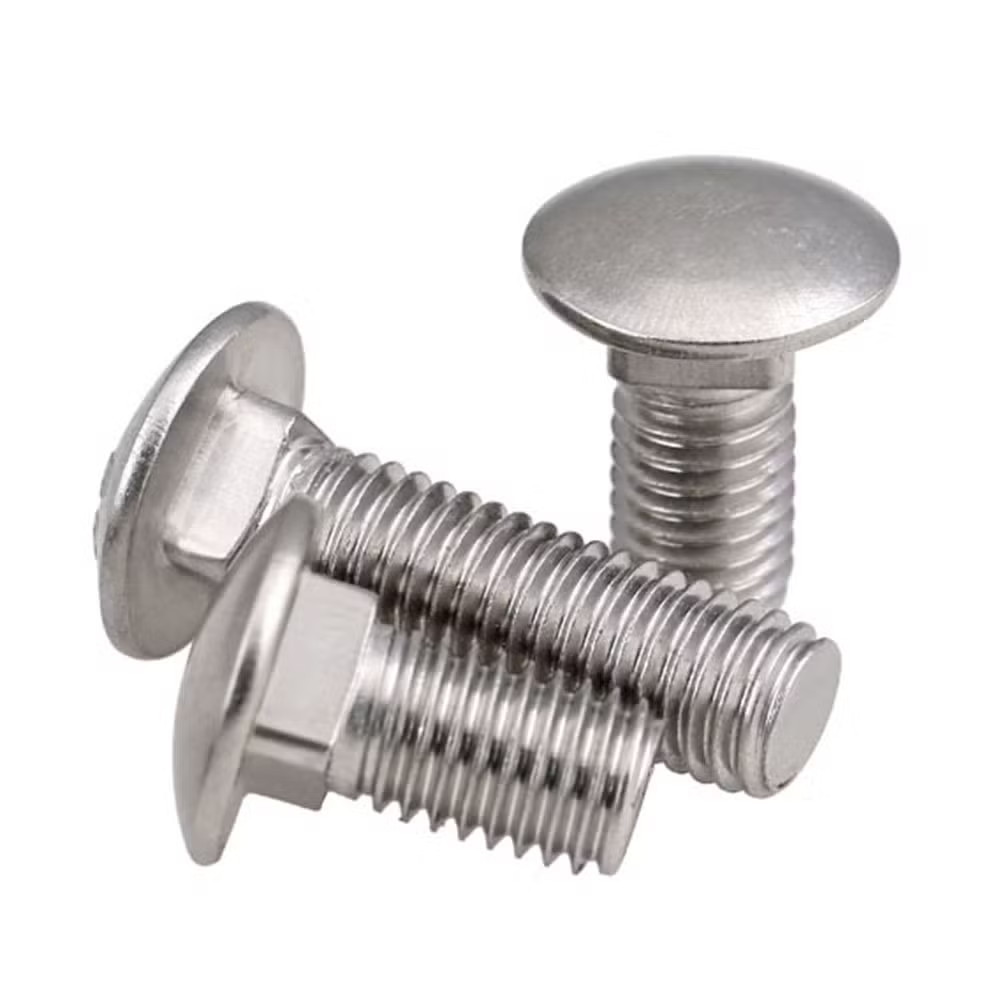
Premium A2 (304) and A4 (316) stainless steel carriage bolt. Available in metric coarse threads and select UNC/BSW on request. Mill Test Certificates (MTC), strict dimensional tolerances, and fast dispatch from ready stock.
DIN 603
Stainless Steel Carriage Bolt
TRSUTED SS Carriage Bolt FOR DEMANDING APPLICATION
Key Specifications
Standards
DIN 603, ANSI B18.2.4.1M, BS 1083
Grades (Material)
A2 (304), A4 (316)
Strength Classes
A2-70, A4-70 and A4-80
Threads
Metric coarse (default). Fine/UNC/BSW available on request
Sizes
M5 to M 20 (others on request)
Lengths
12-100 mm (others on request)
Head
-
Marking
Grade/class & manufacturer ID as applicable
Certificates
MTC 3.1 / chemical composition & mechanicals available
Compliance
RoHS/REACH; generally non-magnetic in solution-annealed state (slight magnetism possible after cold-work)
Choosing the Right Stainless Steel Carriage Bolt
Choosing the right carriage bolt (coach bolt / DIN 603)
What is a carriage bolt & when to use it?
A carriage bolt (also called coach bolt, typically DIN 603) has:
A round, smooth dome head
A square neck under the head
A partially threaded shank (usually)
Use a carriage bolt when you need:
To fasten wood-to-wood or steel-to-wood
The head side to be smooth (no sharp edges, tamper-resistant from one side)
The bolt to self-lock in timber or square holes via the square neck (no spanner required on the head side)
Typical applications:
Timber structures, fencing, gates, handrails
Wooden packing cases, pallets, jigs
Steel plate or bracket to timber joints
Places where a clean, rounded head is preferred for safety or appearance
Environment & corrosion – A2 vs A4
For stainless carriage bolts (DIN 603):
Indoors / general outdoor → A2 (304) carriage bolt
Fencing, garden structures, general outdoor furniture, wooden frames, standard structural work
Marine / coastal / chloride / chemical → A4 (316) carriage bolt
Near the sea, on jetties, piers, seafront railings
Around swimming pools, cooling towers, chemical plants
Match materials:
A2 carriage bolt with A2 nuts and washers
A4 carriage bolt with A4 nuts and washers
This gives consistent corrosion resistance through the entire assembly.
Head & neck – how they affect application
Round dome head
Smooth, safe, and difficult to grip with normal tools → basic anti-tamper effect from head side
Good for public areas, railings, benches, play structures, etc.
Square neck
Designed to bite into timber or fit into a square hole in steel
Prevents the bolt from rotating while tightening the nut
Makes one-person assembly easier: hold just the nut side
Selection tips:
For wooden members → let the square neck press into the timber (pre-drill the round hole slightly undersize for shank, then pull in square neck).
For steel-to-wood or steel plates → you can punch/laser a square hole for positive anti-rotation in the steel.
Mechanical Properties (Guide)
Mechanical Properties (Guide) – Stainless Steel Carriage Bolts (DIN 603)
Mechanically, carriage bolts use the same property classes as standard stainless hex bolts (e.g., A2-70, A4-70).
The head and square neck change how they are used, not the basic material strength.
A2-70 Carriage Bolts (DIN 603)
Material: A2 (304) stainless steel
Property class: 70
Minimum tensile strength: ≈ 700 MPa
Typical proof strength: ≈ 450 MPa
Intended for use with:
A2-70 nuts (hex, nylock) and A2 washers
Applications:
Timber & steel-to-timber joints in general outdoor structures
Fencing, gates, benches, frames, plant structures in normal environments
A4-70 Carriage Bolts (DIN 603)
Material: A4 (316) stainless steel
Property class: 70
Same mechanical strength range as A2-70, with better corrosion resistance.
Intended for use with:
A4-70 nuts and A4 washers
Applications:
Marine/coastal, chemical, poolside and chloride-rich environments
Stainless timber structures, jetties, bridges, outdoor equipment in harsh environments
For both A2-70 and A4-70 carriage bolts:
Joint capacity depends on the bolt diameter & property class, but also on:
Timber / plate strength
Washer size & bearing area
Proper tightening and prevention of loosening
6000+ Products
Trusted by 2000+ Clients
40+ Years of Experience
Exporting to 12+ Countries
What We Do
From a vast manufacturing facility situated in GIDC Wadhwan, Gujarat to strategic
sales offices in Mumbai and Chennai, we design, produce, and deliver a wide array of stainless steel
fasteners, hex bolts, machine screws, socket screws, washers, nuts, self‑tapping screws, threaded rods,
anchor fasteners, and specialty material products, engineered for demanding sectors like petrochemicals,
pharmaceuticals, automotive, and construction.
Our Legacy & Mission
Founded on a vision of precision and service, we have consistently expanded our
capabilities to meet evolving industrial needs. Our commitment to "We Deliver Quality" reflects in the
long-term relationships we build with clients across India and abroad.
Frequently Asked Questions
What is a carriage bolt?
A carriage bolt (coach bolt, typically DIN 603) has:
A smooth, round dome head
A square neck just under the head
A partially threaded shank (in most standard sizes)
It’s designed so the square neck locks into wood or a square hole, allowing you to tighten the nut from the other side without holding the bolt head.
Where are carriage bolts commonly used?
Typical applications:
Timber-to-timber joints (fencing, gates, pergolas, decks)
Steel-to-timber connections (brackets to wooden posts/rafters)
Benches, handrails, playground equipment, outdoor furniture
Packing cases, pallets, jigs and fixtures
Anywhere you want a clean, rounded head and simple tightening from one side, carriage bolts are ideal.
What does the square neck under the head do?
The square neck:
Bites into timber or locates in a square hole in steel
Stops the bolt from rotating while you tighten the nut
Makes one-person assembly easier (no spanner needed on the head side)
If the neck is allowed to spin (hole too big/soft), the bolt may rotate while tightening – then the joint needs rework or a new bolt.
Why are carriage bolts usually partially threaded?
Partial thread gives:
A smooth shank through the main shear plane in timber, which:
Reduces damage to wood fibres
Provides better bearing in the joint
For general timber/steel-to-timber joints, partial thread is preferred. For some special cases, full thread versions are also available.
Do I need washers with a carriage bolt?
Almost always yes, especially on the nut side:
A flat washer spreads the load and protects timber or plate
On very soft wood or slotted holes, use large OD or square plate washers
On the head side, the round head usually bears directly on the wood/plate, but washers can be added if required by design.


