


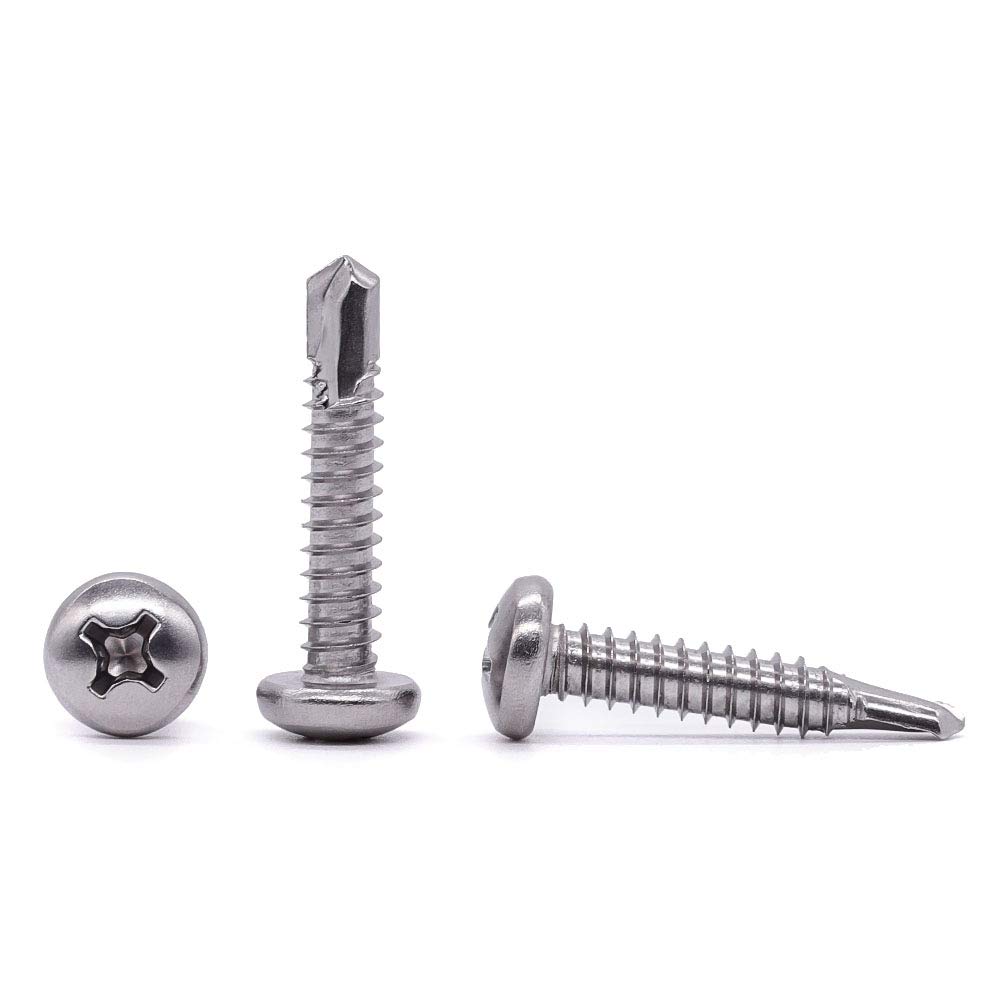
Premium A2 (304) and A4 (316) stainless steel pan head self drilling screw. Available in metric coarse threads and select UNC/BSW on request. Mill Test Certificates (MTC), strict dimensional tolerances, and fast dispatch from ready stock.
DIN 7504M
Stainless Steel Pan Head Self Drilling Screw
TRSUTED SS pan head self drilling screw FOR DEMANDING APPLICATION
Key Specifications
Standards
-
Grades (Material)
A2 (304), A4 (316)
Strength Classes
-
Threads
Metric coarse (default). Fine/UNC/BSW available on request
Sizes
M1.6 to M 70, 3/16" to 2.1/2" (others on request)
Lengths
-
Head
-
Marking
Grade/class & manufacturer ID as applicable
Certificates
MTC 3.1 / chemical composition & mechanicals available
Compliance
RoHS/REACH; generally non-magnetic in solution-annealed state (slight magnetism possible after cold-work)
Choosing the Right Stainless Steel Pan Head Self Drilling Screw
Choosing the Right SS Pan Head Self-Drilling Screw (Guide)
for stainless steel pan head self-drilling screws
1. What is an SS Pan Head Self-Drilling Screw?
An SS pan head self-drilling screw is:
A pan head screw (low, slightly rounded head with flat bearing surface)
With a self-drilling tip – a small drill-bit–shaped point
With a self-tapping machine-type thread for sheet metal
Made fully or partially in stainless steel (body, head, or cap)
It can drill, tap, and fasten in one operation into thin sheet metal or light sections, without separate drilling and tapping.
Typical drive types:
Phillips (PH) / Pozi (PZ)
Torx (star) for higher torque
Occasionally slotted (older designs)
2. Where & When to Use Pan Head Self-Drilling Screws
Choose SS pan head self-drilling screws when:
You are fastening sheet metal to sheet metal or to light sections (within drilling capacity)
You want a head that is low profile but not flush (sits on top of sheet)
You want to avoid separate drilling + tapping + screwing operations
You are working on enclosures, panels, ducting, or light fabrications
Typical applications:
Electrical and electronic enclosures / control panels
Sheet metal cabinets, junction boxes, meter boxes
HVAC ducting and light brackets
Internal cladding / covers / guards
Fastening accessories to thin steel or aluminium sections
Avoid them when:
Base material is too thick/hard for the drill point capacity
Joint is primary structural → then use bolts/anchors as per design
You need a flush head → then use CSK self-drilling instead.
3. Reality Check – “Stainless” in Self-Drilling Screws
Like hex self-drilling screws, drilling requires hard tips. Austenitic stainless (304/316) is relatively soft, so in practice you’ll see:
Carbon steel self-drilling core with stainless head/cap
Drill tip & shank: hardened carbon steel
Head/cap: stainless (appearance + corrosion resistance)
Bi-metal / full stainless body with hardened drill tip
Body: A2/A4 stainless
Tip: hardened carbon steel or specially treated stainless drill point
When you get an enquiry for “SS pan head self-drilling screw”, always clarify:
“Do you want full SS / bi-metal, or carbon-steel drill body with SS pan head/cap?”
This affects drilling capacity, corrosion resistance, and price.
4. Environment & Stainless Grade Selection
a) Normal indoor / mild outdoor / general industrial
Options:
Carbon steel self-drilling with good coating (zinc, Ruspert, etc.) + stainless cap/pan head
A2 (304) self-drilling for thin steel/aluminium where available
Suitable for:
Indoor panels, plant rooms, dry industrial sheds.
b) Coastal / marine / chemical / aggressive environments
Prefer:
Bi-metal or A2/A4 stainless body self-drilling screws
Stainless pan head with high-quality coating on any carbon-steel portion
A4 (316) contact surfaces (head/shank) where atmosphere is very aggressive
Stainless pan head gives:
Better long-term appearance
Reduced staining around the head.
c) Low-cost, non-critical indoor
Standard carbon-steel drillers with zinc coating may be used if customer accepts that only the coating protects against rust (not truly “SS”).
Mechanical Properties (Guide)
Mechanical Properties (Guide) – SS Pan Head Self-Drilling Screws
Exact properties depend on construction, but broadly:
A. Carbon Steel Self-Drilling Core (with SS cap/pan head)
Most common for strong drilling performance.
Core material: case-hardened carbon steel
Tensile strength: typically in range of 900–1200 MPa (product-specific)
Shear strength: high enough for normal sheet-metal fastening
Drill tip hardness: high, to drill through specified steel thickness
Corrosion resistance:
Head & exposed area: good if SS cap/pan head used
Shank: depends on plating system; generally suitable for normal environments, less so for very harsh coastal unless specific high-grade coating is used.
B. Bi-Metal / Full Stainless Body Self-Drilling Screws
Used where corrosion resistance is more critical than maximum drilling capacity.
Body: A2 (304) or A4 (316) stainless
Typical tensile strength: similar to A2-70 / A4-70 – about 700 MPa
Drill tip: hardened carbon-steel piece welded/bonded on, or specially heat-treated tip
Corrosion resistance:
For A4 (316): excellent in marine/coastal/chemical atmospheres
Ideal when aesthetics and long life at the head & shank are very important.
In most sheet-metal applications, failure will come from sheet bearing/pull-through or corrosion at the interface rather than pure tensile breakage of the screw shank.
Quick Selection Cheat Sheet (Shop-Floor Summary)
Material & Thickness
Thin sheet to light section (within drill capacity) → pan head self-drilling ok
Too thick or hard → pre-drill or use bolts.
Environment
Indoor / mild outdoor → carbon-steel drillers with good coating, SS pan head/cap optional
Coastal / marine / chemical → bi-metal or A4 stainless body with suitable drill tip
Head vs Application
Need low profile, not flush → pan head
Need flush → CSK self-drilling
Need maximum torque / roofing → hex head self-drilling
Diameter
Light panels → 3.5–4.2 mm
General sheet-metal → 4.2–4.8 mm
Heavier sheet/brackets → 5.5–6.3 mm
Installation
Correct bit, controlled speed
Drill first, then slow as thread engages
Don’t over-tighten and deform the shee
6000+ Products
Trusted by 2000+ Clients
40+ Years of Experience
Exporting to 12+ Countries
What We Do
From a vast manufacturing facility situated in GIDC Wadhwan, Gujarat to strategic
sales offices in Mumbai and Chennai, we design, produce, and deliver a wide array of stainless steel
fasteners, hex bolts, machine screws, socket screws, washers, nuts, self‑tapping screws, threaded rods,
anchor fasteners, and specialty material products, engineered for demanding sectors like petrochemicals,
pharmaceuticals, automotive, and construction.
Our Legacy & Mission
Founded on a vision of precision and service, we have consistently expanded our
capabilities to meet evolving industrial needs. Our commitment to "We Deliver Quality" reflects in the
long-term relationships we build with clients across India and abroad.
Frequently Asked Questions
What is an SS pan head self-drilling screw?
It is a stainless steel pan head screw with a drill-shaped tip that can drill, tap, and fasten in one go into thin sheet metal or light sections, without pre-drilling.
Where are SS pan head self-drilling screws commonly used?
They’re typically used for:
Electrical & electronic enclosures and control panels
Sheet-metal cabinets, junction boxes, meter boxes
HVAC ducting, light brackets, covers and guards
Light cladding or sheet-to-sheet connections (within drilling capacity)
What does “self-drilling” mean?
“Self-drilling” means the screw’s tip acts like a drill bit:
It creates its own hole in thin metal
Then its thread forms the mating thread in the base material
No separate drilling + tapping step is required within its rated capacity.
What is the advantage of a pan head?
Low-profile, rounded head that sits on top of the sheet (not flush)
Flat underside provides good bearing area on thin sheet
No countersink needed – only straight penetration
Ideal when a small visible head is acceptable and countersinking is not desired.
When should I use pan head self-drilling screws instead of hex head roofing screws?
Use pan head when:
You are fixing panels, boxes, ducting, light brackets
A large hex head and washer is not needed or would look bulky
You don’t need a sealing washer (no direct weather exposure), or sealing is done separately
Use hex head self-drilling for:
Roofing/cladding on purlins
When you need EPDM sealing washer and higher torque.


