


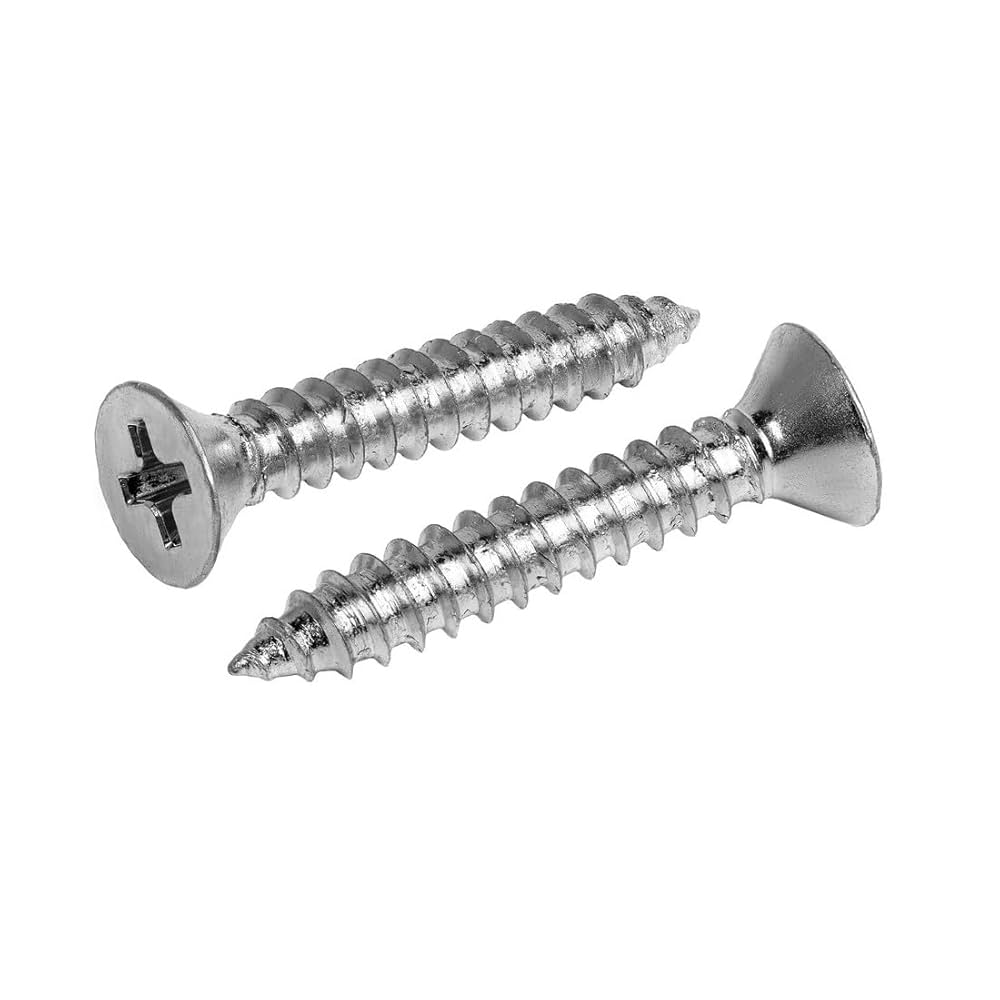
Premium A2 (304) and A4 (316) stainless steel csk philips self tapping screw. Available in metric coarse threads and select UNC/BSW on request. Mill Test Certificates (MTC), strict dimensional tolerances, and fast dispatch from ready stock.
DIN 7982
Stainless Steel Csk Philips Self Tapping Screw
TRSUTED SS csk philips self tapping screw FOR DEMANDING APPLICATION
Key Specifications
Standards
-
Grades (Material)
A2 (304), A4 (316)
Strength Classes
-
Threads
Metric coarse (default). Fine/UNC/BSW available on request
Sizes
M1.6 to M 70, 3/16" to 2.1/2" (others on request)
Lengths
-
Head
-
Marking
Grade/class & manufacturer ID as applicable
Certificates
MTC 3.1 / chemical composition & mechanicals available
Compliance
RoHS/REACH; generally non-magnetic in solution-annealed state (slight magnetism possible after cold-work)
Choosing the Right Stainless Steel Csk Philips Self Tapping Screw
Choosing the Right SS CSK Phillips Self-Tapping Screw (Guide)
for stainless steel countersunk (CSK) Phillips self-tapping screws
1. What is an SS CSK Phillips Self-Tapping Screw?
An SS CSK Phillips self-tapping screw is:
CSK (countersunk) head → flat, conical head that sits flush with the surface after countersinking
Phillips drive → cross-recess for PH screwdriver/bit
Self-tapping thread → forms/cuts its own mating thread in thin sheet metal/plastic
Made from stainless steel → corrosion-resistant
It is used to fasten thin sheets or components directly into a pre-drilled/punched hole, without a nut.
2. When Should You Use CSK Self-Tapping vs Pan Self-Tapping?
Use SS CSK Phillips self-tapping when:
You want the screw head to be flush or slightly below surface
Aesthetics and no projection are important (no snagging)
There is enough material thickness to make a proper countersink
Typical applications:
Electrical & electronic panel covers (flush finish)
Control panels, switch plates, faceplates
Architectural / decorative sheet-metal work
Flush fixing of hinges, handles, trims on sheet metal/plastic
Use pan head instead when:
Sheet is too thin for countersinking
A little projection is acceptable
You prefer easier/cheaper straight-hole assembly
3. Environment & Stainless Steel Grade
a) Choose by environment
Normal indoor / mild outdoor / general industrial
→ A2 (SS 304) CSK Phillips self-tapping
Standard, economical, good corrosion resistance
Coastal / marine / chemical / high-chloride
→ A4 (SS 316) CSK Phillips self-tapping
Superior pitting & crevice corrosion resistance
Best for outdoor terminals, marine panels, chemical plant enclosures
Low-risk, dry indoor & cost-sensitive
→ SS 202 (only if accepted by customer)
Lower corrosion resistance
Avoid for exterior, marine or chemical environments
b) Match other hardware
Use same grade as hinges, plates, covers and other visible fasteners, especially in corrosive or high-end aesthetic applications.
4. Head & Countersink Details
a) CSK head
Typically 90° countersink (check standard & matching countersink tool)
Gives a smooth, flat finish – no head projection
Good where there is movement over the surface (sliding parts, wipe-down surfaces, people walking/leaning)
b) When is CSK a bad choice?
Avoid CSK self-tapping screws when:
Sheet is very thin (head may “knife” through or distort sheet)
You cannot easily countersink (process limitation)
High loads are expected but the countersunk area is small → consider pan/hex + washer instead.
Mechanical Properties (Guide)
Mechanical Properties (Guide) – SS CSK Phillips Self-Tapping Screws
These screws are typically made from austenitic stainless steel similar to other SS fasteners. Exact values vary by manufacturer, but you can use the following as a guide level.
A2 (SS 304) CSK Self-Tapping Screws
Material: A2 (approx. SS 304)
Indicative tensile strength: ≈ 700 MPa (similar to A2-70 fastener wire)
Ductile → some bending before breakage
Corrosion resistance:
Good in indoor & general outdoor industrial environment
Suitable for electrical panels, machinery enclosures, sheet-metal cabinets
A4 (SS 316) CSK Self-Tapping Screws
Material: A4 (approx. SS 316)
Indicative tensile strength: similar order to A4-70 (~700 MPa tensile)
Key advantage:
Excellent resistance in marine, coastal, poolside, and many chemical environments
Typical use:
Outdoor stainless enclosures
Marine Junction boxes, food & pharma equipment covers, chemical plant panels
SS 202 CSK Self-Tapping Screws (Where Used)
Material: 200 series Cr-Mn stainless
Mechanical strength often adequate for sheet-metal fastening
Corrosion resistance: clearly lower than 304/316
Limit to dry indoor, non-critical applications.
In practice, for self-tapping applications, sheet material and thread engagement usually govern the joint capacity before the stainless screw actually fails in tension.
Quick Selection Cheat Sheet (For Sales / Shop Floor)
Base Material & Finish Required
Need flush surface on sheet → CSK Phillips self-tapping
No flush requirement → consider pan self-tapping (easier manufacturing)
Environment
Standard industrial / indoor / mild outdoor → A2 (304)
Coastal, marine, chemical, aggressive → A4 (316)
Diameter
Light covers → 3.0–3.9 mm
General panels → 4.2–4.8 mm
Heavier sheet → 5.5–6.3 mm
Length
Total sheet stack + 2–3 × diameter effective engagement in base material
Hole & Countersink
Use proper pilot hole size recommended by supplier
Use correct countersink angle and depth so the head sits flush
Assembly
Correct PH bit, firm axial pressure
Avoid over-torque to protect head and threads
Use lubrication for stainless-into-stainless or harder substrates.
6000+ Products
Trusted by 2000+ Clients
40+ Years of Experience
Exporting to 12+ Countries
What We Do
From a vast manufacturing facility situated in GIDC Wadhwan, Gujarat to strategic
sales offices in Mumbai and Chennai, we design, produce, and deliver a wide array of stainless steel
fasteners, hex bolts, machine screws, socket screws, washers, nuts, self‑tapping screws, threaded rods,
anchor fasteners, and specialty material products, engineered for demanding sectors like petrochemicals,
pharmaceuticals, automotive, and construction.
Our Legacy & Mission
Founded on a vision of precision and service, we have consistently expanded our
capabilities to meet evolving industrial needs. Our commitment to "We Deliver Quality" reflects in the
long-term relationships we build with clients across India and abroad.
Frequently Asked Questions
What is an SS CSK Phillips self-tapping screw?
It is a stainless steel screw with a countersunk (flat, conical) head and Phillips drive that can form its own mating thread in thin sheet metal or plastic, when driven into a pre-drilled hole. The head sits flush with the surface after countersinking.
Where are SS CSK Phillips self-tapping screws commonly used?
They are usually used in:
Electrical and electronic panel covers & faceplates
Control panels, instrument plates, switch plates
Sheet-metal cabinets, stainless facades and trims
Hinges, handles, trims on sheet metal/plastic where a flush finish is needed
Anywhere you need a flat, snag-free surface.
Why choose CSK (countersunk) instead of pan head?
Choose CSK when:
You want the head to be flush or slightly below the surface
There must be no projection (safety, aesthetics, sliding components)
The sheet is thick enough to create a proper countersink
Choose pan when:
Sheet is too thin to countersink
Some head projection is acceptable
You want simpler drilling (straight hole only, no countersink)
Do I still need a hole if the screw is “self-tapping”?
Yes. “Self-tapping” means the screw forms or cuts the thread, not the hole. You must provide a pilot hole:
Hole is slightly smaller than the screw’s outside thread diameter
Correct hole size ensures proper thread formation and reasonable driving torque.
What is the advantage of a Phillips (PH) drive?
Very common and easy to source bits (PH1, PH2, etc.)
Suitable for most manual and power-driver applications
Familiar to most technicians and electricians
Note: Phillips is designed to cam-out at higher torque, so if over-tightened, it can slip and damage the head. For very high-torque production, some users prefer Pozi or Torx.


