


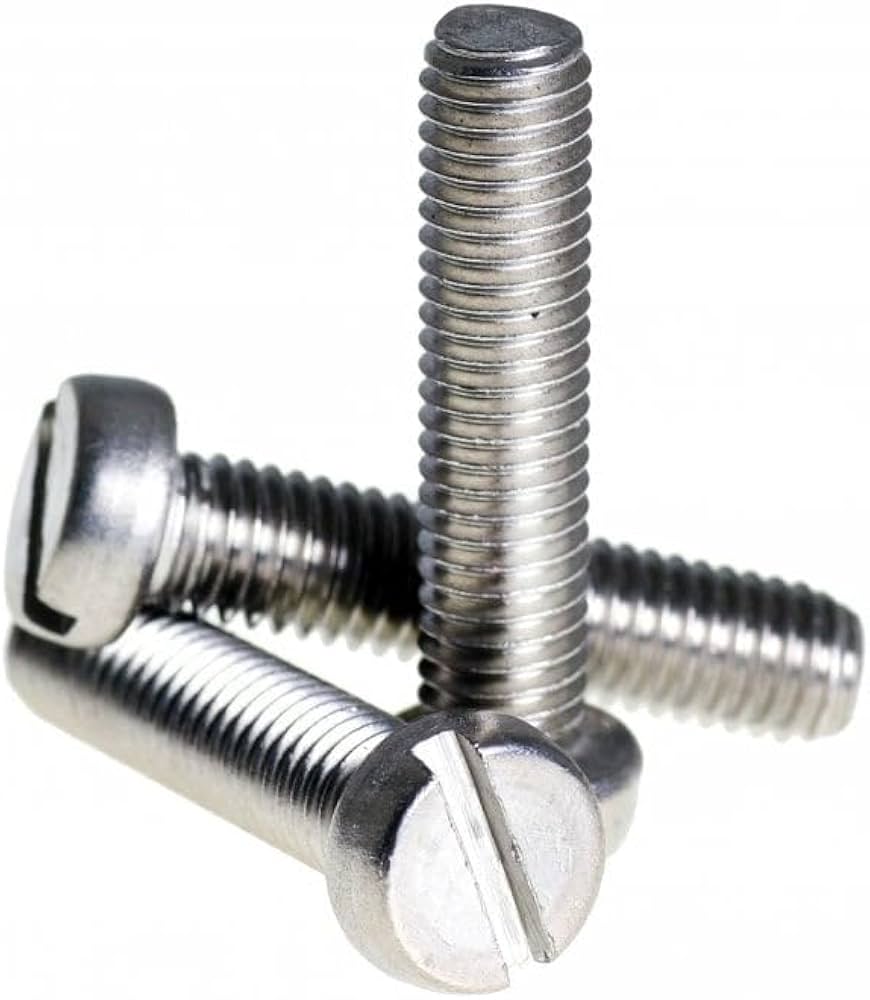
Premium A2 (304) and A4 (316) stainless steel Cheese head slotted screw. Available in metric coarse threads and select UNC/BSW on request. Mill Test Certificates (MTC), strict dimensional tolerances, and fast dispatch from ready stock.
DIN 84
Stainless Steel Cheese Head Slotted Screw
TRSUTED SS Cheese head slotted screw FOR DEMANDING APPLICATION
Key Specifications
Standards
-
Grades (Material)
A2 (304), A4 (316)
Strength Classes
-
Threads
Metric coarse (default). Fine/UNC/BSW available on request
Sizes
M1.6 to M 70, 3/16" to 2.1/2" (others on request)
Lengths
-
Head
-
Marking
Grade/class & manufacturer ID as applicable
Certificates
MTC 3.1 / chemical composition & mechanicals available
Compliance
RoHS/REACH; generally non-magnetic in solution-annealed state (slight magnetism possible after cold-work)
Choosing the Right Stainless Steel Cheese Head Slotted Screw
1) What is a cheese head slotted screw & when should you use it?
A cheese head slotted screw is a cylindrical, tall head screw with a straight (slotted) drive. Compared to pan/round heads it has:
A tall, straight-sided cylindrical head
A flat top with a single slot
Smaller head diameter than pan, but greater head height
Use a cheese head slotted screw when you need:
A high head that is easy to grip and turn with a screwdriver or by hand (for assembly/adjustment)
A compact head diameter that doesn’t interfere with surrounding parts
A more “classic” or traditional look for old machinery, restoration work, panels, instruments, etc.
Typical applications:
Electrical and control panels
Instruments, meters, machine covers
Older machines / restoration / retro-fit work
Jigs, fixtures and clamps needing a tall head for access
2) Head style – why cheese head instead of pan / CSK / hex?
Cheese head (your product):
Tall cylindrical head, small-ish diameter
Easy to access in recessed areas where a wider head would clash
Suitable where head height is available, but head diameter must be limited
Pan / round head:
Lower, dome/pan-shaped with wider head diameter
Better for spreading load on thin sheet without washer
More modern appearance, but larger diameter may clash with nearby walls/slots
Countersunk (CSK):
Conical head, sits flush with the surface
Best where the surface must be flat, but requires a countersunk hole
Hex / Allen cap:
For higher strength and torque with wrench/Allen key drive
Used where strong tightening is more important than traditional slotted appearance
Choose cheese head slotted when:
You want a tall, visible head for screwdriver access
There is limited space around the head but enough space above
The design calls for traditional slotted screws (electrical/instrumentation, retro/industrial look)
3) Drive type – slotted head selection
Slotted drive:
Single straight slot across the top
Can be driven with a normal flat screwdriver
Common in panels, terminals, electrical & older industrial equipment
Pros:
Very universal tool availability
Classic appearance
Cons:
More prone to cam-out (screwdriver slipping) than Phillips/Pozi/Allen
Less suitable for very high torque or power-driver assembly
For your catalogue, cheese head slotted screws are ideal where:
Assemblies are hand-assembled or serviced manually
Torque is moderate, not extreme
A traditional, simple head is desired
Mechanical Properties (Guide)
Mechanical Properties (Guide) – Cheese Head Slotted Screw. The mechanical strength is governed by the material grade and thread diameter, not by the head style alone. The cheese head and slotted drive mainly limit the practical tightening torque.
Stainless Steel Cheese Head Screws (A2 / A4)
Typical minimum properties:
A2-70 / A4-70
Tensile strength ≈ 700 MPa
Proof strength ≈ 450 MPa
A4-80 (where available)
Tensile strength ≈ 800 MPa
Proof strength ≈ 600 MPa
Behaviour:
Good combination of strength + corrosion resistance.
Ideal for stainless panels, covers, equipment housings, clamps and fixtures.
Stainless threads are more prone to galling if assembled into stainless nuts/inserts – use:
Anti-seize / thread lubricant,
Metric coarse threads,
Controlled tightening.
6000+ Products
Trusted by 2000+ Clients
40+ Years of Experience
Exporting to 12+ Countries
What We Do
From a vast manufacturing facility situated in GIDC Wadhwan, Gujarat to strategic
sales offices in Mumbai and Chennai, we design, produce, and deliver a wide array of stainless steel
fasteners, hex bolts, machine screws, socket screws, washers, nuts, self‑tapping screws, threaded rods,
anchor fasteners, and specialty material products, engineered for demanding sectors like petrochemicals,
pharmaceuticals, automotive, and construction.
Our Legacy & Mission
Founded on a vision of precision and service, we have consistently expanded our
capabilities to meet evolving industrial needs. Our commitment to "We Deliver Quality" reflects in the
long-term relationships we build with clients across India and abroad.
Frequently Asked Questions
What is a cheese head slotted screw?
A cheese head slotted screw is a machine screw with a tall, cylindrical head and a single straight slot on top.
Compared to a pan head, it has:
More head height (taller head)
A smaller head diameter
A flat top with a straight slot for a flat screwdriver
It’s widely used in electrical panels, instruments, covers and machine assemblies.
When should I use a cheese head screw instead of a pan head or CSK screw?
Use a cheese head slotted screw when:
You need a tall head that’s easy to reach with a screwdriver
There is limited space around the head (small head diameter helps)
The design prefers a traditional slotted look (electrical / instrumentation / retro machinery)
Use pan head when you want a wider bearing area on thin sheet.
Use CSK (countersunk) when the screw has to sit flush with the surface.
Where are cheese head slotted screws commonly used?
Typical uses:
Electrical and control panels
Terminals, instruments, meters, measuring devices
Machine covers and access doors
Jigs, fixtures, clamps and toolroom assemblies
Restoration / retro / classic equipment that originally used slotted screws
They’re ideal where screws are visible and frequently accessed with a screwdriver.
Are slotted cheese head screws suitable for high-torque applications?
Not really. Slotted drives are:
More prone to cam-out (driver slipping)
Limited in torque capacity compared to Philips/Pozi/Allen/hex drives
Cheese head slotted screws are best for light–medium duty clamping and panel/cover fastenings.
For high-torque or structural joints, use hex bolts or Allen cap screws.
Are stainless cheese head slotted screws magnetic?
SS 304 (A2) screws can be slightly magnetic due to cold working during manufacturing.
SS 316 (A4) is usually less magnetic, but light magnetism is still possible.
If a customer requires strictly non-magnetic screws, that must be clearly specified.


