


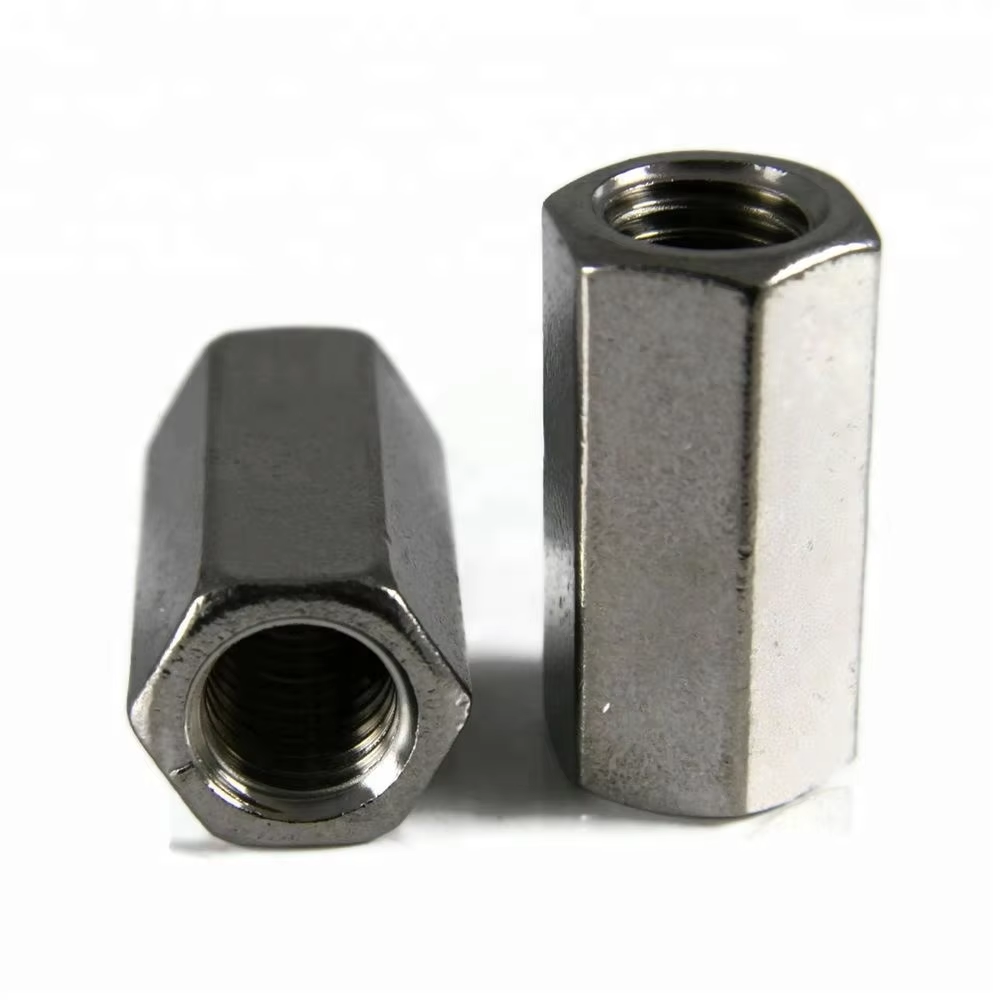
Premium A2 (304) and A4 (316) stainless long nuts. Available in metric coarse threads and select UNC/BSW on request. Mill Test Certificates (MTC), strict dimensional tolerances, and fast dispatch from ready stock.
DIN 6334
Stainless Steel Long Nuts
TRSUTED SS LONG NUT FOR DEMANDING APPLICATION
Key Specifications
Standards
DIN 6334
Grades (Material)
A2 (304), A4 (316)
Strength Classes
-
Threads
Metric coarse (default). Fine/UNC/BSW available on request
Sizes
M6 to M 20 (others on request)
Lengths
-
Head
-
Marking
Grade/class & manufacturer ID as applicable
Certificates
MTC 3.1 / chemical composition & mechanicals available
Compliance
RoHS/REACH; generally non-magnetic in solution-annealed state (slight magnetism possible after cold-work)
Choosing the Right Stainless Steel Long Nuts
Function – when to use a long nut
A long nut (also called coupling nut / extension nut) is a long hex nut used mainly to:
Join two threaded rods/studs end-to-end (extend length).
Allow length adjustment on tie rods, hangers, and bracing members.
Provide extra thread engagement where a normal hex nut is too short.
Typical applications:
Threaded rod assemblies for supports, pipe hangers, cable trays, ducts.
Tie rods / bracing in structures and machinery.
Alignment/adjustment joints where you need to fine-tune length.
Think of a long nut as a connector + adjuster between two threaded pieces, not just a “big nut”.
Environment & corrosion – material selection
For stainless long nuts:
Indoors / general outdoor → A2 (304) long nut
Marine / coastal / chloride / chemical → A4 (316) long nut
Match nut material with the rods/bolts:
A2 long nut with A2 threaded rods/studs
A4 long nut with A4 threaded rods/studs
This avoids galvanic corrosion and gives consistent corrosion resistance across the whole assembly.
Length & thread engagement – the critical choice
The length of the long nut decides how much thread engagement you get on each rod/stud. That directly affects the load capacity.
Common thumb rules:
For normal duty joints:
Aim for at least 1× rod diameter of thread engagement on each side.
For higher loads / safety-critical joints:
Aim for 1.5× rod diameter or follow your design standard.
Examples (simplified rule of thumb):
M10 rod → want at least 10–15 mm full thread engagement per side.
M16 rod → want at least 16–24 mm per side.
Most long nuts are designed with a length of ~2d to 3d (2–3 times the thread diameter) to give adequate engagement for both ends combined.
Key point:
Always ensure the rods are fully engaged inside the long nut – they should not just “catch” a few threads at the ends.
Application type – adjustment vs fixed connection
Adjustment / tensioning joints
Long nuts are often used where you can rotate the nut to lengthen/shorten a tie rod.
Marking the centre of the nut and rod ends can help visually confirm engagement.
Permanent extensions
When used simply to extend two rods, once the correct length is set, you can lock each side with jam nuts if needed for extra security.
If significant tension, compression, or vibration is involved, treat the design like a proper tie-rod system, not just a casual extension.
Mechanical Properties (Guide)
Long nuts follow the same property classes as standard stainless hex nuts (e.g., A2-70, A4-70).
Their length increases available thread engagement, but basic material strength is the same as the corresponding nut class.
A2-70 Long Nuts
Material: A2 (304) stainless steel
Property class: 70 (compatible with A2-70 rods/bolts).
Suitable for:
General indoor/outdoor structures and supports.
Threaded rod systems in fabrication, HVAC, cable tray, and machinery support.
A4-70 Long Nuts
Material: A4 (316) stainless steel
Property class: 70 (compatible with A4-70 rods/bolts).
Suitable for:
Marine, coastal, chemical, and chloride-rich environments.
Stainless threaded rod systems in plants, offshore structures, water treatment, and food/pharma areas.
Key mechanical points:
For a given size (e.g., M12 A2-70 long nut):
Thread yield and tensile capacity are similar to an M12 A2-70 hex nut.
Additional length allows more thread engagement, which improves:
Resistance to thread stripping
Load distribution between the two rods
The overall joint strength is governed by:
Rod tensile strength
Thread stripping capacity of the nut and rods
Bending or buckling if the rods are used as compression members
Any additional locking elements (jam nuts, etc.)
Long nuts are not a substitute for engineered turnbuckles in highly critical tensioning systems unless specifically designed and rated as such.
6000+ Products
Trusted by 2000+ Clients
40+ Years of Experience
Exporting to 12+ Countries
What We Do
From a vast manufacturing facility situated in GIDC Wadhwan, Gujarat to strategic
sales offices in Mumbai and Chennai, we design, produce, and deliver a wide array of stainless steel
fasteners, hex bolts, machine screws, socket screws, washers, nuts, self‑tapping screws, threaded rods,
anchor fasteners, and specialty material products, engineered for demanding sectors like petrochemicals,
pharmaceuticals, automotive, and construction.
Our Legacy & Mission
Founded on a vision of precision and service, we have consistently expanded our
capabilities to meet evolving industrial needs. Our commitment to "We Deliver Quality" reflects in the
long-term relationships we build with clients across India and abroad.
Frequently Asked Questions
What is a long nut (coupling nut)?
A long nut – also called a coupling nut or extension nut – is a long hex nut with full-length internal threads.
It is mainly used to join two threaded rods or studs together, or to provide extra thread engagement and adjustment in a threaded assembly.
When should I use a long nut instead of a normal hex nut?
Use a long nut when:
You want to extend the length of a threaded rod/stud.
You need more thread engagement than a standard hex nut can provide.
You need length adjustment (turning the long nut alters the effective length of the tie rod/hanger).
A normal hex nut is used mainly for clamping, not for joining two threaded elements end-to-end.
Where are long nuts commonly used?
Typical applications include:
Threaded rod supports for cable trays, ducts, pipes, and ceilings.
Tie rods and bracing systems in steel structures and machinery.
Alignment and adjustment joints in frames, conveyors, and mechanical linkages.
Anywhere you need to fine-tune length or extend a threaded connection.
How do I select the correct length of long nut?
The key is thread engagement on each side:
For normal duty → aim for at least 1× rod diameter engaged on each side.
For higher loads / critical joints → often 1.5× rod diameter or as per design standard.
Example:
M12 rod → aim for 12–18 mm minimum engagement per side inside the long nut.
Make sure the long nut is long enough so both rods are properly engaged, not just “catching a few threads” at the ends.
Do both ends of a long nut have the same thread?
Standard coupling nuts:
Have the same thread both sides, usually right-hand metric coarse (e.g., M10×1.5).
Special types:
Right-hand / left-hand (RH/LH) long nuts – one end RH, the other LH.
Turning the nut pulls both rods together or pushes them apart, like a turnbuckle, for easy tensioning/adjustment.
Always check diameter, pitch and handedness before use.


