


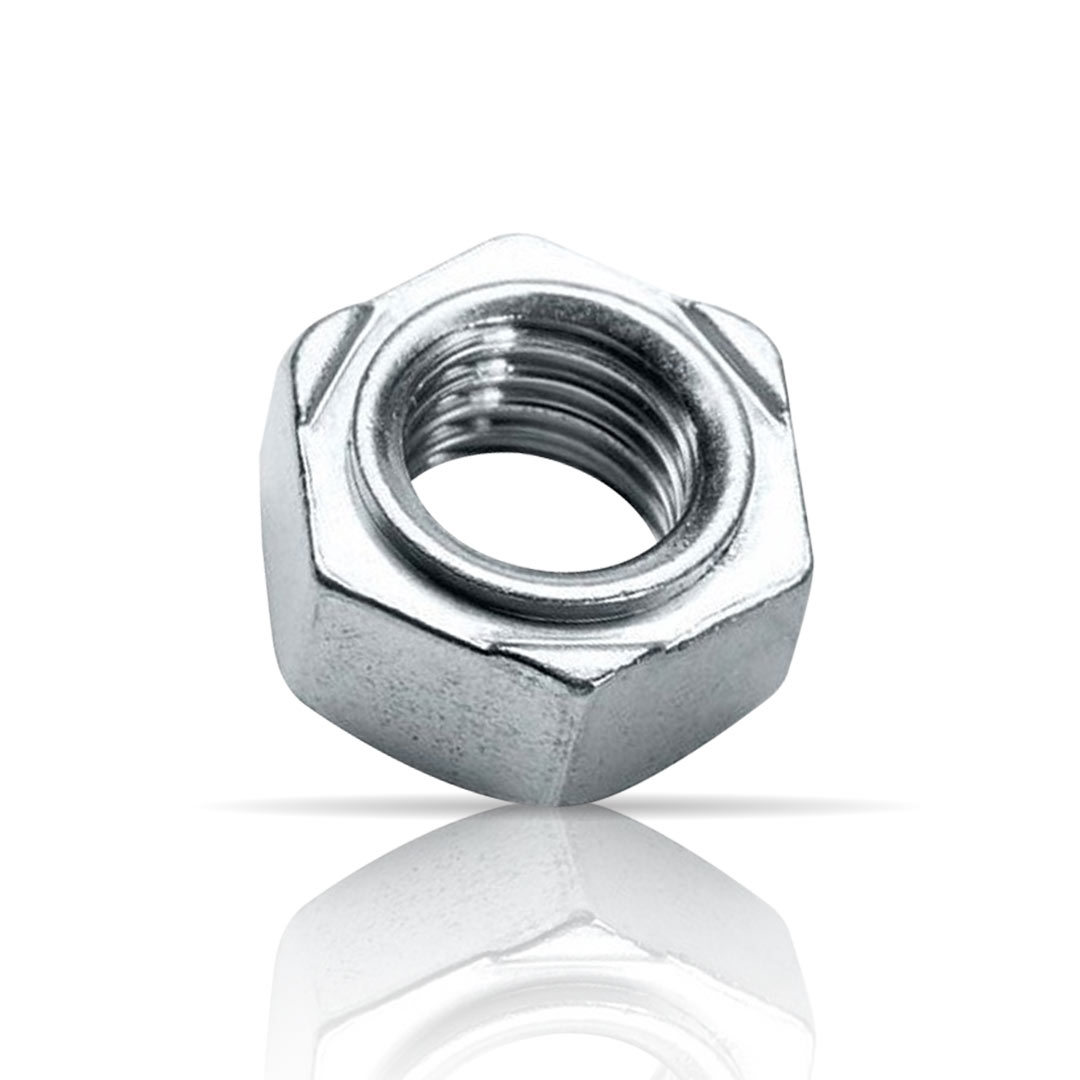
Premium A2 (304) and A4 (316) stainless hex weld nuts. Available in metric coarse threads and select UNC/BSW on request. Mill Test Certificates (MTC), strict dimensional tolerances, and fast dispatch from ready stock.
DIN 929
Stainless Steel Hex Weld Nuts
TRSUTED SS HEX WELD NUT FOR DEMANDING APPLICATION
Key Specifications
Standards
DIN 929
Grades (Material)
A2 (304), A4 (316)
Strength Classes
-
Threads
Metric coarse (default). Fine/UNC/BSW available on request
Sizes
M6 to M 20 (others on request)
Lengths
-
Head
-
Marking
Grade/class & manufacturer ID as applicable
Certificates
MTC 3.1 / chemical composition & mechanicals available
Compliance
RoHS/REACH; generally non-magnetic in solution-annealed state (slight magnetism possible after cold-work)
Choosing the Right Stainless Steel Hex Weld Nuts
When to use a hex weld nut
Use a hex weld nut when you want a permanent threaded point on a plate or section and:
You can weld, but tapping or using loose nuts is not practical.
You want to assemble from one side only (other side closed/inaccessible).
You want a strong, non-rotating nut that stays fixed to the component for life.
Typical applications:
Fabricated frames & machine bases
Automotive / body structures / chassis parts
Heavy brackets, mounting plates, guards
Anywhere a fixed stainless thread is needed on a plate or structural member.
Environment & corrosion (material selection)
For stainless systems (typical for your product line):
Indoors / general outdoor → A2 (304) hex weld nut
Marine / coastal / chloride / chemical → A4 (316) hex weld nut
Match nut with bolt:
A2 weld nut with A2 bolts
A4 weld nut with A4 bolts
If you’re using carbon steel, match coating + grade to the rest of the hardware (plain, zinc, HDG, etc.).
Weld style & base design
Hex weld nuts come in different weld configurations – choose based on base thickness, process and access:
Projection weld hex nut
Small weld projections on the nut face.
Designed for resistance/spot welding to sheet metal.
Gives repeatable welds in production lines (automotive, mass fabrication).
Plain-face hex weld nut
Flat face for manual fillet welding around the nut.
Best for thicker plates or where projection welding isn’t available.
Pilot / boss type hex weld nut
Has a small pilot/boss that fits into a punched/drilled hole.
Helps locate the nut and keep it centred.
Reduces risk of weld spatter entering threads.
Thumb rule:
Thin sheet + resistance welding → Projection hex weld nut.
Thicker plate + manual welding → Plain-face hex weld nut (with or without pilot).
Thread size, load & engagement
When choosing size:
Select M6, M8, M10, M12, etc. based on:
Required clamping load
Matching bolt size
Ensure sufficient thread engagement:
Typically aim for ≈ 1× bolt diameter engagement in steel designs (or as per your design standard).
The joint capacity depends on:
Bolt strength
Nut thread strength
Weld strength between nut and plate
If the weld is weak, it becomes the weakest link even with high-grade nuts and bolts.
Hole & fit (for pilot-type hex weld nuts)
If using pilot/boss type:
Punch/drill a hole to the correct diameter for the pilot.
The pilot:
Locates the nut during welding
Helps keep threads aligned
Acts as a barrier to weld spatter entering the thread
Wrong hole size can cause:
Poor seating or misalignment
Difficult welding
Reduced strength
Mechanical Properties (Guide)
Hex weld nuts follow the same property class logic as standard hex nuts (e.g., A2-70, A4-70).
The main difference is that the nut is fixed by welding, so the weld becomes part of the load path.
A2-70 Hex weld nuts
Material: A2 (304) stainless steel
Property class: 70 (for use with A2-70 bolts/studs).
Suitable for:
General stainless fabrications (frames, brackets, panels).
Indoor / outdoor structures in mild to moderate corrosive environments.
A4-70 Hex weld nuts
Material: A4 (316) stainless steel
Property class: 70 (for use with A4-70 bolts/studs).
Suitable for:
Marine, coastal, chemical, chloride-rich environments.
Stainless structures and equipment where long-term corrosion resistance is critical.
Key mechanical points:
For a given size (e.g., M10 A2-70 hex weld nut):
Thread strength is similar to a standard A2-70 hex nut.
Overall joint strength = min( bolt capacity, nut thread capacity, weld capacity, plate capacity ).
Correct weld size, length and quality are essential to fully use the bolt+nut property class.
6000+ Products
Trusted by 2000+ Clients
40+ Years of Experience
Exporting to 12+ Countries
What We Do
From a vast manufacturing facility situated in GIDC Wadhwan, Gujarat to strategic
sales offices in Mumbai and Chennai, we design, produce, and deliver a wide array of stainless steel
fasteners, hex bolts, machine screws, socket screws, washers, nuts, self‑tapping screws, threaded rods,
anchor fasteners, and specialty material products, engineered for demanding sectors like petrochemicals,
pharmaceuticals, automotive, and construction.
Our Legacy & Mission
Founded on a vision of precision and service, we have consistently expanded our
capabilities to meet evolving industrial needs. Our commitment to "We Deliver Quality" reflects in the
long-term relationships we build with clients across India and abroad.
Frequently Asked Questions
What is a hex weld nut?
A hex weld nut is a hexagonal nut designed to be welded permanently to a plate, bracket, or structure.
Once welded, it provides a fixed threaded point, so you can assemble and disassemble bolts from the other side without holding a loose nut.
When should I use a hex weld nut instead of a loose hex nut?
Use a hex weld nut when:
You need a permanent thread on a component.
Access to the nut side is limited or impossible during assembly.
You want to speed up assembly (only handle bolts, not nuts).
You want to ensure the nut cannot rotate or fall out in service.
For simple, accessible joints that are not permanent, a loose hex nut is usually enough.
What’s the difference between a hex weld nut and a square weld nut?
Both are made to be welded, but:
Hex weld nut:
Hexagonal shape, familiar for spanners and standard dimensions.
Often used where tool access and standardization with other hex hardware is preferred.
Square weld nut:
Square shape with larger bearing area, good in pockets/recesses.
Often used in channels, recesses and sheet metal where anti-rotation is helped by the shape.
Choice usually depends on drawing, access, and preferred style.
Should I choose A2 or A4 stainless steel hex weld nuts?
A2 (304) → For indoor, general outdoor, and mildly corrosive environments.
A4 (316) → For marine, coastal, chemical, or chloride-rich environments.
Match weld nut material with your bolt material where possible:
A2 weld nut with A2 bolt
A4 weld nut with A4 bolt
Will welding affect the corrosion resistance of stainless hex weld nuts?
Yes, welding causes a heat-affected zone which can:
Produce heat tint / discoloration
Slightly reduce local corrosion resistance
Best practice:
Remove slag/spatter and discoloration.
Pickle and/or passivate the welded area for critical stainless applications.
This helps restore corrosion resistance around the weld.


