


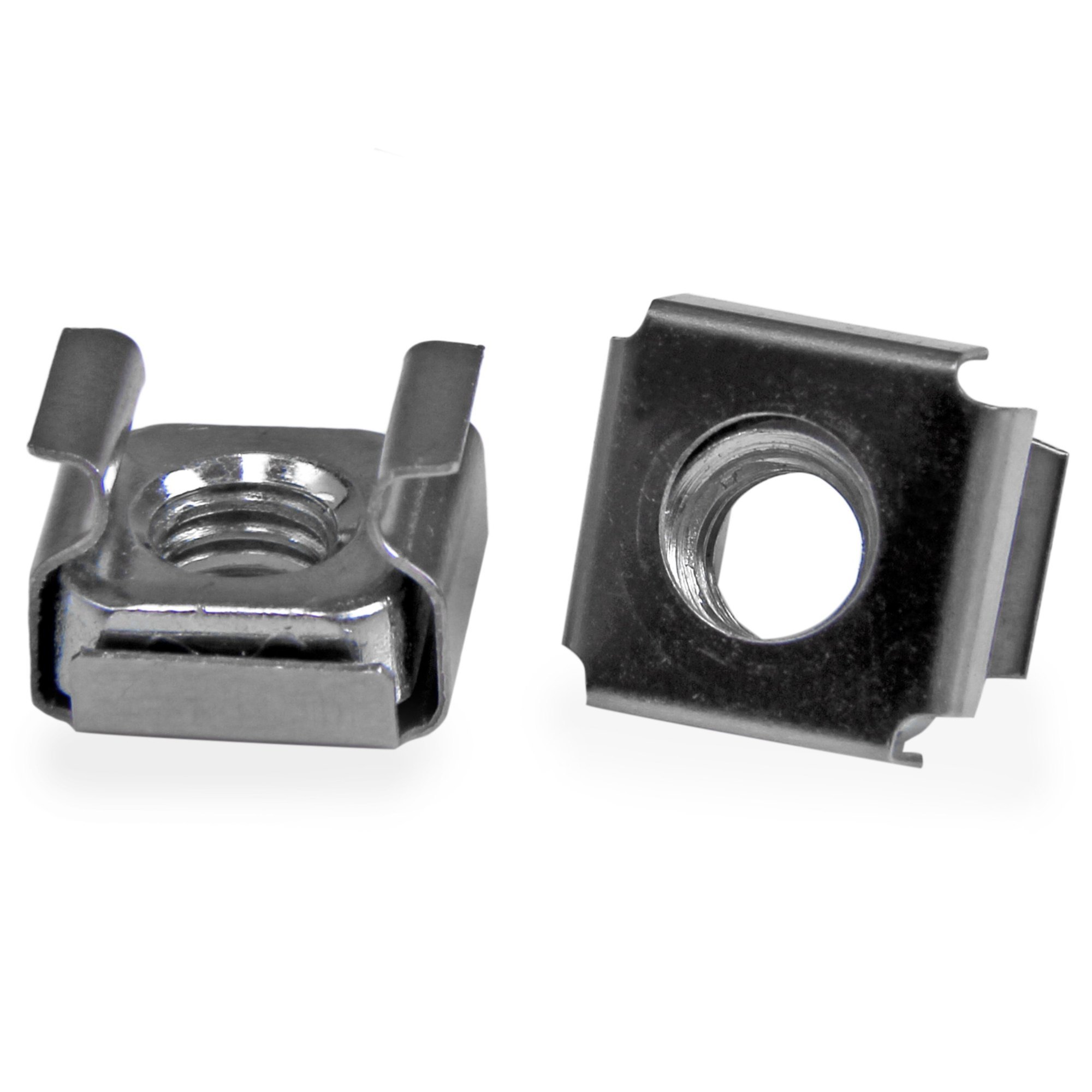
Premium A2 (304) and A4 (316) stainless cage nuts. Available in metric coarse threads and select UNC/BSW on request. Mill Test Certificates (MTC), strict dimensional tolerances, and fast dispatch from ready stock.
DIN 88109
Stainless Steel Cage Nuts
TRSUTED SS CAGE NUT FOR DEMANDING APPLICATION
Key Specifications
Standards
DIN 88109
Grades (Material)
A2 (304), A4 (316)
Strength Classes
-
Threads
Metric coarse (default). Fine/UNC/BSW available on request
Sizes
M6 to M 20 (others on request)
Lengths
-
Head
-
Marking
Grade/class & manufacturer ID as applicable
Certificates
MTC 3.1 / chemical composition & mechanicals available
Compliance
RoHS/REACH; generally non-magnetic in solution-annealed state (slight magnetism possible after cold-work)
Choosing the Right Stainless Steel Cage Nuts
What is a cage nut & when to use it?
A cage nut is a square nut held in a spring-steel “cage” that clips into a square hole in sheet metal or rack rails.
Use a cage nut when you want:
A strong threaded point in thin sheet / rack rail
The ability to change positions easily (move the nut to another hole)
To mix different thread sizes in the same panel (M5, M6, M8 etc.)
Typical uses:
19″ equipment racks / server racks / network racks
Control panels, enclosures and cabinets with square punched holes
Sheet metal frames where you can’t tap threads due to thin material
Rack / panel system & thread type
First confirm where you’re using the cage nut:
19″ Rack / cabinet rails
Common standard sizes: M5, M6, M8 (metric) or #10-32, 12-24 (imperial)
Most EU/India racks → M6 is the most common for equipment mounting.
Choose thread type based on:
The bolts / rack screws you or your customers already use
The standard in that industry (e.g., M6 for IT/server racks in India)
Rule:
Cage nut thread must match the screw/bolt thread – same diameter & pitch.
Panel thickness & cage style
Cage nuts are made for specific panel/rail thickness ranges (e.g., 1.0–1.5 mm, 1.5–2.5 mm, etc.):
For thin sheet / rack rails
Use cage nuts specified for that thickness range, so the tabs clip firmly and don’t loosen.
Check:
Hole size (usually square) must match cage nut design.
Panel thickness must be within the cage nut’s clamping range.
If panel is too thick or too thin, the cage nut may:
Be difficult to install, or
Sit loose and move during tightening.
Material & corrosion (nut + cage)
You need to consider both the nut and the cage:
Standard option (most common)
Nut: carbon steel, property class 8 or 10, zinc-plated
Cage: spring steel, zinc-plated
Good for indoor racks, IT rooms, electrical panels.
Stainless option (for corrosive / clean environments)
Nut: A2 (304) stainless, sometimes A4 (316) if available
Cage: stainless or coated spring steel
For outdoor cabinets, marine, food, pharma, chemical plants or wash-down environments.
Selection thumb rule:
Normal indoor racks/panels → Zinc-plated steel cage nuts (class 8/10).
Corrosive / outdoor / hygienic → A2 (304) or A4 (316) stainless cage nuts.
Match with same-grade bolts where possible (A2 with A2, etc.).
Mechanical Properties (Guide)
Mechanical Properties (Guide) – Cage Nuts
Mechanically, the nut follows a standard property class (e.g., 8, 10, A2-70), while the cage is a spring element whose job is to position/retain the nut in the panel.
The joint strength is governed by: nut property class, bolt grade, thread engagement, cage fit, and panel strength.
Carbon Steel Cage Nuts (Zinc-plated)
Nut material: carbon steel, typically property class 8 or 10
Capable of working with class 8.8 or 10.9 screws, depending on nut class.
Cage material: spring steel, zinc-plated for basic corrosion resistance.
Usage:
Indoor racks, IT cabinets, control panels, server/network racks.
Stainless Steel Cage Nuts
Nut material:
A2 (304), property class ~70 (A2-70), or
A4 (316) where available for higher corrosion resistance.
Cage material:
Stainless or coated spring steel, depending on design.
Usage:
Outdoor enclosures, marine/coastal installations, food/pharma/chemical plants, high humidity or aggressive environments.
Key mechanical points:
For carbon steel type:
Property class 8 / 10 nuts with compatible screws can safely handle standard rack mounting loads when used correctly.
For stainless type:
A2-70 / A4-70 nuts provide sufficient strength for most equipment mounting, plus excellent corrosion resistance.
6000+ Products
Trusted by 2000+ Clients
40+ Years of Experience
Exporting to 12+ Countries
What We Do
From a vast manufacturing facility situated in GIDC Wadhwan, Gujarat to strategic
sales offices in Mumbai and Chennai, we design, produce, and deliver a wide array of stainless steel
fasteners, hex bolts, machine screws, socket screws, washers, nuts, self‑tapping screws, threaded rods,
anchor fasteners, and specialty material products, engineered for demanding sectors like petrochemicals,
pharmaceuticals, automotive, and construction.
Our Legacy & Mission
Founded on a vision of precision and service, we have consistently expanded our
capabilities to meet evolving industrial needs. Our commitment to "We Deliver Quality" reflects in the
long-term relationships we build with clients across India and abroad.
Frequently Asked Questions
What is a cage nut?
A cage nut is a square nut held inside a spring-steel “cage” that clips into a square hole in a panel or rack rail.
The cage allows you to add a strong threaded fixing point in thin sheet metal or rack rails where you can’t tap threads directly.
Where are cage nuts commonly used?
Most commonly in:
19″ server/network racks and cabinets
Electrical/control panels with square punched holes
Sheet metal frames and enclosures
Anywhere you see square holes in rails or panels, cage nuts are often used to provide the thread.
Why use a cage nut instead of a normal nut or tapped hole?
Use a cage nut when:
The sheet is too thin to tap threads reliably.
You want to change the nut position easily – just move the cage nut to another square hole.
You want flexibility to use different thread sizes (M5, M6, M8) in the same panel.
You can only access one side of the panel for assembly.
With a cage nut, you get a replaceable, floating threaded point in a thin sheet.
How do I know if the cage nut will fit my rack or panel?
You must check:
Hole shape & size – usually a square hole to match the cage nut design.
Panel/rail thickness – the cage nut has a specific thickness range it can clip over.
If the panel is too thin or too thick, the cage nut may not clip firmly and can become loose or hard to install.
How do I install and remove a cage nut?
Installation:
Place one side of the cage in the square hole.
Compress the opposite tab and snap the cage fully into the hole.
Using cage nut pliers makes this much easier and avoids pinched fingers.
Removal:
Compress the tabs again and push the cage nut back out of the hole.
They are meant to be removable and repositionable.


