


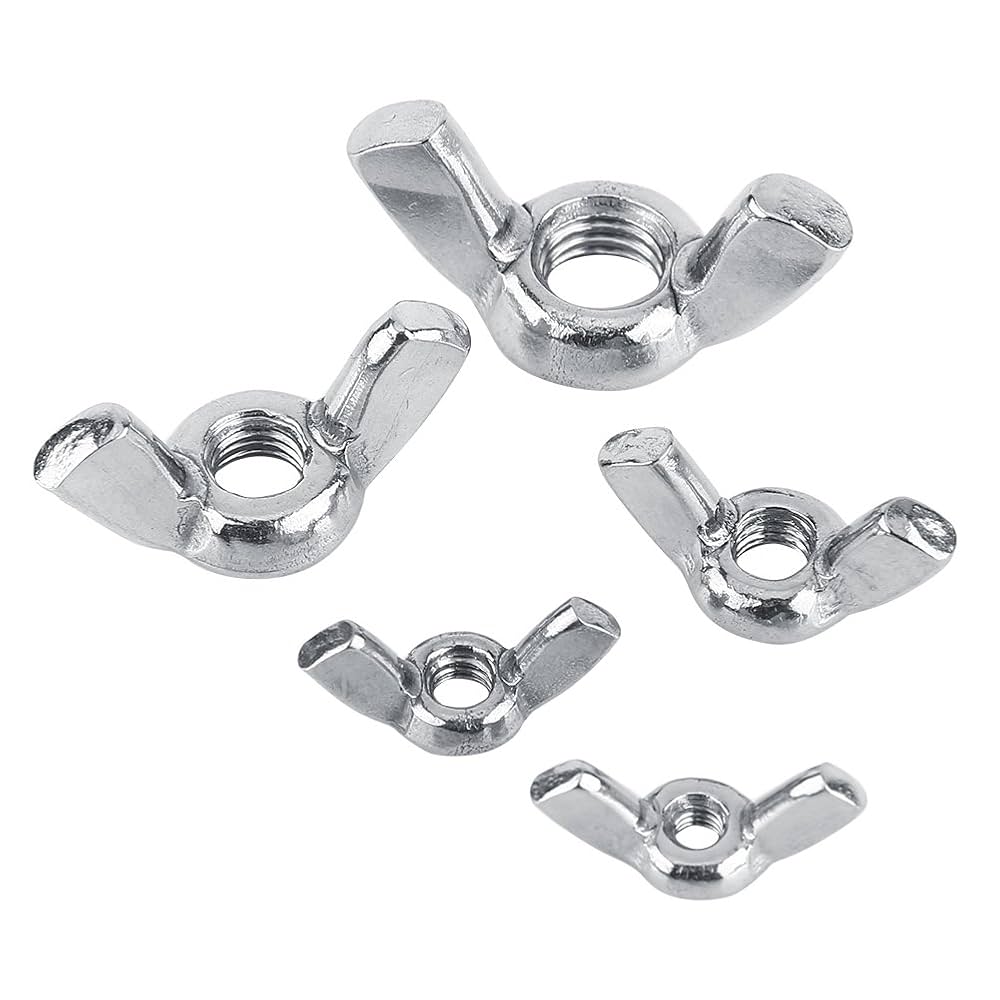
Premium A2 (304) and A4 (316) stainless wing nuts. Available in metric coarse threads and select UNC/BSW on request. Mill Test Certificates (MTC), strict dimensional tolerances, and fast dispatch from ready stock.
DIN 315
Stainless Steel Wing Nuts
TRSUTED SS WING NUT FOR DEMANDING APPLICATION
Key Specifications
Standards
DIN 315
Grades (Material)
A2 (304), A4 (316)
Strength Classes
-
Threads
Metric coarse (default). Fine/UNC/BSW available on request
Sizes
M6 to M 20 (others on request)
Lengths
-
Head
-
Marking
Grade/class & manufacturer ID as applicable
Certificates
MTC 3.1 / chemical composition & mechanicals available
Compliance
RoHS/REACH; generally non-magnetic in solution-annealed state (slight magnetism possible after cold-work)
Choosing the Right Stainless Steel Wing Nuts
What is a wing nut & when to use it?
A wing nut is a nut with two “wings” so it can be tightened and loosened by hand without tools.
Use a wing nut when you need:
Frequent adjustment – parts that are assembled/disassembled regularly
Tool-free tightening – maintenance or users don’t carry spanners
Light to medium clamping – not highly loaded structural joints
Typical applications:
Covers, guards, and panels that need regular access
Fixtures, jigs, clamping arrangements on machines and workshops
Signage, stands, displays, lighting rigs
Temporary or adjustable connections
Important: Wing nuts are not meant for high-strength structural joints or critical safety connections.
Environment & corrosion – material selection
Indoors / general outdoor → A2 (304) wing nut
Marine / coastal / chloride / chemical → A4 (316) wing nut
A2: general machinery, workshop fittings, indoor and mild outdoor exposure.
A4: near sea, on decks, poolside, chemical plants, food/pharma where corrosion resistance is critical.
Where possible, match material with the bolt:
A2 wing nut with A2 bolt
A4 wing nut with A4 bolt
Wing nut vs hex nut – which to choose?
Choose a wing nut when:
Connection is adjusted or opened frequently
You want quick, tool-free operation
Loads are moderate and non-critical
User may not have tools (customer-facing products, field adjustments, exhibition hardware)
Choose a hex nut or lock nut when:
Joint is highly loaded or safety critical
You need controlled torque and precise preload
Vibration is high and you need secure locking
Mechanical Properties (Guide)
Wing nuts generally follow the same material grades (A2, A4) as standard stainless fasteners, but in practice they are used in hand-tightened, light-to-medium duty applications.
Their functional limit is usually hand torque, not the full theoretical tensile capacity of the material.
A2 Stainless Wing Nuts (A2 / 304)
Material: A2 (304) stainless steel
Used with: A2 stainless bolts/studs
Typical usage:
Indoor machinery & equipment
Clamps, jigs, fixtures
Panels, guards, covers that require regular manual opening
General outdoor environments without extreme corrosion
A4 Stainless Wing Nuts (A4 / 316)
Material: A4 (316) stainless steel
Used with: A4 stainless bolts/studs
Typical usage:
Marine & coastal environments
Food, pharma, chemical plants (with regular washing/cleaning)
Outdoor fixtures and equipment exposed to chlorides and harsh chemicals
Key mechanical considerations:
In theory, an A2 or A4 wing nut made to a given property class has similar material strength to a hex nut of the same class.
In practice, actual clamp load is limited by:
What a person can apply by hand
The size and shape of the wings
Therefore, wing nuts should be treated as non-structural, adjustment-type fasteners, not primary high-strength, safety-critical nuts.
6000+ Products
Trusted by 2000+ Clients
40+ Years of Experience
Exporting to 12+ Countries
What We Do
From a vast manufacturing facility situated in GIDC Wadhwan, Gujarat to strategic
sales offices in Mumbai and Chennai, we design, produce, and deliver a wide array of stainless steel
fasteners, hex bolts, machine screws, socket screws, washers, nuts, self‑tapping screws, threaded rods,
anchor fasteners, and specialty material products, engineered for demanding sectors like petrochemicals,
pharmaceuticals, automotive, and construction.
Our Legacy & Mission
Founded on a vision of precision and service, we have consistently expanded our
capabilities to meet evolving industrial needs. Our commitment to "We Deliver Quality" reflects in the
long-term relationships we build with clients across India and abroad.
Frequently Asked Questions
What is a wing nut?
A wing nut is a hand-tightened nut with two “wings” on the head.
The wings let you tighten and loosen it without tools, making it ideal for parts that are adjusted or removed frequently.
When should I use a wing nut instead of a hex nut?
Use a wing nut when:
The connection needs frequent opening/adjustment
You want tool-free operation (by hand)
Loads are light to medium and not safety-critical
Use a hex nut when:
The joint is highly loaded or structural
You need controlled torque with a spanner
The assembly is permanent or rarely adjusted
Where are wing nuts commonly used?
Typical applications include:
Machine guards and access panels
Fixtures, jigs, and clamps in workshops
Sign boards, stands, displays, lighting rigs
Temporary structures, exhibition hardware, and DIY setups
Anywhere the user needs to tighten/loosen quickly without tools, a wing nut is useful.
Are wing nuts suitable for high-strength or structural joints?
Generally no.
Even though the stainless material is strong, a wing nut is hand-tightened, so actual clamp load is limited by how much a person can apply.
For high preload or safety-critical joints, use a hex or heavy hex nut, not a wing nut.
Do I need a washer with a wing nut?
In most cases, yes, it’s recommended:
Use a flat washer under the wing nut to:
Spread the load
Protect surfaces (painted, plastic, timber, sheet metal)
Reduce wear from repeated tightening/loosening
For soft or thin materials, consider larger OD washers or plate washers.


