


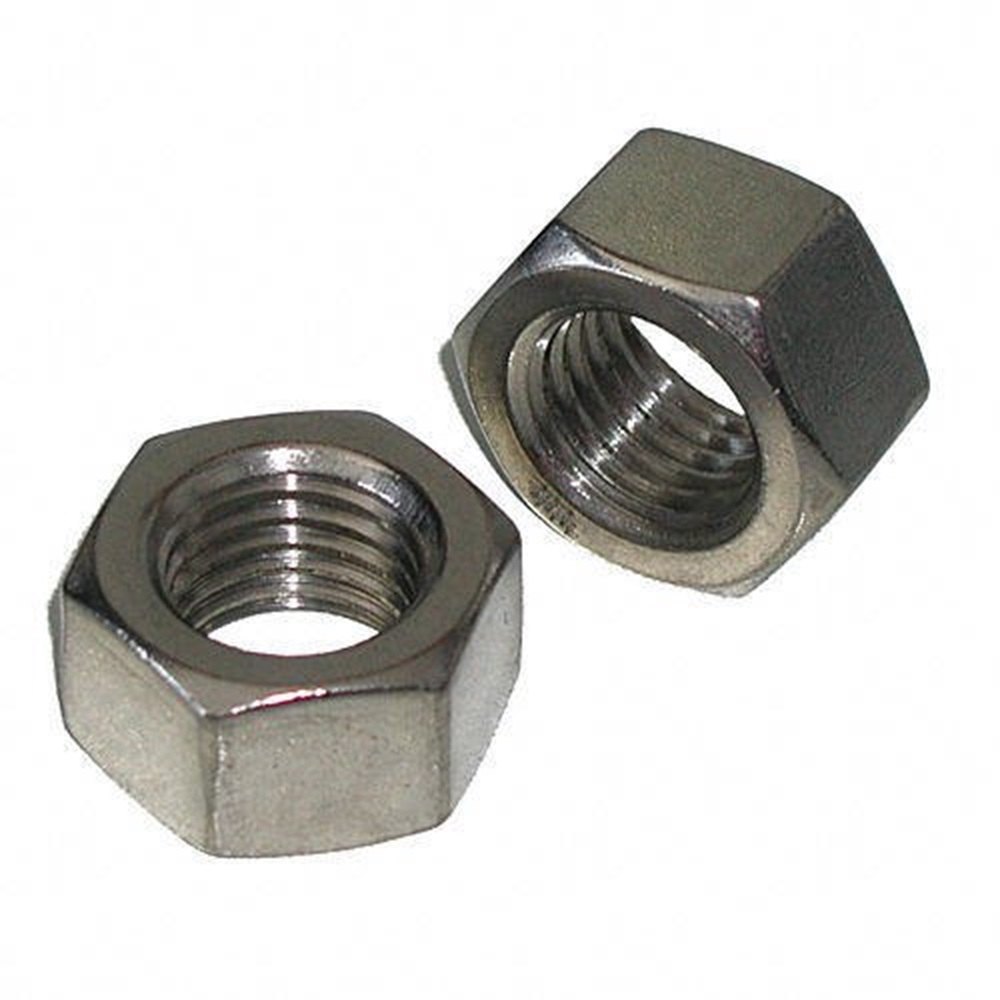
Premium A2 (304) and A4 (316) stainless steel heave hex nuts. Available in metric coarse threads and select UNC/BSW on request. Mill Test Certificates (MTC), strict dimensional tolerances, and fast dispatch from ready stock.
DIN 5587
Stainless Steel Heavy Hex Nuts
TRSUTED SS HEAVY HEX NUT FOR DEMANDING APPLICATION
Key Specifications
Standards
DIN 5587
Grades (Material)
A2 (304), A4 (316)
Strength Classes
-
Threads
Metric coarse (default). Fine/UNC/BSW available on request
Sizes
M8 to M20, 1/2" to 1" (others on request)
Lengths
-
Head
-
Marking
Grade/class & manufacturer ID as applicable
Certificates
MTC 3.1 / chemical composition & mechanicals available
Compliance
RoHS/REACH; generally non-magnetic in solution-annealed state (slight magnetism possible after cold-work)
Choosing the Right Stainless Steel Heavy Hex Nuts
What is a heavy hex nut & when to use it?
A heavy hex nut has:
Larger across-flats size than a standard hex nut
Greater thickness (height)
Use a heavy hex nut when you need:
Higher clamp load / stronger joints
More bearing surface under the nut (spreads load better)
Structural / critical applications (steel structures, flanges, high-strength bolted joints)
Typical uses:
Structural steel connections (beams, columns, bracings)
Flange connections in piping / equipment
High-strength bolt assemblies where standard nuts are not sufficient
Environment & corrosion
For stainless versions (if you’re supplying stainless heavy hex nuts):
Indoors / general outdoor → A2 (304) heavy hex nut
Marine / coastal / chemical / chloride exposure → A4 (316) heavy hex nut
Match nut material with the bolt material:
A2 heavy hex nut with A2 bolts
A4 heavy hex nut with A4 bolts
For carbon steel structural systems, heavy hex nuts are usually matched to bolt grade & coating (plain, zinc, HDG, etc.).
Strength & matching with bolt grade
Heavy hex nuts are chosen primarily for strength and bearing area.
For stainless systems:
With A2-70 / A4-70 bolts → use A2-70 / A4-70 heavy hex nuts
With higher-grade stainless bolts (e.g., A4-80) → use matching or higher-grade heavy hex nuts as specified
For carbon steel structural bolts (example: A325 / A490 type systems):
Use heavy hex nuts meeting the appropriate nut standard/property class specified for that bolt (e.g., structural nut grades).
Rule of thumb:
The heavy hex nut property class must be ≥ bolt property class, and must follow the same material family (stainless with stainless, structural carbon steel with structural bolts).
Application type: when heavy hex is preferred over standard hex
Choose a heavy hex nut instead of a standard hex nut when:
You need higher preloads (higher tightening torque)
The design requires greater safety factor against thread stripping / bearing failure
You’re following a structural or flange standard that calls for heavy hex nuts specifically
You want more wrenching surface and robustness in harsh assembly conditions
For light / medium-duty general-purpose joints, a standard hex nut is usually sufficient.
Mechanical Properties (Guide)
Heavy hex nuts are defined by their geometry (larger AF & height) and property class / grade.
Mechanically, their property class (e.g., A2-70, A4-70, structural nut grade) determines the proof strength and compatibility with the bolt.
Stainless heavy hex nuts – typical guide
A2-70 Heavy Hex Nuts
Material: A2 (304) stainless steel
Property class: 70
Intended for use with A2-70 bolts / studs
Suitable for general structural stainless joints, equipment frames, moderate outdoor environments.
A4-70 Heavy Hex Nuts
Material: A4 (316) stainless steel
Property class: 70
Intended for use with A4-70 bolts / studs
Suitable for marine, coastal, chemical, and chloride-rich environments where both strength and high corrosion resistance are required.
Higher class (e.g., A4-80) Heavy Hex Nuts (if used)
Used with A4-80 bolts in high-strength stainless joints
Provide higher proof load and allow higher clamp forces
Key mechanical points:
Higher proof strength vs. lower classes → allows higher tightening torque and clamp load.
Larger nut height → more thread engagement → improved resistance to thread stripping.
Larger across-flats → allows higher tool torque and better handling in heavy applications.
6000+ Products
Trusted by 2000+ Clients
40+ Years of Experience
Exporting to 12+ Countries
What We Do
From a vast manufacturing facility situated in GIDC Wadhwan, Gujarat to strategic
sales offices in Mumbai and Chennai, we design, produce, and deliver a wide array of stainless steel
fasteners, hex bolts, machine screws, socket screws, washers, nuts, self‑tapping screws, threaded rods,
anchor fasteners, and specialty material products, engineered for demanding sectors like petrochemicals,
pharmaceuticals, automotive, and construction.
Our Legacy & Mission
Founded on a vision of precision and service, we have consistently expanded our
capabilities to meet evolving industrial needs. Our commitment to "We Deliver Quality" reflects in the
long-term relationships we build with clients across India and abroad.
Frequently Asked Questions
What is a heavy hex nut?
A heavy hex nut is a larger, thicker version of a standard hex nut.
Compared to a normal hex nut, it has:
Bigger across-flats size
Greater height (thickness)
This gives more thread engagement and more bearing area, making it suitable for high-strength and structural applications.
Where are heavy hex nuts typically used?
Heavy hex nuts are commonly used in:
Structural steel connections (beams, columns, bracings)
Flange joints in piping and equipment
High-strength bolt assemblies
Any application where higher clamp loads and safety margins are required compared to standard nuts.
Why would I choose a heavy hex nut instead of a standard hex nut?
Choose a heavy hex nut when:
You need higher tightening torque and clamp load
You want more thread engagement to reduce the risk of thread stripping
You’re following structural / flange standards that specifically require heavy hex
The joint is critical for safety or strength (e.g., structural steel, pressure piping).
Which bolt grade should I use with heavy hex nuts?
Always match or exceed the bolt grade:
With A2-70 / A4-70 bolts → use A2-70 / A4-70 heavy hex nuts
With higher stainless grades (e.g., A4-80) → use matching or higher class heavy hex nuts as per specification
In carbon steel structural bolting, use the exact nut grade specified for the structural bolt (e.g., matching A325/A490 type systems, etc.).
Are heavy hex nuts reusable?
They can be reused only if:
Threads are clean, undamaged, and not stretched
There is no visible deformation or heavy corrosion
However, in structural and safety-critical applications, good practice (and many standards) recommend using new heavy hex nuts whenever joints are dismantled and retightened.


