


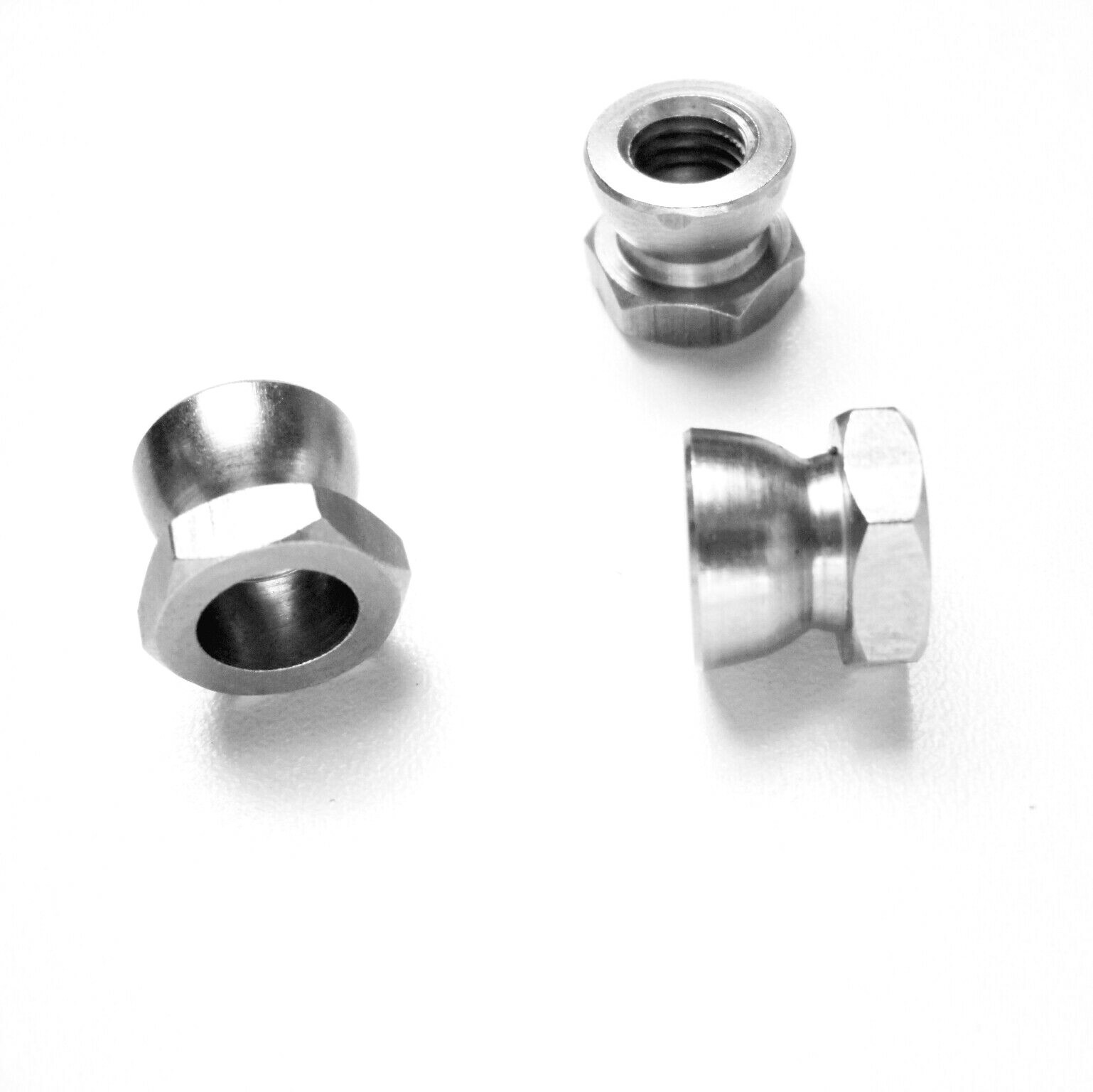
Premium A2 (304) and A4 (316) stainless steel anti theft nuts. Available in metric coarse threads and select on request. Mill Test Certificates (MTC), strict dimensional tolerances, and fast dispatch from ready stock.
DIN 9150
Stainless Steel Anti-Theft Nuts
TRSUTED SS ANTI THEFT NUT FOR DEMANDING APPLICATION
Key Specifications
Standards
DIN 9150
Grades (Material)
A2 (304), A4 (316)
Strength Classes
-
Threads
Metric coarse (default). Fine/UNC/BSW available on request
Sizes
M 6 to M 20
Lengths
-
Head
-
Marking
Grade/class & manufacturer ID as applicable
Certificates
MTC 3.1 / chemical composition & mechanicals available
Compliance
RoHS/REACH; generally non-magnetic in solution-annealed state (slight magnetism possible after cold-work)
Choosing the Right Stainless Steel Anti-Theft Nuts
Function – when to use an anti-theft nut
Use an anti-theft (security) nut when you need to discourage unauthorized removal of parts, especially in:
Public areas – street furniture, lighting poles, sign boards, guard rails, barriers
Outdoor equipment – CCTV poles, solar structures, telecom towers, gates
High-theft risk components – wheels, covers, grating, enclosures, access panels
Security nuts are designed to make removal difficult without special tools or to be one-way (non-removable) after tightening.
Environment & corrosion
Indoors / general outdoor → A2 (304) anti-theft nut
Marine / coastal / chloride / chemical → A4 (316) anti-theft nut
A2 for general structures, poles, fences, indoor & city outdoor use.
A4 for coastal, marine, industrial chemical areas or where long-term corrosion resistance is critical.
As with other stainless fasteners:
If you’re near sea, salt spray, chemical plants, cooling towers → choose A4.
Type of anti-theft nut
Choose the security concept based on how the joint will be used and maintained:
Shear nuts / breakaway nuts
Hex portion used for tightening shears off at a preset torque, leaving a smooth, conical nut underneath.
One-way security: very hard to remove without cutting tools.
Ideal where no future maintenance is expected or access must be strictly controlled.
Special drive / keyed security nuts
Require a matching special key or socket (e.g., pin–torx, multi-lobe, unique key patterns).
Allow removal with the correct tool.
Good where occasional maintenance is required but theft risk must be reduced.
Sleeve / shroud type security nuts
Nut protected by a spinning sleeve or smooth outer shell that prevents standard tools from gripping.
Often used on exposed studs where tools can otherwise easily attack the nut.
Selection thumb rule:
No maintenance, maximum tamper resistance → Shear nut / one-way nut.
Need controlled removal for service → Special-key / sleeve-type security nut.
Strength & matching with bolt/stud
Even though the geometry is different, the basic rules of strength still apply:
Choose an anti-theft nut whose material and property class match the bolt/stud:
With A2-70 bolts/studs → use A2-70 anti-theft nuts.
With A4-70 bolts/studs → use A4-70 anti-theft nuts.
For highly loaded structural joints, confirm that the chosen security nut:
Gives adequate thread engagement, and
Is rated (by supplier/standard) for the required preload/torque.
Often the security shape reduces usable wrenching area, so practical tightening torque may be lower than a conventional hex nut – keep that in mind while designing joints.
Thread form & compatibility
Default is metric coarse thread (e.g., M8×1.25, M10×1.5, M12×1.75).
Use fine threads / UNC / UNF only when matching existing bolts or tapped holes.
Always ensure:
Same diameter, pitch, and thread standard between bolt/stud and anti-theft nut.
For shear nuts, check:
The thread length inside the nut is sufficient for proper engagement with the stud.
Mechanical Properties (Guide)
Security nuts are usually based on standard stainless steel nut materials (A2 / A4) and property classes (e.g., A2-70, A4-70), but incorporate special shapes or features for tamper resistance.
The locking / security design is in addition to the basic mechanical strength of the nut.
A2-70 Anti-theft nuts
Material: A2 (304) stainless steel
Property class: 70 (compatible with A2-70 bolts/studs)
Typical usage:
City infrastructure, railings, sign boards, street lights, fences, covers
Medium corrosion exposure (urban outdoor, indoor industrial).
A4-70 Anti-theft nuts
Material: A4 (316) stainless steel
Property class: 70 (compatible with A4-70 bolts/studs)
Typical usage:
Marine/coastal installations, ports, piers, seafront railings
Chemical plants, water treatment, poolside environments
Installations where corrosion resistance and tamper-resistance are both critical.
In most designs, anti-theft nuts are treated as structurally equivalent to standard nuts of the same property class, provided thread engagement and tightening practices are correct.
However, due to special shapes (shear head, smooth cone, sleeves), practical torque and tool grip may be different from a normal hex nut – always follow the manufacturer’s tightening recommendations.
Simple selection guide
General outdoor security (sign boards, railings, basic infrastructure) →
→ A2-70 anti-theft nut, shear type where no access is needed, or keyed type for serviceable joints.
Coastal / marine / chemical plants / high corrosion risk →
→ A4-70 anti-theft nut, typically shear or keyed, depending on maintenance requirements.
One-time installation, no removal allowed →
→ Shear / breakaway anti-theft nut matched to bolt material and size.
High theft risk but periodic maintenance required →
→ Keyed or sleeve-type security nut with controlled key/sockets.
6000+ Products
Trusted by 2000+ Clients
40+ Years of Experience
Exporting to 12+ Countries
What We Do
From a vast manufacturing facility situated in GIDC Wadhwan, Gujarat to strategic
sales offices in Mumbai and Chennai, we design, produce, and deliver a wide array of stainless steel
fasteners, hex bolts, machine screws, socket screws, washers, nuts, self‑tapping screws, threaded rods,
anchor fasteners, and specialty material products, engineered for demanding sectors like petrochemicals,
pharmaceuticals, automotive, and construction.
Our Legacy & Mission
Founded on a vision of precision and service, we have consistently expanded our
capabilities to meet evolving industrial needs. Our commitment to "We Deliver Quality" reflects in the
long-term relationships we build with clients across India and abroad.
Frequently Asked Questions
What is an anti-theft nut?
An anti-theft nut (security nut) is a special nut designed to prevent or discourage unauthorized removal.
It uses a special shape, breakaway head, or unique drive so that it cannot be opened with normal spanners or sockets, and in some designs, cannot be removed at all without destroying it.
Where are anti-theft nuts typically used?
They are commonly used wherever fasteners are exposed in public areas or at high risk of theft/tampering, for example:
Street lights, sign boards, gantries
Railings, barriers, fences, gates
CCTV poles, solar panel structures, telecom towers
Gratings, manhole covers, access panels & covers
What is a shear (breakaway) nut and how does it work?
A shear nut has a hex head on top of a conical base:
You tighten it using the hex head like a normal nut.
At a preset torque, the hex section shears off, leaving a smooth, cone-shaped nut underneath.
This smooth cone cannot be gripped with standard tools, making removal very difficult without cutting or grinding.
It is ideal where no future maintenance or opening is planned.
Can anti-theft nuts be removed later if required?
It depends on the type:
Shear / breakaway nuts → generally not removable with standard tools; removal usually requires cutting or destroying the nut.
Keyed or special-drive security nuts → can be removed using a matching security key or socket; meant for controlled access by authorized personnel.
If you require periodic maintenance, choose a keyed type, not a shear nut.
Are anti-theft nuts as strong as normal nuts?
Most security nuts are made from standard stainless materials (A2/A4, class 70) and are designed to give similar strength to standard nuts of the same property class, provided:
The threads are fully engaged, and
The correct bolt/stud grade is used (e.g., A2-70 nut with A2-70 stud).
Because of their special shape, the wrenching surface is different, so always follow the supplier’s recommended torque values.


