


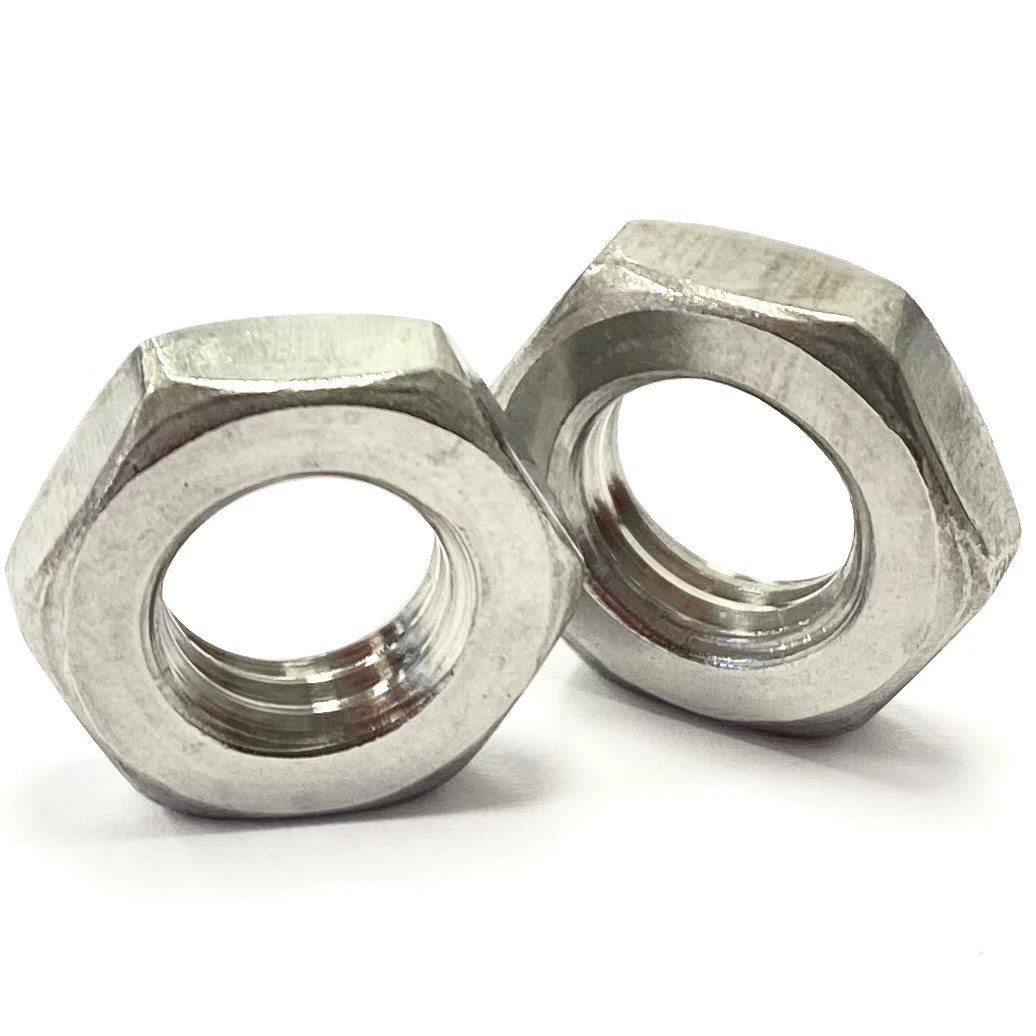
Premium A2 (304) and A4 (316) stainless steel lock nuts. Available in metric coarse threads and select UNC/BSW on request. Mill Test Certificates (MTC), strict dimensional tolerances, and fast dispatch from ready stock.
DIN 439
Stainless Steel Lock Nuts
TRSUTED SS LOCK NUT FOR DEMANDING APPLICATION
Key Specifications
Standards
DIN 439
Grades (Material)
A2 (304), A4 (316)
Strength Classes
-
Threads
Metric coarse (default). Fine/UNC/BSW available on request
Sizes
M 6 to M 56, 1/4" to 1" (others on request)
Lengths
-
Head
-
Marking
Grade/class & manufacturer ID as applicable
Certificates
MTC 3.1 / chemical composition & mechanicals available
Compliance
RoHS/REACH; generally non-magnetic in solution-annealed state (slight magnetism possible after cold-work)
Choosing the Right Stainless Steel Lock Nuts
Environment & corrosion
Indoors / general outdoor → A2 (304) lock nut
Marine / chemical / chloride exposure → A4 (316) lock nut
High temperature / aggressive chemicals →
→ Prefer all-metal lock nuts (no nylon) – nylon inserts can soften or degrade at elevated temperatures or in some chemicals.
Locking method & vibration level
Low to medium vibration, general machinery →
→ Nyloc (nylon insert) lock nut
Smooth operation, reusable a limited number of times
Temperature & chemical limits (avoid high heat / solvents)
High vibration or shock loading →
→ All-metal prevailing torque lock nut (top-lock, elliptical, distorted thread, etc.)
No plastic insert, stable at higher temperatures
Better for heavy-duty / dynamic applications
Need larger bearing surface / integrated washer →
→ Serrated flange lock nut
Flange spreads load + serrations resist loosening
Not ideal on soft or finished surfaces (serrations can mark the surface)
Limited space / want mechanical lock without special nut →
→ Double-nut arrangement (standard hex nut + thin jam nut)
Common engineering solution when special lock nuts are not available
Strength & matching with bolt grade
General purpose joints →
→ With A2-70 / A4-70 bolts → use A2-70 / A4-70 lock nuts
Higher clamp load / critical joints →
→ With A4-80 bolts → use A4-80 lock nuts (all-metal type preferred in high-duty service)
Rule of thumb:
Lock nut grade ≥ bolt grade, and use the same stainless family (A2 with A2, A4 with A4) wherever possible.
Temperature & media limits (especially for nyloc)
Nyloc lock nuts →
Suitable for normal room to moderate temperatures
Avoid high-temperature zones, ovens, exhaust systems, or direct flame
Avoid contact with solvents / strong chemicals that can attack nylon
All-metal lock nuts →
Preferred for high-temperature service and harsh chemical environments
No polymer insert to degrade
Thread form & compatibility
Default → Metric coarse threads (better galling resistance, easier assembly).
Use metric fine / UNC / UNF only when:
Matching existing bolts or tapped holes
Finer adjustment or controlled preload is required
Always match: thread diameter + pitch + standard between bolt and lock nut (e.g., M10×1.5 nut with M10×1.5 bolt).
Reusability
Nyloc lock nuts →
Can be reused a limited number of times
If the nylon ring is visibly damaged, loose, or the nut spins too freely → replace it
All-metal prevailing torque nuts →
Torque reduces with each reuse
For critical joints, treat as limited-use and replace if torque resistance drops noticeably
Mechanical Properties (Guide)
Lock nuts are designed so that their proof load safely matches the bolts they are used with. Property classes follow the same logic as standard hex nuts.
A2-70 / A4-70 lock nuts
Used with A2-70 / A4-70 bolts (700 MPa class)
Designed to withstand the proof load of matching bolts without thread stripping or permanent deformation.
A4-80 lock nuts
Used with A4-80 bolts (800 MPa class)
Higher proof strength to support higher clamp forces in critical joints.
Simple selection guide
For general stainless applications →
→ A2-70 or A4-70 lock nut, depending on the environment (A2 for normal, A4 for marine/chemical).
For high-strength / safety-critical joints →
→ A4-80 all-metal lock nut with A4-80 bolts.
For marine, chemical, and chloride-rich environments →
→ Prefer A4 (316) lock nuts in the appropriate class (A4-70 or A4-80) and use all-metal types where temperature or chemicals may damage nylon.
6000+ Products
Trusted by 2000+ Clients
40+ Years of Experience
Exporting to 12+ Countries
What We Do
From a vast manufacturing facility situated in GIDC Wadhwan, Gujarat to strategic
sales offices in Mumbai and Chennai, we design, produce, and deliver a wide array of stainless steel
fasteners, hex bolts, machine screws, socket screws, washers, nuts, self‑tapping screws, threaded rods,
anchor fasteners, and specialty material products, engineered for demanding sectors like petrochemicals,
pharmaceuticals, automotive, and construction.
Our Legacy & Mission
Founded on a vision of precision and service, we have consistently expanded our
capabilities to meet evolving industrial needs. Our commitment to "We Deliver Quality" reflects in the
long-term relationships we build with clients across India and abroad.
Frequently Asked Questions
What is a lock nut and when should I use it?
A lock nut is a special hex nut designed to resist loosening under vibration or dynamic loads.
Use a lock nut when:
The joint is subject to vibration, shock, or movement
You want extra safety so the nut doesn’t back off over time
You want to reduce dependence on only spring washers or thread-locking chemicals
What’s the difference between a standard hex nut and a lock nut?
Standard hex nut:
Provides clamping force only through thread friction and bolt preload.
Suitable for static or low-vibration applications.
Lock nut:
Has a mechanical or friction-based locking feature (nylon insert, distorted threads, serrations, etc.).
Designed specifically to resist loosening under vibration or repeated loading.
What are the main types of lock nuts you supply?
Common lock nut types include:
Nyloc (nylon insert) lock nut – good for general vibration resistance; limited by temperature and chemicals.
All-metal prevailing torque lock nut – distorted thread/top-lock type, suitable for high temperature and harsh environments.
Serrated flange lock nut – built-in flange with serrations for extra grip; ideal where you want large bearing area + anti-loosening, but can mark the surface.
Jam-nut arrangement – using a thin nut + standard nut together to create a mechanical lock.
(You can list only the variants you actually stock.)
Should I choose A2 or A4 stainless steel lock nuts?
A2 (304) → For indoor, general outdoor, and mildly corrosive environments.
A4 (316) → For marine, coastal, chemical, or chloride-rich environments with higher corrosion risk.
If you see pitting, rust spots, or are near the sea, A4 is strongly recommended.
Which lock nut grade should I use with my bolt?
Match or exceed the bolt’s strength class:
With A2-70 / A4-70 bolts → use A2-70 / A4-70 lock nuts.
With A4-80 bolts → use A4-80 lock nuts (all-metal types preferred for critical joints).
Rule of thumb: Lock nut grade ≥ bolt grade in the same material family.


